
GridAI Technologies’ Strategic Pivot to Energy Orchestration for AI Data Centers Highlights Early-Stage Execution and Compliance Challenges
Following the Grid AI Corp. acquisition, GridAI Technologies refocused on AI data center energy orchestration amid Nasdaq compliance risks and no current revenue.
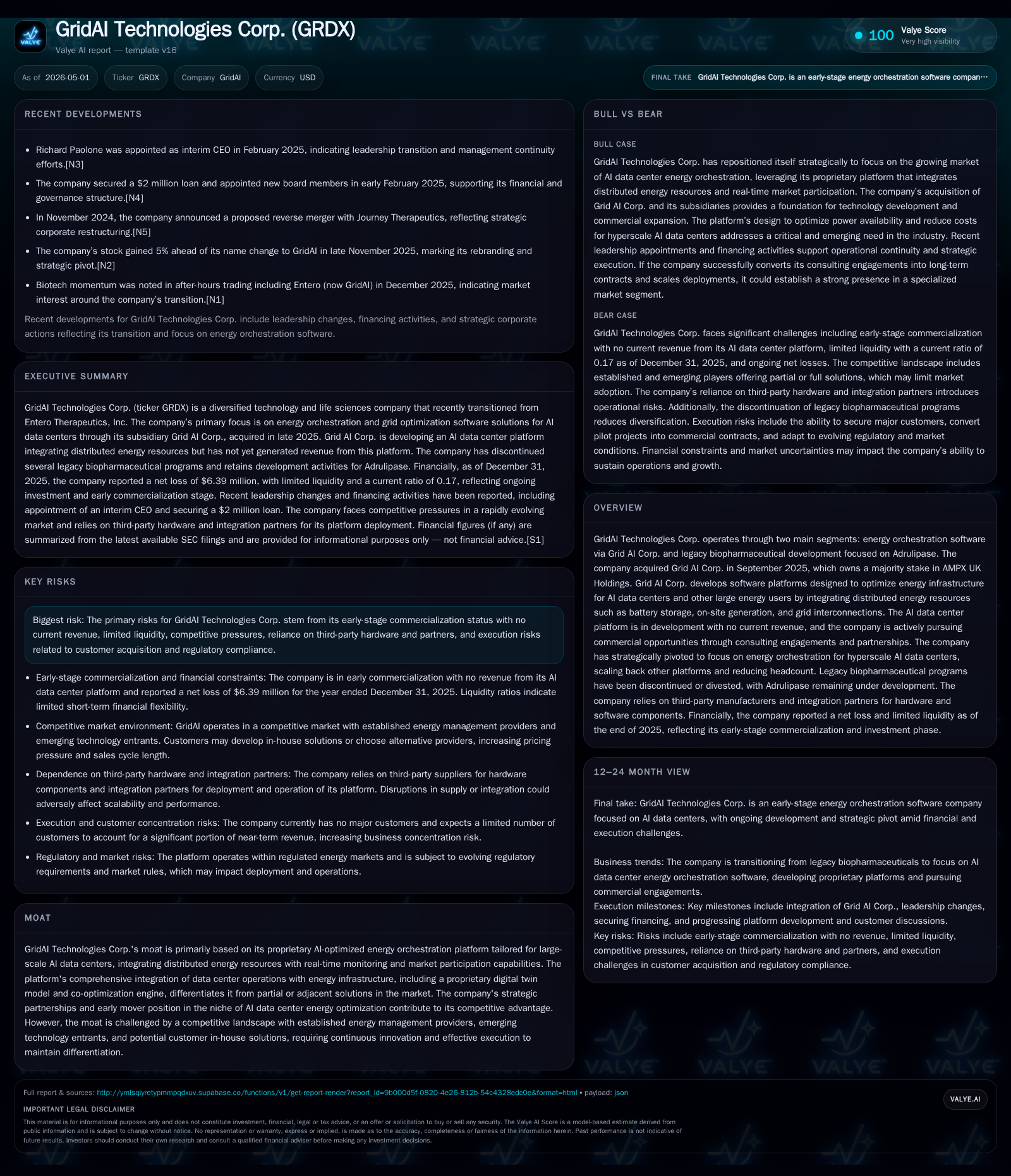
GridAI Technologies Corp. recently completed its acquisition of Grid AI Corp., marking a strategic shift from legacy biopharmaceutical operations to focus on developing an AI-optimized energy orchestration platform for hyperscale data centers. The company faces near-term challenges including delayed 10-K filing and Nasdaq compliance risk but is advancing platform development through consulting engagements and partnerships. The business model centers on software-driven integration of distributed energy resources with real-time data center operations, targeting growing demand from hyperscalers and AI infrastructure developers. However, the early-stage commercialization status, competitive market dynamics, regulatory complexities, and financial constraints represent significant execution risks in the medium term.
Recent Operating Update
GridAI Technologies Corp.’s most recent material operating development was its April 22, 2026 notification from Nasdaq regarding noncompliance with Listing Rule 5250(c)(1) stemming from its delayed filing of the annual report (10-K) for fiscal year ended December 31, 2025 [S3]. The company has until June 22, 2026 to submit a plan to regain compliance; failure to do so or rejection by Nasdaq could lead to delisting proceedings. This event sharply highlights ongoing governance and operational challenges during the company’s transition after acquiring Grid AI Corp. in September 2025 [S8].
Following that acquisition—the basis for the December 1, 2025 corporate rebranding and ticker change to GRDX—the company undertook a strategic pivot away from its former biopharma identity toward building an integrated software platform orchestrating distributed energy resources (DERs) tailored to large-scale AI data centers and hyperscale campuses [S1][S8][S19]. However, as of the latest filings there is no commercial revenue generated from this new platform; product development remains at a pre-commercial stage supported by consulting engagements with potential customers such as battery storage providers and engineering firms [S11][S16].
Business Model
GridAI Technologies operates via two main segments: (1) the newly acquired Grid AI Corp., which develops energy orchestration software designed specifically for hyperscale AI data centers; and (2) legacy biopharmaceutical operations focused primarily on Adrulipase—a recombinant lipase enzyme intended for exocrine pancreatic insufficiency treatment—though this segment has diminished sharply post-pivot [S1][S16].
The core value proposition lies in Grid AI Corp.'s proprietary software platform that integrates various distributed energy resources—battery energy storage systems (BESS), onsite generation assets, grid interconnections—alongside real-time monitoring of data center assets through a centralized dashboard providing operational visibility [S25]. A distinctive feature is the digital twin technology that simulates site-level behavior across engines, substations, and battery systems under varying load and market conditions informed by forecasting models.
Revenue generation is targeted through subscription-like base platform fees granting operational visibility plus performance-based fees tied to power cost optimization outcomes achieved via co-optimization engines engaging wholesale electricity markets (day-ahead, real-time reserves) while respecting critical uptime requirements of data center operations [S25]. Customers expected include enterprise hyperscalers operating multi-megawatt campuses as well as energy infrastructure companies seeking optimization solutions.
GridAI also pursues consulting-led engagements with system integrators and hardware providers like Mango Power and Nomad Transportable Power Systems to refine commercial offerings [S16]. The business model depends heavily on seamless interoperability with third-party hardware and regulatory entitlements embedded in complex regional electricity markets [S20][S22].
Industry Structure and Competitive Position
Grid AI Corp. operates within a fragmented but rapidly evolving sector that sits at the nexus of advanced energy management software, virtual power plants (VPPs), DER integration, and AI-driven grid optimization [S20]. Competition comes from multiple vectors:
- Established energy management software providers with broader integrated services or hardware franchises;
- Emerging technology startups focused narrowly on certain optimization components or niche DER applications;
- Utility-owned platforms or engineering firms offering custom solutions;
- Hyperscale operators’ own internal development teams building proprietary systems.
The unique combination of end-to-end data center orchestration combined with grid-edge DER coordination—including digital twin modeling and market participation algorithms—positions GridAI with some differentiation versus partial competitors who typically address either IT operational metrics or separate energy assets without this integration [S25]. Nonetheless, maintaining this moat demands continuous innovation given rapid technology advances.
Market demand is shaped strongly by escalating hyperscale data center buildouts driven by AI workloads requiring substantial power capacity often sourced with sustainability mandates. Complexity around integrating intermittent renewable sources plus fluctuating grid constraints creates an opportunity for adaptive orchestration platforms. However, regulatory fragmentation across jurisdictions combined with varied utility market rules complicates universal solution deployment [S22].
Growth Drivers
Growth derives primarily from:
- Hyperscale AI Infrastructure Expansion: Massive investment in AI clouds necessitates optimized power consumption and green integration at scale.
- Distributed Energy Resources Adoption: Proliferation of BESS and onsite generation assets creates fertile ground for advanced control platforms able to capture value via market arbitrage.
- Increasing Grid Complexity: As grids become more decentralized and variable, customers seek sophisticated orchestration software bridging IT loads to DERs.
- Partnership Ecosystem: Collaborations with energy project developers, system integrators, and hardware providers accelerate platform refinement and access.
While initial traction is early-stage with no material revenues yet recorded [F1][S11], management projects that most 2026 revenues will come from the new AI data center platform with stepwise escalation thereafter as pilot deployments convert into contracts [S25]. Scaling across multijurisdictional customers requires establishing robust regulatory compliance frameworks combined with rapid deployment capabilities.
Risks / Watchpoints / Growth Constraints
The company faces considerable execution risks including:
- No Current Revenues: Commercialization remains nascent with only pilot stage deployments; transitions to paying customers remain uncertain [S11][F1].
- Liquidity Pressure: With under $1 million in cash against over $15 million in current liabilities as of year-end 2025 ([F1]), financial constraints could impair R&D spending or commercial activities.
- Nasdaq Compliance Risk: Delayed filings endangered listing status which could reduce investor confidence or liquidity ([S3]).
- Competitive Pressures: Larger incumbents or alternative emerging players may leverage deeper resources or faster innovation cycles.
- Regulatory Complexity: The need for interconnection agreements, market participation approvals, plus evolving energy regulations present potential deployment delays or limitations [S22].
- Customer Concentration Risk: Limited major customers currently; reliance on securing anchor clients critical for scale [S11].
- Legacy Biopharma Uncertainty: While Adrulipase remains under development as a fallback segment, growth prospects are limited given terminated other pipelines [S14][S16].
What To Watch Next
Key near-term milestones include:
- Submission of Nasdaq compliance plan by June 22, 2026 and potential resolution before October deadline ([S3]).
- Conversion of current letter-of-intent discussions into definitive commercial contracts especially around battery storage system integration ([S11]).
- Progression of pilot deployments through construction/operational readiness stages at initial customer sites ([S11]).
- Regulatory approvals related to grid interconnection permits or market participation licenses by customers/partners ([S22]).
- Financial updates revealing cash burn trends relative to limited liquidity sustaining R&D activities ([F1]).
- Any public disclosures concerning expanded partnerships or technology integrations signaling commercial momentum.
Financial Profile Overview
Latest financial snapshot
| Metric | Value | Period |
|---|---|---|
| Cash & equivalents | $899784 | |
| 2025-12-31 | ||
| Current assets | $3mm | |
| 2025-12-31 | ||
| Current liabilities | $15mm | |
| 2025-12-31 | ||
| Current ratio | 0.17x | |
| 2025-12-31 |
Source: SEC companyfacts cache [F1].
GridAI Technologies reported no recorded revenues as of December 31, 2025 but consolidated post-acquisition losses attributable mainly to operating expenses tied to the development stage business model (net loss approx. $6.4 million) [F1]. Cash & equivalents stood around $900K while total debt was over $8.4 million as last reported in Q1 2024 leading to net debt exceeding $7.5 million as of early 2025 [F1]. The current ratio was critically low at approximately 0.17 reflective of significant current liabilities dwarfing short-term assets [F1]. This liquidity profile underscores substantial near-term financing needs during commercialization.
Successful capital raises or improved operating cash flow following revenue ramp will be vital going forward given sustained losses linked to R&D investments associated with developing the complex orchestration platform envisaged.
| Metric | Value | Period End |
|---|---|---|
| Cash & Equivalents | $899,784 | |
| 2025-12-31 | ||
| Total Debt | $8,425,073* | |
| 2024-03-31 | ||
| Net Income | -$6,392,654 | |
| 2025-12-31 | ||
| Current Ratio | 0.17 | |
| 2025-12-31 | ||
| *From latest available point; may differ currently [F1] |
Disclaimer: This analysis is based solely on publicly available securities filings up to May 2026 and does not constitute investment advice or recommendation. Readers should conduct their own due diligence before making any decisions involving GridAI Technologies Corp.
Disclaimer: This is research-only, informational analysis and not investment advice. It may include AI-generated interpretation and general industry context. Always verify important details using primary sources.

Comments