
Meridian Holdings Advances with Global Expansion and Licensing Momentum
Q1 2026 results highlight Meridian's growth via MeridianBet operations amid regulatory licensing efforts and balance sheet pressures.
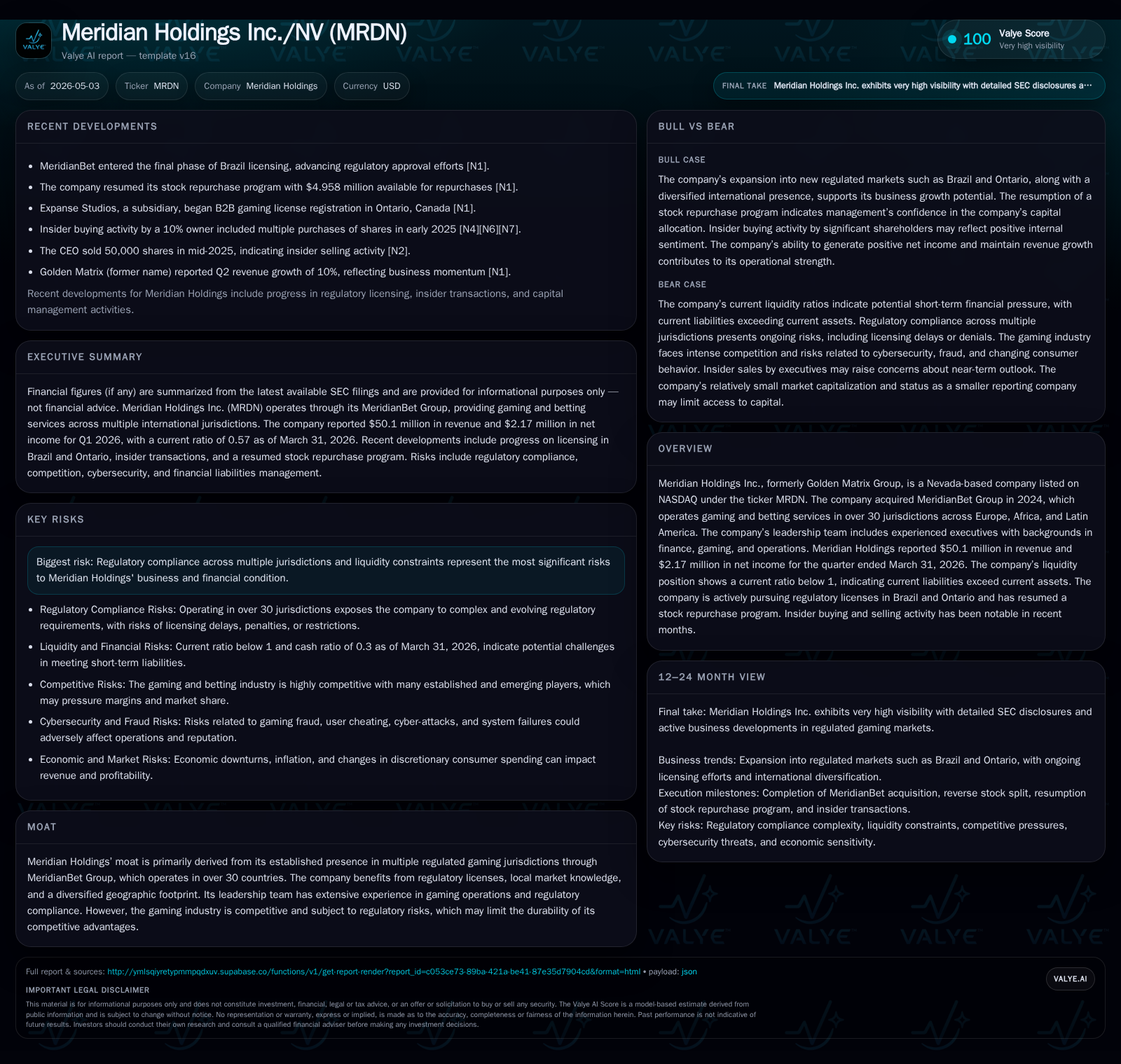
Meridian Holdings Inc. reported $50.1 million in revenue and $2.17 million net income for Q1 2026, driven primarily by its MeridianBet acquisition that spans over 30 regulated jurisdictions across Europe, Africa, and Latin America. The company is actively pursuing new gaming licenses in Brazil and Ontario to fuel geographic expansion but faces liquidity constraints reflected in a current ratio of 0.57. While leveraging regulatory licenses and diverse markets offers competitive advantages, regulatory complexity alongside financial tightness presents key risks. Monitoring licensing progress and stock repurchase activity will be critical near-term indicators of operational execution.
Q1 2026 Operating Update: Revenue Growth Meets Liquidity Pressure
Meridian Holdings Inc. disclosed strong operational results for the quarter ended March 31, 2026, reporting revenue of $50.1 million alongside net income of $2.17 million, confirming growth trajectories primarily powered by its MeridianBet acquisition completed in early 2024 [S2][S3]. This performance underscores the effective integration of MeridianBet’s multi-jurisdictional gaming operations spanning Europe, Africa, and Latin America.
However, the company's liquidity remains challenged with current assets trailing current liabilities significantly; the current ratio stood at approximately 0.57 as of March 31, 2026—a clear indication that short-term obligations exceed readily available resources [F1]. Despite positive earnings, this imbalance suggests working capital management will be a crucial focus going forward.
Alongside operational updates, Meridian signaled the resumption of its stock repurchase program in Q1 2026 which, together with insider buying/selling dynamics noted recently, implies management's intent to bolster shareholder value under constrained conditions [S3]. Such activity also reflects confidence about the company’s underlying asset value despite market headwinds.
Business Model and Service Offerings: MeridianBet’s Multi-Regional Footprint
Meridian’s business model revolves around the acquisition and operation of MeridianBet Group—an established gaming platform operating across more than 30 licensed jurisdictions in Europe, Africa, and Latin America [S1]. These regulated markets provide a diversified geographic footprint that reduces exposure to localized regulatory or economic shocks.
The company generates revenue predominantly from online gaming and sports betting services offered through localized platforms subject to various national gambling authorities' licenses. Customers pay for access to betting services through wagers placed on sporting events or casinos games; revenues scale with betting volumes adjusted for take rates minus payouts.
Margins are influenced by costs of third-party gaming content licenses—a known pressure point—and regulatory compliance expenses which vary widely across jurisdictions [S4]. Meridian’s platform benefits from local market knowledge accumulated through leadership’s extensive experience in gaming operations and finance sectors, enabling tailored offerings that enhance user retention and currency conversion rates.
Industry Dynamics: Competitive Challenges in Regulated Gaming Markets
The global online gaming sector is notably fragmented with high barriers to entry comprised of stringent licensing requirements coupled with ongoing regulatory compliance overheads. Competitors range from large multinational operators to regional specialists with entrenched local ties.
Pricing power tends to be limited by the need to secure popular third-party content as well as adhere to mandated consumer protections enforced by regulators; these factors compress margins as operators balance user engagement incentives with profitability targets [S4].
Geographic diversification remains one of Meridian’s principal competitive advantages—diluting operational risk stemming from adverse regulatory changes or policy shifts within any single market.
Growth Drivers: Licensing in Brazil and Ontario Fuel Expansion Prospects
Meridian is actively pursuing additional regulatory licenses in Brazil and Ontario—two burgeoning markets undergoing liberalization of sports betting laws—signaling a clear strategic push toward geographic expansion beyond existing territories.
Successful acquisition of these licenses would allow Meridian to tap into large addressable customer bases with substantial long-term revenue potential given rising consumer adoption trends in legalized online wagering.
This licensing momentum is critical for sustaining growth amidst intensifying competition in established markets while strengthening strategic positioning on a global scale.
Key Risks and Constraints: Regulatory Complexity and Financial Liquidity
Operating across diverse regulatory regimes presents ongoing challenges including adherence to varying legal standards, potential penalties for non-compliance, and investment needed to maintain up-to-date licensing status [S8]. This multi-jurisdictional complexity can limit operational agility.
Financially, the imbalance between current assets ($30.5M) and current liabilities ($53.3M) points to liquidity constraints that could restrict flexibility in funding marketing initiatives or capital expenditures essential for scaling platforms further [F1]. Moreover, convertible securities exposure potentially poses dilution risks if triggered under liquidity pressures [S4].
Dependency on third-party content suppliers introduces additional vendor risk with cost volatility directly impacting gross margins.
Near-Term Catalysts: Monitor Licensing Progress, Regulatory Approvals, and Stock Repurchase Execution
Investors should watch closely for updates on the Brazilian and Ontario gaming license applications as these approvals will materially influence Meridian’s addressable market size and revenue outlook.
Further earnings disclosures will reveal success rates translating into customer acquisition gains or margin improvements amidst evolving competition.
Execution on announced stock repurchase programs provides insight into capital allocation efficacy under financial strain while insider trading patterns may illuminate confidence levels within management ranks [S3].
Financial Snapshot: Current Liquidity, Debt Profile, and Profitability Analysis
Latest financial snapshot
| Metric | Value | Period |
|---|---|---|
| Total debt | $12.9mm | |
| 2026-03-31 | ||
| Net debt | $-2.9mm | |
| 2026-03-31 | ||
| Current assets | $30.5mm | |
| 2026-03-31 | ||
| Current liabilities | $53.3mm | |
| 2026-03-31 | ||
| Current ratio | 0.57x | |
| 2026-03-31 |
Source: SEC companyfacts cache [F1].
| Metric | Value (USD) |
|---|---|
| Cash & Equivalents | 15,753,813 |
| Total Debt | 12,886,475 |
| Net Debt | -2,867,338 |
| Current Assets | 30,482,524 |
| Current Liabilities | 53,259,524 |
As of March 31, 2026, Meridian maintains approximately $15.8 million in cash versus total debt nearing $12.9 million resulting in a net cash position after adjusting for debt around negative $2.9 million indicative of leverage-related financial commitments [F1].
The company delivered modest net income improvement reflecting operational scalability benefits post-merger integration within MeridianBet Group.
It aims to provide an evidence-based perspective anchored on recent operating performance while highlighting strategic pathways plus associated risks requiring continued monitoring.
No investment advice or price commentary is provided herein.
Disclaimer: This is research-only, informational analysis and not investment advice. It may include AI-generated interpretation and general industry context. Always verify important details using primary sources.

Comments