
Safe Pro Group Inc. Advances AI Defense Innovation with Executive Changes
The appointment of Jarret Mathews as COO signals a strategic push to scale AI-enabled defense solutions amid continued operational challenges.
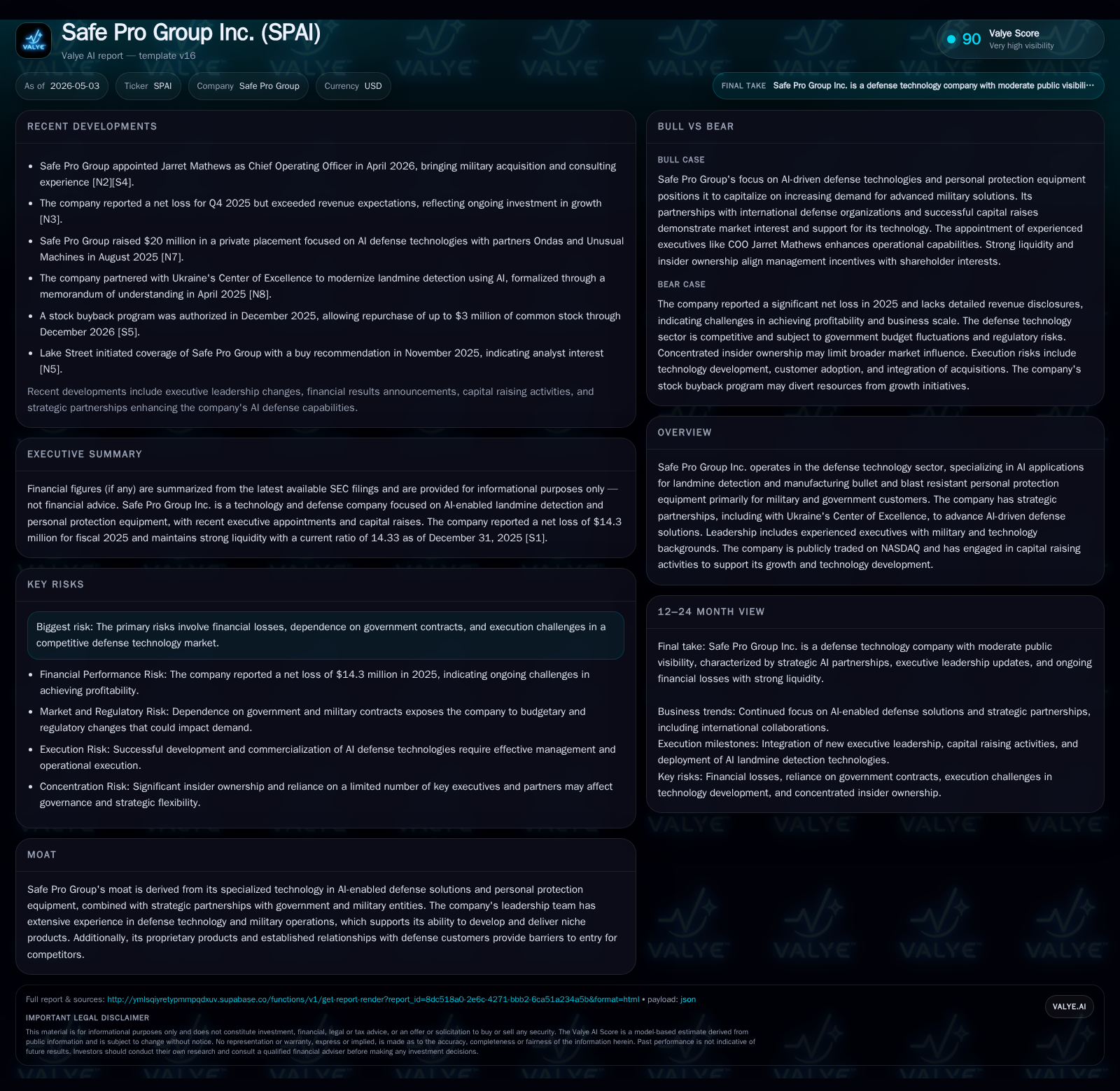
Safe Pro Group Inc. has recently appointed Jarret Mathews as Chief Operating Officer, a move anchored in the latest SEC filings that denotes a focus on accelerating operational execution. The company specializes in AI-driven defense technology, including landmine detection and advanced personal protection products for military clients, supported by strategic partnerships and experienced leadership. While the defense tech niche offers competitive barriers and growth potential tied to government contracts and geopolitical demand, SPAI faces risks from persistent financial losses and reliance on public sector spending. Upcoming milestones around contract awards and revenue targets under new leadership will be critical to monitor.
Latest Operating Update: Leadership Transition and Operational Insights
Anchoring this analysis on Safe Pro Group Inc.’s latest public disclosures reveals a material leadership development: the April 1, 2026 appointment of Jarret Mathews as Chief Operating Officer [S3]. Coming from a background combining U.S. Army officer experience—specifically as Director of Joint Acquisition Task Force—and consulting roles advising government clients on emerging technology integration, Mathews’ hiring illustrates a deliberate strategy to bolster the company’s operational capabilities amid its growth phase. His Employment Agreement notably includes accelerated vesting of prior equity grants (15,000 shares) and an inducement award of 20,000 restricted stock units outside the standard stock plan [S3], signaling management's commitment to retention and performance alignment through equity incentives.
No material changes were reported in risk factors since the preceding quarterly Form 10-Q filing dated November 14, 2025 [S2], which confirms ongoing identified risks without escalation. However, the annual report amendment filed April 30, 2026 reiterates persistent operating losses alongside efforts toward stabilizing governance frameworks—a common profile for companies transitioning from early-stage development to scaled delivery [S1]. The executive shuffle is thus timely within a context of evolving execution priorities.
Core Business Model: AI-Powered Defense Solutions and Product Offering Quality
Safe Pro Group monetizes through designing and supplying defense technologies focused on two primary verticals: AI-enabled landmine detection systems and bullet/blast-resistant personal protective equipment (PPE) primarily for military and governmental customers worldwide [S1; valye_report_excerpt]. Revenues derive mostly from contracts awarded by defense agencies seeking enhanced battlefield safety through cutting-edge technology integration.
AI drives differentiation by enabling superior detection accuracy in minefield clearance operations—reducing human risk—and the firm’s protective gear uses proprietary manufacturing processes aligned with stringent military certification standards. The company’s partnership with Ukraine’s Center of Excellence reflects an ecosystem strategy leveraging external expertise to refine AI algorithms tailored to active conflict zones. This symbiotic relationship not only accelerates innovation cycles but also enhances customer trust through sustained collaborative development.
Revenue mechanics hinge on securing government contracts often structured as multi-year agreements with milestone-based payments linked to testing outcomes or deployment metrics. Pricing incorporates premium margins reflective of product efficacy backed by certified safety standards—a critical factor given use-case sensitivity. Switching costs materialize through integration complexities once deployed systems become mission-critical components.
Competitive Environment and Industry Structure
SPAI operates in a specialized corner of the broader defense technology sector characterized by high barriers due to regulatory compliance demands, extensive testing protocols for safety-critical gear, and entrenched relationships with government customers [S1; valye_report_excerpt]. The niche focus reduces direct competition somewhat relative to broader defense contractors yet exposes SPAI to competitive pressure from select incumbents rapidly enhancing their AI capabilities.
Government procurement cycles introduce cyclicality; contract bids fluctuate based on budget appropriations which may be influenced by geopolitical climates or shifting defense priorities. Pricing power is moderately durable given the bespoke nature of products but ultimately constrained by procurement cost controls.
Supply chain resilience is crucial given reliance on specialty materials for PPE manufacturing and sophisticated hardware components within detection devices. Although no acute supply issues were outlined recently, this remains a watchpoint common across defense tech firms globally.
Growth Catalysts and Market Penetration Opportunities
Strategic growth vectors for Safe Pro Group lie principally in expanding government contract wins fueled by heightened awareness of asymmetric warfare risks—especially those involving landmines—in various theaters globally [N3; valye_report_excerpt]. Increasing adoption is structurally driven by international security organizations endorsing advanced detection technology to limit casualties.
Additionally, SPAI is poised for penetration into allied military markets beyond current geographies leveraging existing partnerships as credibility signaling platforms. This geographic diversification strategy mitigates concentration risk associated with relying on singular national budgets.
Further amplifying growth potential are sustained R&D investments advancing AI tooling accuracy—improving false positive rates during demining efforts—and optimizing product ergonomics in PPE lines enhancing soldier compliance.
The recent onboarding of COO Jarret Mathews is expected to sharpen operational discipline thereby improving delivery timelines and contract fulfillment efficiency—a non-trivial lever given prior execution challenges highlighted by operating losses [S3; N3]. Milestone-tied stock option awards keyed to revenue thresholds underscore investor confidence in management’s ability to scale effectively under his leadership.
Key Risks and Execution Challenges
SPAI faces perennial risks centered around its financial profile; large operating losses (over $14 million net loss in 2025) constrain free cash flow generation necessary for sustained investment in product development and market expansion [F1; S1]. Unless accompanied by accelerating revenues or additional capital raises, pursuing aggressive growth could amplify balance sheet pressures.
Dependency on government contracts introduces heightened execution risk: funding delays or policy shifts can abruptly affect order flows while competitive bid dynamics demand constant innovation. Furthermore, technology adoption cycles are protracted due to required certifications and client validation processes limiting near-term revenue predictability.
Competitor advances in AI-enabled defense technologies represent another risk vector—larger incumbents may leverage scale advantages or R&D budgets to erode SPAI’s differentiated positioning if pace or quality falters.
Lastly, integrating new executive leadership entails transitional uncertainties impacting team coherence though equity incentive structures attempt mitigation through aligned interests [S3].
Upcoming Milestones and Market Signals to Monitor
Critical markers for stakeholders include SPAI’s forthcoming quarterly reports which will likely illuminate early impacts of enhanced COOs operations regime on contract pipeline conversion rates and cost efficiencies [S2; S3]. AWS announcements pertaining to new or renewed defense contracts will directly reflect market validation of product offerings.
Technological milestones such as release notes or certification completions related to AI algorithm improvements or PPE durability tests serve as barometers for future revenue ramp potential. Additionally, tracking R&D expenditure against stated targets offers insights into innovation momentum sustaining competitive differentiation.
Monitoring insider equity transactions following milestone-based vesting schedules can provide indirect signals regarding internal confidence levels aligned with near- to medium-term growth outlooks.
Financial Snapshot Supporting Operational Discourse
Financially as of fiscal year-end December 31, 2025, Safe Pro Group exhibits strong liquidity evidenced by a high current ratio of approximately 14x stemming from current assets significantly outpacing short-term liabilities [F1]. Total debt is modest at $146,000, reflecting conservative leverage usage relative to the asset base. However, operating income deficits exceeding $14 million highlight substantial ongoing expenses exceeding revenues implying continued burn during scaling efforts [F1]. This gap underscores the imperative for management excellence under incoming COO stewardship aimed at closing loss margins through operational efficiencies while growing top-line contract revenues.
This analysis synthesizes information explicitly drawn from Safe Pro Group Inc.’s SEC filings up through April 2026 alongside validated company fact sets without extrapolation. It is intended solely for informational purposes reflecting observed business developments grounded in documented disclosures.
Disclaimer: This is research-only, informational analysis and not investment advice. It may include AI-generated interpretation and general industry context. Always verify important details using primary sources.

Comments