
Atlassian’s Q3 Shift: Cloud Momentum and AI Integration Drive Growth
Atlassian’s latest quarter underscores accelerating cloud subscription growth bolstered by AI innovation amidst competitive and operational challenges.
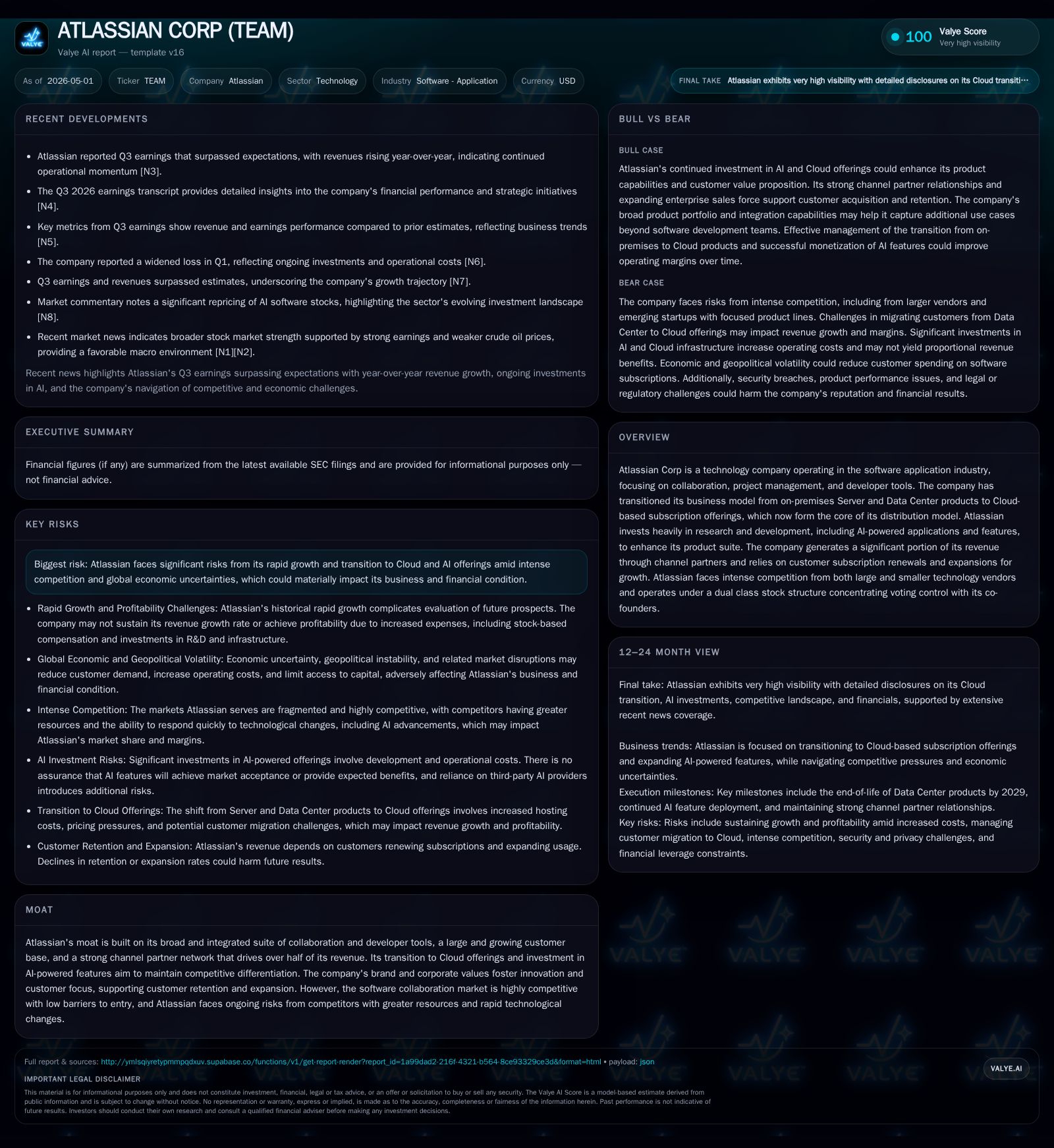
Atlassian Corp reported in its Q3 2026 filing a revenue beat driven primarily by its ongoing cloud migration and layered AI-powered features. Despite restructuring costs impacting operating margins, the company’s cloud subscription base showed robust expansion, supported by an extensive channel partner network that generates over half of revenues. The firm faces intensifying competition and risks tied to rapid growth, Cloud transition, and AI investment execution. Key near-term indicators include subscription renewal trends and AI adoption metrics. Atlassian maintains a solid liquidity position with $1.14 billion cash against $989 million debt as of quarter-end.
Q3 2026 Operating Update: Key Developments and Implications
Atlassian's Q3 fiscal 2026 results filed on May 1 reveal continued acceleration in revenue largely fueled by the company’s pivot towards cloud-based subscriptions and initial contribution from newly integrated AI capabilities [S2][N3][N6]. The quarter saw revenues surpass consensus estimates with notable expansion in subscription renewals and upsell growth within the cloud segment—confirming the effectiveness of Atlassian's strategic shift away from legacy Server/Data Center licenses.
In tandem with revenue growth, Atlassian announced a reorganization involving approximately 10% workforce reduction aimed at optimizing operational efficiency and boosting focus on key growth areas such as AI-driven features and enterprise sales channels [S24]. The restructuring is expected to incur charges around $225 million primarily impacting Q3 and Q4 periods but is positioned as an investment towards sustaining long-term innovation momentum.
This operational update signals progress but also highlights short-term margin pressures due to restructuring expenses and elevated R&D spend targeting AI-powered enhancements.
Business Model Evolution and Product Portfolio Analysis
Historically anchored in on-premises software with a licensed model (Server/Data Center products), Atlassian has transitioned predominantly to a cloud SaaS subscription approach—a shift imperative for scalable recurring revenue streams [S23]. This move aligns offerings including Jira (project tracking), Confluence (collaboration), Bitbucket (code management), Trello (workflow visualization), and newer integrations augmented with artificial intelligence.
Revenue mechanisms fundamentally revolve around customer subscriptions: businesses pay recurring fees based on user volume and product tiers. Renewals drive gross retention while account expansions via cross-product adoption enhance net retention rates. Importantly, over half of these revenues flow through an extensive ecosystem of channel partners who aid customer acquisition, onboarding, and local support—ensuring broad market reach without proportionate direct sales expense [S23].
Product differentiation rests on an integrated suite that combines developer tools with business collaboration workflows—a system designed to reduce friction between software development teams and business units. Recent investments emphasize embedding AI features (e.g., automated issue triage, smart recommendations) that theoretically improve productivity outcomes for end users.
Customer stickiness benefits from switching costs inherent in deeply embedded workflows plus the company's brand reputation for innovation. However, since the market remains crowded with low barriers to entry for new SaaS offerings, ongoing innovation is critical to sustain differentiation.
Competitive Environment and Industry Dynamics
The software collaboration space is intensely competitive and dynamic. Atlassian competes against large incumbents like Microsoft (Teams, Azure DevOps), Salesforce (Slack), Google Workspace, alongside specialized startups continuously innovating niche features [S23]. Many competitors possess larger sales forces or deeper pockets enabling aggressive pricing or bundling tactics.
Switching costs for customers are moderate; users can adopt alternative platforms relatively easily if perceived value diminishes. This generates pricing pressure across the sector.
Atlassian attempts to maintain advantage through its broad platform integration, consistent product upgrades, strong partner distribution channels (>50% revenue), and evolving AI capabilities which align with emergent enterprise demand for workflow automation.
Governance-wise,the dual-class stock structure concentrates voting power among co-founders potentially insulating management strategy from activist pressures but raising governance scrutiny among investors [S11].
Growth Drivers: Cloud Transition, AI Investment, and Channel Expansion
Growth continues powered by:
- Cloud Transition: The ongoing migration of existing customers from legacy on-premises licenses to cloud subscriptions expands recurring revenue visibility while opening upsell potential as customers adopt additional modules.
- AI Investments: Atlassian’s focus on embedding AI functionalities into core products enhances commercial appeal by improving productivity through automation of routine tasks like ticket classification or project insights [N8][N9]. This supports improved renewal and expansion metrics demonstrably driving higher average revenue per user.
- Channel Partner Network: Expanding partner ecosystem remains critical; these partners provide localized sales expertise driving adoption in diverse geographic markets while extending reach profitably beyond direct sales capacity [S2].
These drivers reflect structural shifts aligned with modern software consumption patterns favoring SaaS platforms enhanced by intelligent automation.
Risks and Constraints Facing Atlassian’s Strategic Path
Despite promising momentum, Atlassian is exposed to significant risks:
- Execution Risk: The rapid pivot to Cloud coupled with substantial investments in unproven AI offerings elevate the risk of missed technical targets or slower-than-expected customer adoption that could impair forward growth projections [S2].
- Competitive Pressures: Rival vendors with deeper capital reserves may outspend Atlassian on innovation or marketing campaigns. Also growing customer propensity for developing internal tools could partially erode demand.
- Subscription Volatility: Customer retention remains key; contractions or churn amid economic uncertainty directly impact top-line stability.
- Leverage Considerations: With $989 million debt against $1.136 billion cash at quarter-end (net cash roughly $147 million), leverage is manageable but bears watching especially if macroeconomic conditions tighten credit availability or increase funding costs [F1][S6].
- Regulatory & ESG Scrutiny: Increasing global regulatory attention especially concerning data privacy, security standards, export controls, ESG disclosures require continuous compliance expenditure or else risk legal/financial penalties [S14][S25].
- AI-Specific Risks: Potential flaws or bias in deployed AI models could damage brand credibility or trigger litigation/regulatory intervention under evolving laws around AI use [S26].
Upcoming Catalysts and What to Monitor Next
Key near-term milestones include:
- Monitoring Q4 fiscal 2026 guidance updates for insights into post-restructuring operational cadence [S7].
- Tracking detailed customer subscription renewal and expansion rates post-Q3 given restructuring impact.
- Assessing market reception and adoption depth for newly launched or enhanced AI-driven features within key products.
- Observing capital allocation trends such as progression of the current $2.5 billion share repurchase program signaling management confidence in valuation [S7].
- Evaluating channel partnership activation metrics reflecting geographic expansion or vertical market penetration shifts.
These data points will elucidate whether current strategic changes translate into sustainable growth trajectories.
Latest Financial Snapshot: Capital Structure and Liquidity
Latest financial snapshot
| Metric | Value | Period |
|---|---|---|
| Cash & equivalents | $1136mm | |
| 2026-03-31 | ||
| Total debt | $989mm | |
| 2026-03-31 | ||
| Net debt | $-147mm | |
| 2026-03-31 | ||
| Current assets | $2.3bn | |
| 2026-03-31 | ||
| Current liabilities | $3.3bn | |
| 2026-03-31 | ||
| Current ratio | 0.7x | |
| 2026-03-31 |
Source: SEC companyfacts cache [F1].
| Metric | Value (USD) |
|---|---|
| Cash & Equivalents | 1.136 billion |
| Total Debt | 989 million |
| Net Debt | -147 million |
| Current Assets | 2.333 billion |
| Current Liabilities | 3.323 billion |
| Current Ratio | 0.7 |
As of March 31, 2026 fiscal Q3 close, Atlassian maintains healthy liquidity supported by cash balances exceeding total debt by approximately $147 million providing flexibility for ongoing R&D investments despite near-term restructuring charges [F1]. The current ratio below 1 reflects working capital pressures typical given sizable deferred revenue liabilities intrinsic to SaaS subscription billing cycles but does not pose immediate solvency risk given access to capital markets.[S2][S6]
While leverage is moderate relative to peers in tech SaaS sectors, appropriate monitoring is warranted given macroeconomic uncertainties impacting credit markets alongside Atlassian’s strategic reinvestment ambitions.
This analysis synthesizes recently disclosed operating data anchored primarily on Atlassian’s May 2026 quarterly filing supplemented by credible secondary news sources. It assesses how Atlassian's evolution toward cloud-centric, AI-enhanced SaaS offerings drives its competitive positioning plus attendant growth prospects balanced against material risks inherent in this dynamic industry context.
Disclaimer: This report is for informational purposes only reflecting publicly available data as of May 2026 without offering investment advice or recommendations.
Disclaimer: This is research-only, informational analysis and not investment advice. It may include AI-generated interpretation and general industry context. Always verify important details using primary sources.

Comments