
Tiziana Life Sciences Advances Foralumab Trials with Positive Preclinical Data and Funding Amid Neurodegenerative Focus
Recent data underscore Tiziana’s evolving clinical strategy in neurodegeneration, supported by capital raises fueling late-stage trials.
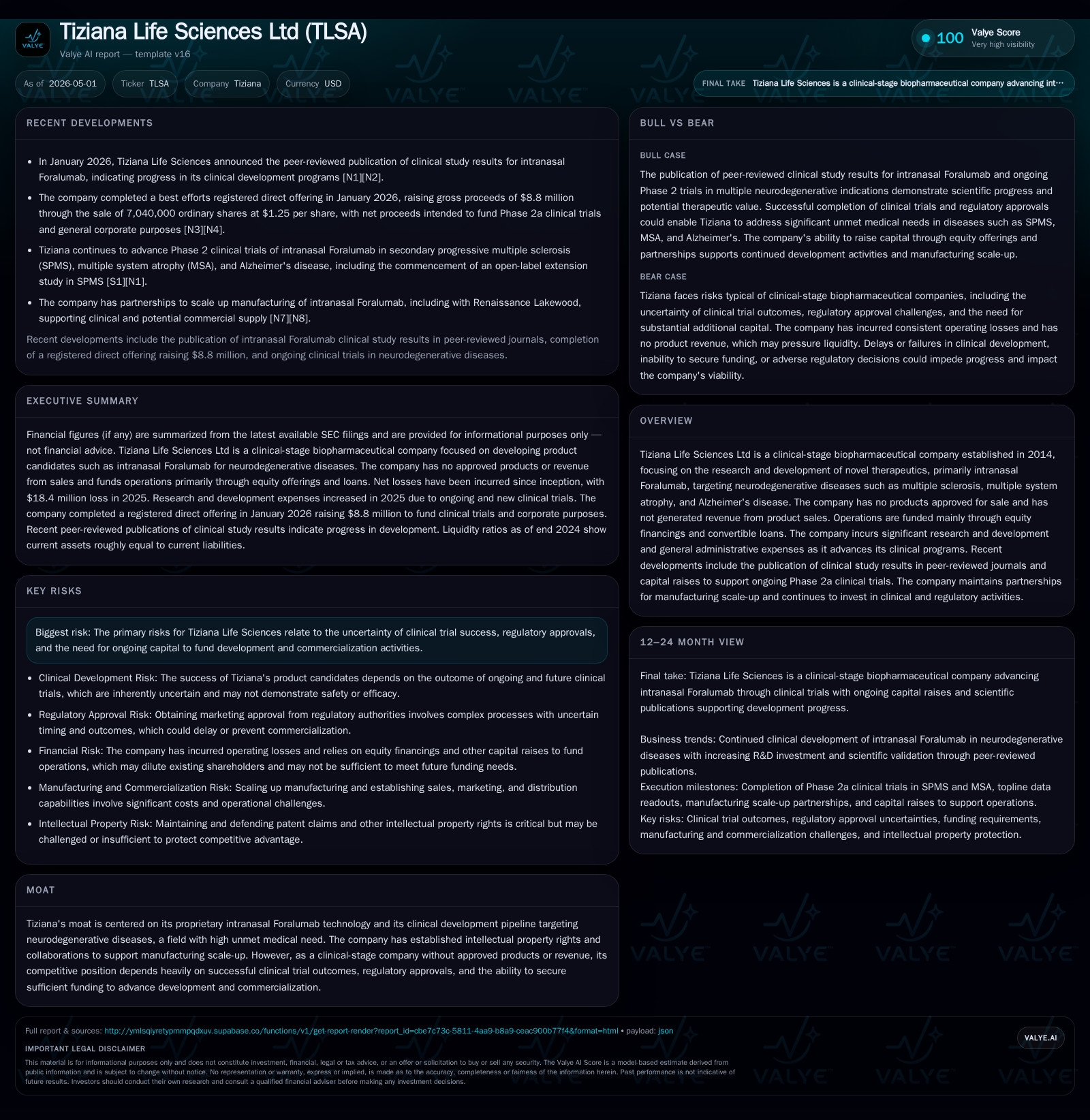
Tiziana Life Sciences Ltd’s recent April 2026 disclosures highlight progress in its intranasal anti-CD3 antibody program (Foralumab) with preclinical evidence showing benefits in a Long COVID neuroinflammation model. Concurrently, the company secured $8.6 million net proceeds in a January 2026 equity raise, aimed at advancing its Phase 2a clinical trials targeting neurodegenerative diseases including SPMS and MSA. While still pre-revenue and reliant on external funding, Tiziana is positioned in a high unmet need therapeutic area with proprietary technology and committed pipeline investments. Key challenges include clinical trial outcomes, regulatory approval timelines, and ongoing capital requirements.
Recent Operating Update
Tiziana Life Sciences LTD’s latest quarterly filing dated April 16, 2026 [S2] anchors the current strategic picture with publication of compelling preclinical data in a bioRxiv preprint. The study titled "Intranasal Anti-CD3 Antibody Treatment Attenuates Post COVID Neuroinflammation and Enhances Hippocampal Neurogenesis and Cognitive Function in Mice" demonstrates that nasal delivery of their proprietary anti-CD3 antibody, Foralumab, significantly dampens brain inflammation, elevates regulatory T cells (Tregs), restores hippocampal neurogenesis, and improves short-term memory in a Long COVID mouse model. This evidence underscores Foralumab's broad immunomodulatory potential relevant not only for neurodegeneration but also emerging post-viral syndromes.
Coinciding with this data release is the January 2026 completion of a best efforts registered direct offering raising net proceeds around $8.6 million [S1][S12]. The transaction involved senior management and existing investors subscribing at $1.25 per share with warrants attached exercisable at $1.50 through July 16, 2026. Proceeds are earmarked primarily to advance the multiple Phase 2a clinical trials underway for non-active Secondary Progressive Multiple Sclerosis (na-SPMS) and Multiple System Atrophy (MSA), along with general corporate purposes. Notably, the company's late-breaking poster on intranasal Foralumab's MSA study has been accepted for presentation at the upcoming World Parkinson Congress in May 2026 [S3], signaling growing clinical visibility.
Business Model
Tiziana operates as a clinical-stage biopharmaceutical developer aiming to bring novel therapeutics targeting neurodegenerative diseases to market. Currently without any approved products or revenue streams from sales, the company’s financial sustainability depends on capital raises and financing activities. Its core asset is Foralumab — an intranasally delivered anti-CD3 monoclonal antibody intended to modulate immune responses implicated in diseases like multiple sclerosis variants (SPMS), MSA, Alzheimer's disease, and conditions aggravated by neuroinflammation such as Long COVID.
Revenue generation will ultimately depend on progressing these candidates through costly late-stage clinical trials toward regulatory approvals followed by successful commercialization. Until then, Tiziana incurs substantial R&D expenses primarily linked to outsourced contract research organizations (CROs), contract manufacturing organizations (CMOs), clinical sites, intellectual property maintenance costs, and internal personnel supporting these activities [S8][S20]. General administrative expenses cover corporate governance, legal, finance functions, investor relations, and public company compliance.
Strategically, Tiziana's differentiator lies in its proprietary intranasal delivery platform enabling targeted modulation of pathologic immune cascades within the central nervous system while minimizing systemic exposure — a compelling approach given the blood-brain barrier challenge faced by many neurotherapeutics. Partnerships facilitate scale-up manufacturing capabilities needed for larger pivotal trials or eventual commercial supply.
Industry Structure and Competitive Position
The neurodegenerative therapeutics industry is characterized by high unmet medical need but equally high development risk due to complex pathophysiology and challenging clinical endpoints. Tiziana occupies a niche segment focusing on immunomodulation via an innovative administration route (intranasal anti-CD3) targeting immune dysregulation contributing to disease progression.
Competition spans large pharmaceutical companies investing broadly in neuroimmunology alongside smaller biotech firms advancing similar monoclonal antibody technologies or alternate modalities like cell therapies or gene editing approaches. The lack of currently approved drugs specifically modifying progressive forms of MS or MSA leaves a significant market void but also intensifies the pressure to demonstrate robust efficacy and safety profiles.
Intellectual property protections around Foralumab's composition of matter and administration method strengthen Tiziana’s moat; however, these are contingent upon maintaining patent portfolio integrity and avoiding infringement challenges. Manufacturing partnerships reduce execution risk but require vigilant oversight ensuring supply chain readiness as development scales.
Growth Drivers
Key growth catalysts derive from:
- Clinical Progression: Positive outcomes from ongoing Phase 2a trials in na-SPMS and MSA could validate hypotheses about efficacy, informing design of pivotal studies.
- Regulatory Milestones: Successful initiation or completion of clinical phases enables strategic interactions with regulators potentially expediting development timelines.
- Expansion into Alzheimer’s Disease: Initiation of Phase 2 efforts targeting Alzheimer’s broadens pipeline relevance addressing another large market with limited treatment options.
- Scientific Validation: Publication of peer-reviewed or preprint studies supports credibility with investors, partners, clinicians.
- Capital Raising Capacity: Access to equity markets demonstrated by recent offerings underpins ability to sustain funding through high-cost trial phases.
Risks / Watchpoints / Growth Constraints
Risks inherent to Tiziana’s trajectory include:
- Clinical Outcome Uncertainty: Trials may fail to meet primary endpoints or reveal safety concerns undermining development viability.
- Funding Adequacy: Existing cash (~$3.7 million as of Dec ’24 [F1]) is limited relative to burn; ongoing capital raises required may dilute shareholders or face market resistance.
- Regulatory Delay or Denial: Complex CNS indications may involve protracted review periods or additional data demands increasing time/cost burdens.
- Commercial Readiness: Establishing marketing/sales infrastructure post-approval will entail significant incremental investment which could strain resources.
- Competitive Advances: Larger well-resourced rivals developing alternative therapies could capture market share or render intranasal approach obsolete.
- Operational Dependencies: Outsourced CROs/CMOs quality issues or scale-up failures could delay timelines or increase costs.
What to Watch Next
Investors and analysts should monitor:
- Data releases from ongoing Phase 2a trials for SPMS and MSA expected through late 2026 presentations/publications including the upcoming World Parkinson Congress where MSA poster will be showcased [S3].
- Updates on Alzheimer’s disease trial progression expanding pipeline breadth.
- Additional financing activities indicating runway extension status given operating losses surpassing $18m in FY25 [F1][S1].
- Regulatory filings or communications signaling pathway toward registrational studies.
- Scientific publications reinforcing mechanism-of-action credibility beyond recent Long COVID preclinical findings [S2].
- Collaborations or licensing deals enhancing commercialization capacity or geographic reach.
Financial Profile Summary (Latest Annual Context)
Operating losses remain significant reflecting heavy R&D investment typical for early-stage biopharma: net loss after tax was approximately $18.4 million for FY2025 compared to $11.9 million for FY2024 [F1][S1]. Research spending notably increased from $5.2m in FY24 to over $10m in FY25 driven largely by escalated activity surrounding Foralumab’s multiple Phase 2 programs including na-SPMS, MSA, Alzheimer’s trials plus open-label extensions [S20]. General & administrative expenses were stable near $10.9m but included non-recurring adjustments such as write-offs related to related party receivables [S21][S23].
Balance sheet metrics suggest a modest working capital position with a current ratio of approximately 1.02 as per end-2024 data [F1], indicating near parity between current assets and liabilities. Cash and equivalents stood at about $3.7 million as of December 31, 2024 [F1], underscoring the need for careful cash management going forward. Investment gains from related party holdings partially offset operational deficits but represent volatile income sources unrelated to core operations [S21][S23].
Overall financial strategy is one of incremental fundraising interspersed with milestone-dependent spending ramps characteristic for clinical-stage developers navigating multi-year pathways toward commercialization readiness.
This analysis synthesizes publicly filed SEC reports up through May 2026 without giving investment advice or recommendations. It aims to provide an informed perspective on Tiziana Life Sciences Ltd based on documented operational developments and financial disclosures reflecting its status as an emerging biotechnology company pursuing innovative treatments within neurodegenerative disease segments characterized by unmet needs.
Disclaimer: This is research-only, informational analysis and not investment advice. It may include AI-generated interpretation and general industry context. Always verify important details using primary sources.

Comments