
Forum Energy Technologies Advances Diversification but Faces Competitive and Regulatory Pressures
Forum Energy Technologies' Q1 2026 update underscores resilience through diversified products amid volatile oil and gas markets.
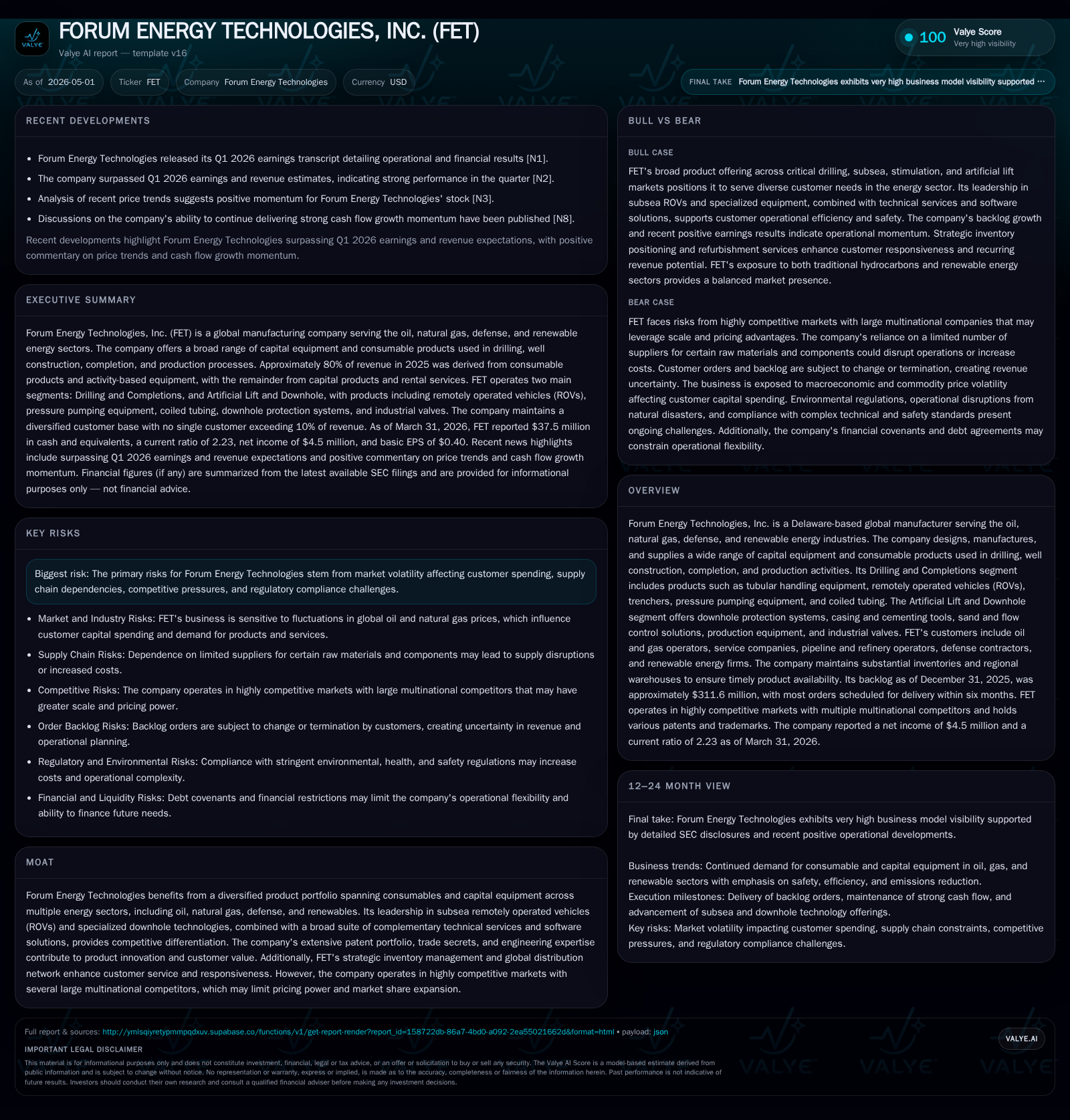
In its latest quarter ending March 31, 2026, Forum Energy Technologies (FET) highlighted steady demand in its consumables segment and progress in capital equipment deployments despite lingering industry cyclicality. The company’s broad portfolio spans drilling, completions, subsea robotics, and artificial lift products serving oil, gas, defense, and renewable sectors. While competitive intensity and regulatory complexities persist, FET leverages strong engineering capabilities and global distribution to maintain relevance. Key growth hinges on incremental adoption of low-emission technologies and subsea innovations, balanced against supply chain risks and leveraged balance sheet constraints.
Recent Operating Update
Forum Energy Technologies' first quarter 2026 earnings report filed May 1 outlines ongoing steady demand for its consumable products that primarily support rig activity, well construction, and completion services. Despite the inherent cyclicality in oilfield services driven by commodity price volatility, consumables continue to underpin about 80% of FET's revenue mix—showing structural resilience in near-term operations as customers emphasize cost-effective drilling inputs [S2][N2].
Capital equipment sales encountered typical elongated project cycles reflective of customer capital discipline; however, aftermarket services and technical support maintained a stable contribution. The company’s backlog remains solid but subject to typical order timing uncertainties given macroeconomic conditions impacting operator spending plans [S2][S3].
Business Model
Forum operates predominantly as a manufacturer and supplier of highly engineered products segmented into Drilling and Completions, and Artificial Lift and Downhole equipment. The Drilling and Completions segment includes tubular handling solutions, coiled tubing units, pressure pumping systems, subsea ROVs (notably under Dynacon® and Sub-Atlantic® brands), trenchers, specialty vehicles like submarine rescue crafts, along with hydraulic power units. Meanwhile, the Artificial Lift segment covers casing/cementing tools, sand control elements, production hardware, industrial valves, and downhole protection devices.
Customers span oil & gas operators aggressively developing new or enhanced wells, service companies executing stimulation or intervention activities, pipeline/refinery operators requiring process components, alongside defense sector clients and renewable energy firms deploying infrastructural assets. Consumables such as drill bits or frac pumps represent repeat business with relatively short replenishment cycles; capital equipment sales involve longer sales cycles but higher value.
Revenue is driven by a volume-price-mix dynamic: high volumes in drilling consumables sustain day rates charged per rig activity; pricing is sensitive though insulated somewhat by brand reputation and service contracts. Capital products yield higher margins but are exposed to project deferrals. The company also invests in software-enabled technical services augmenting product offerings to improve operational efficiencies for end customers.
Inventory management is a strategic focus to balance responsiveness with exposure to obsolete stock risks—a significant consideration given fluctuating commodity-driven demand levels affecting bookings [S1][S24]. Payment terms average around 70 days receivables versus 60 days payables indicating robust working capital needs.
Industry Structure and Competitive Position
The markets Forum serves are highly competitive with no single player dominating all product lines. Rivals range from multinational conglomerates like NOV Inc., Tenaris S.A., SLB (Schlumberger), TechnipFMC plc, Baker Hughes, Weatherford International PLC to regional specialized manufacturers. Price competition is intense particularly for standard consumable goods; however, FET differentiates through embedded technology in subsea robotics (e.g., ROV thrusters), durable downhole instrumentation, patented valve designs, and proprietary hydraulic controls.
The company's extensive patent portfolio combined with trade secrets strengthens its moat especially in subsea ROV launch-and-recovery systems—a niche requiring advanced engineering credentials. Furthermore, its global distribution network ensures localized availability improving delivery timings amid offshore projects.
Still, the cyclical nature of the upstream oil & gas sector imposes fluctuating demand patterns driven by exploration budgets linked to crude price trends. Renewable energy growth introduces a structural shift opportunity yet currently contributes modestly due to early stage equipment adoption curves relative to hydrocarbon investments.
Growth Drivers
- Structural Energy Demand: Despite global renewable growth, hydrocarbons expectedly remain central to meeting long-term demand supporting sustained need for drilling/completions equipment.
- Technological Innovation: Investment in emissions-lowering completions tools aligns with operator ESG priorities potentially opening new revenue streams.
- Subsea Expansion: Increasing offshore developments drive demand for specialty ROVs and trenchers where Forum holds market leadership.
- Renewable Sector Penetration: Offering capital equipment tailored for wind turbine foundations and subsea cables positions FET within evolving energy infrastructure markets.
- Aftermarket Services: Growth in parts refurbishments/service contracts provides recurring revenue less dependent on new rig builds.
Each driver correlates with KPIs such as backlog size in capital projects bookings, utilization rates of technical service teams, renewal rates of aftermarket agreements, book-to-bill ratios reflecting inbound order vitality [S2][N2][S24].
Risks / Watchpoints / Growth Constraints
Key risks center on:
- Commodity price volatility translating into operator CAPEX cuts leading to order cancellations or postponements negatively impacting revenue realization.
- Supply chain disruptions causing raw material cost inflation or delivery delays impacting margins and customer satisfaction.
- Heightened regulatory burden encompassing environmental laws (RCRA/CERCLA), export controls (OFAC compliance), workplace safety requirements adding operating complexity.
- Competitive pressures limiting pricing power especially in commoditized consumables segments potentially compressing gross margins.
- Balance sheet leverage (~$121 million net debt as of Q1 end) constraining future strategic investments or refinancing flexibility under adverse market conditions [F1][S4].
- Inventory obsolescence risk if demand projections don't materialize amidst technological shifts or consolidated customer procurement practices.
These factors warrant monitoring alongside evolving geopolitical tensions which could impact cross-border trade flows or sanctions regimes affecting customers/suppliers [S19][S21].
What to Watch Next
Investors should focus on:
- Quarterly booking trends and backlog composition updates indicating project momentum or softness.
- Pricing environment shifts especially as raw material inflation moderates or intensifies.
- Execution on technology launches targeting emissions reduction or renewable energy applications.
- Service contract renewals signaling customer retention strength amid competitive bids.
- Balance sheet adjustments including debt repayments or new financing arrangements.
- Regulatory developments that might influence manufacturing costs or product certifications.
- Macro indicators such as rig counts correlating with consumable volume demands.
Management commentary during earnings calls and event filings will provide crucial insight into cyclical recovery prospects versus secular headwinds related to energy transition dynamics [N1][N2][S3].
Financial Profile (Supporting Evidence)
Latest financial snapshot
| Metric | Value | Period |
|---|---|---|
| Cash & equivalents | $37mm | |
| 2026-03-31 | ||
| Total debt | $159mm | |
| 2026-03-31 | ||
| Net debt | $121mm | |
| 2026-03-31 | ||
| Current assets | $464mm | |
| 2026-03-31 | ||
| Current liabilities | $209mm | |
| 2026-03-31 | ||
| Current ratio | 2.23x | |
| 2026-03-31 |
Source: SEC companyfacts cache [F1].
As of March 31, 2026:
- Cash & equivalents stand at approximately $37.5 million indicating liquidity cushion [F1].
- Total debt reported at about $159 million results in net debt near $121 million after cash offsets [F1].
- Current assets ($464 million) over current liabilities ($209 million) translate into a healthy current ratio of 2.23 reflecting sound short-term solvency [F1].
Overall leverage limits aggressive capital deployment but supports measured growth investment aligned with cash flow generation capacity. The company balances inventory stocking policies carefully given working capital intensity inherent to product mix ranges from fast-moving consumables to bespoke capital goods requiring longer turnaround times [S4][S16].[F1]
This analysis is based solely on publicly filed documentation from SEC forms April–May 2026 filings alongside contemporaneous news transcripts without offering investment advice.
Disclaimer: This is research-only, informational analysis and not investment advice. It may include AI-generated interpretation and general industry context. Always verify important details using primary sources.

Comments