
Repay Holdings Strengthens Position with KUBRA Acquisition and Strategic Leadership Moves
Recent acquisition agreement and operational enhancements aim to bolster Repay's fintech growth amid financial challenges.
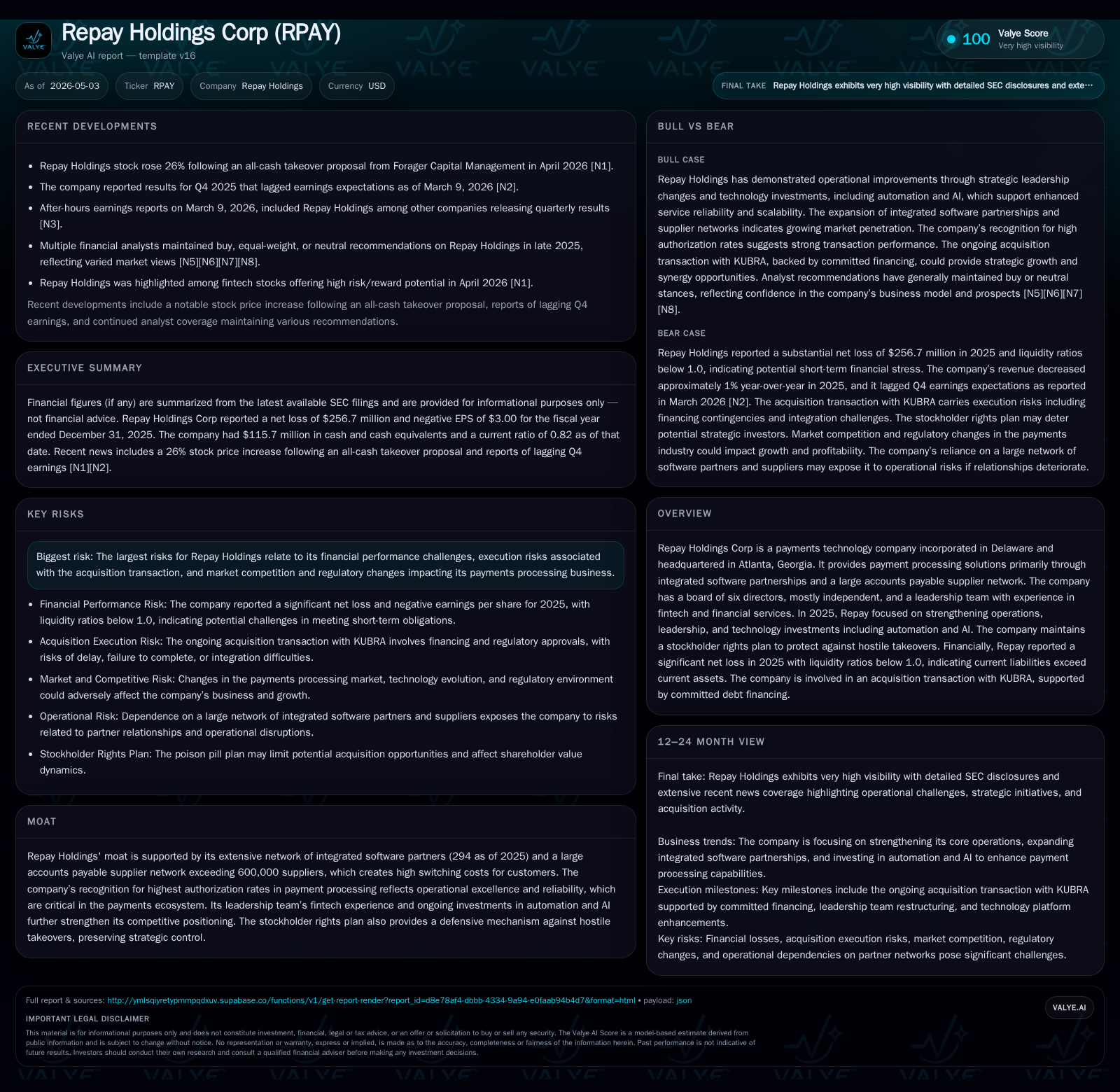
In early 2026, Repay Holdings Corp announced a definitive agreement to acquire KUBRA in a transaction valued at approximately $372 million, financed through cash on hand and committed debt facilities. This acquisition is poised to expand Repay’s product capabilities and market reach within payments technology. Concurrently, the company advanced governance protections by adopting a stockholder rights plan and restructured executive leadership to support strategic execution. Despite ongoing financial headwinds marked by a substantial net loss and liquidity constraints, these moves reflect Repay’s efforts to strengthen its operational foundation and competitive edge in the integrated payment processing ecosystem.
Recent Operating Update: Anchoring Change on Latest Event Filing
On April 27, 2026, Repay Holdings Corp disclosed preliminary results for the first quarter ending March 31, 2026 [S3][S23]. The filing primarily highlighted progress on the signed acquisition of KUBRA—an agreement reached on March 30, 2026 [S10][S22]. The deal is valued at approximately $372 million with customary adjustments, expected to close in Q2 2026 subject to regulatory clearance. Financing consists of cash on hand supplemented by committed debt facilities including a $500 million term loan and $100 million revolving credit facility extended by Truist Bank [S22]. Notably, the purchase agreement lacks a financing contingency, underscoring Repay’s commitment despite capital structure pressure.
Alongside corporate development, Repay established a stockholder rights plan in April designed to deter hostile takeovers by imposing significant dilution triggers at beneficial ownership of 12.5% without board approval [S24][S25][S26]. This defensive move complements leadership restructuring efforts initiated in 2025 aimed at improving execution focus and deploying automation/AI initiatives [S1].
These developments represent tangible steps taken by Repay's management to shore up growth avenues and secure governance controls.
Business Model: Payments Tech via Partnerships and Supplier Networks
Repay operates as a payments technology intermediary facilitating payment processing largely through deeply embedded software partnerships (294 integrated partners at year-end 2025) [S1]. This partner ecosystem embeds Repay’s payment rails directly into third-party vertical market software platforms, driving recurring transaction volumes from client end-users.
Simultaneously, the company leverages an extensive accounts payable supplier network exceeding 600,000 vendors. This creates high switching costs for clients reliant on seamless payment processing across their supplier base. By controlling critical flows within payables ecosystems—particularly electronic payments—Repay generates revenue primarily from transaction fees aligned with payment volumes authorized through its systems.
The firm's product relevance is underscored by its industry recognition for highest payment authorization rates [N1], reflecting operational excellence vital in minimizing declined transactions which directly impact merchant revenue.
Technology investments center around automation including robotic process automation (RPA) and artificial intelligence applications targeted at both client onboarding workflows and ongoing operational reliability. These help reduce manual error rates and decrease customer support overheads while improving margins over time.
Pricing power is supported by embeddedness within clients’ ERP or accounting platforms plus switching complexity tied to supplier relationships, though pricing sensitivity remains due to competition from entrenched payment processors and emerging fintech alternatives.
Industry Structure and Competitive Position
The integrated payments processing sector is highly fragmented with competition from established incumbents like FIS/Fiserv alongside niche fintech players offering vertical-specific payment solutions. In this environment:
- Partnership Scale matters significantly; Repay’s nearly 300 software partners create distribution advantages that smaller players struggle to replicate.
- Supplier Network Breadth further differentiates offerings—invoices paid electronically across hundreds of thousands of suppliers anchor client retention.
- Operational Reliability such as best-in-class authorization rates increases customer trust essential for high-volume transaction businesses.
- Regulatory Compliance imposes ongoing cost pressures; providers must continually update systems for PCI DSS standards plus evolving AML/KYC requirements.
Repay’s leading operational metrics within its niche underline competitive moats but barriers are not insurmountable given rapid innovation cycles elsewhere in fintech. Strategic acquisitions like KUBRA aim to broaden product scope—possibly encompassing additional billing platforms or consumer engagement tools—to deepen market penetration.
Growth Drivers: Acquisition Synergies & Technology Investments
Three main vectors underpin Repay’s growth potential:
KUBRA Acquisition: Folding KUBRA expands Repay’s product portfolio beyond core integrated payments toward broader billing management solutions. Cross-selling opportunities across matched client profiles could drive incremental revenue streams post-integration [S10]. The transaction size relative to existing market capitalization suggests meaningful scale enhancement.
Automation & AI Deployment: Continued investment in technology reduces per-transaction costs while improving client onboarding speeds and customer experiences—critical levers in volume growth scenarios [S1]. Automation also supports scaling with fewer incremental hires.
Partner Ecosystem Expansion: Adding new vertical software partners fuels usable payment inflows embedded directly within business processes of end clients—organic volume expansion benefits from robust ecosystem dynamics with sticky integration points [S1].
However, growth visibility hinges on successful integration of acquired assets consistent execution on technology roadmap, plus sustained demand from large enterprise users facing their own digital transformation pressures.
Risks and Watchpoints: Execution and Market Pressures
Despite strategic moves forward, multiple risks warrant attention:
- Financial Performance & Liquidity Constraints: The company reported an operating loss exceeding $254 million for FY2025 alongside a current ratio below one (0.82), signaling that short-term liabilities exceed assets [F1]. This leverage profile raises refinancing risks especially if expected acquisition synergies fail to materialize timely.
- Acquisition Execution Risks: Integrating KUBRA’s operations involves technological assimilation, cultural alignment, and realizing projected cost synergies. Failure here could impair cash flow trajectories [S10][S22].
- Competitive Disruption: Fintech investments flood the payment sector with new entrants offering alternative value propositions; incumbents' pricing pressure might compress margins.
- Regulatory Environment: Heightened scrutiny around data security breaches or anti-money laundering could increase compliance costs or delay innovations.
- Customer Concentration or Attrition: Dependence on large software partners may expose Repay if partners alter alliances or build internal capabilities reducing reliance on external processors.
Monitoring these risks requires assessing quarterly updates around new partner additions, financial health metrics post-KUBRA closing, regulatory guidance changes, and competitive landscape moves.
What To Watch Next
Key forthcoming milestones include:
- Q2 2026 Closing of KUBRA Deal: Regulatory approvals completion coupled with public commentary about integration strategies will provide clarity on timing and expected contributions [S10][N1].
- Subsequent Quarterly Financials: Indicators like organic revenue growth versus acquired revenue offsetting net losses will gauge if strategic execution improves financial stability [S3].
- Automation Rollout Progress: Updates on AI-driven features adoption rates or EBITDA margin improvements would signal operational leverage from technology investments [S1].
- Partner Ecosystem Growth Metrics: Increases in active software integrations or supplier networks expandability serve as demand markers [S1].
- Corporate Governance Impact: Effects of the stockholder rights plan on shareholder composition or activist investor involvement might influence strategic options [S24].
Scrutiny of these execution cues will inform how effectively Repay capitalizes on its expanded platform while navigating legacy financial burdens.
Financial Profile Snapshot (as of December 31, 2025)
Latest financial snapshot
| Metric | Value | Period |
|---|---|---|
| Cash & equivalents | $116mm | |
| 2025-12-31 | ||
| Total debt | $434mm | |
| 2025-12-31 | ||
| Net debt | $318mm | |
| 2025-12-31 | ||
| Current assets | $197mm | |
| 2025-12-31 | ||
| Current liabilities | $241mm | |
| 2025-12-31 | ||
| Current ratio | 0.82x | |
| 2025-12-31 |
Source: SEC companyfacts cache [F1].
While cash reserves appear substantial relative to peers in fintech scaling phases, significant debt load coupled with operating losses indicate near-term liquidity management challenges remain central concerns pending better operating leverage post-acquisition [F1][S2][S3].
This analysis synthesizes recent filings through April 27, 2026 focusing on Repay Holdings' strategic moves amid financial pressures without issuing investment recommendations or prognostications about future performance outcomes.
Disclaimer: This is research-only, informational analysis and not investment advice. It may include AI-generated interpretation and general industry context. Always verify important details using primary sources.

Comments