
Masimo Corp Strengthens Market Position Ahead of Potential Sale
Recent strategic board discussions and operational updates position Masimo amid transformative acquisition interest.
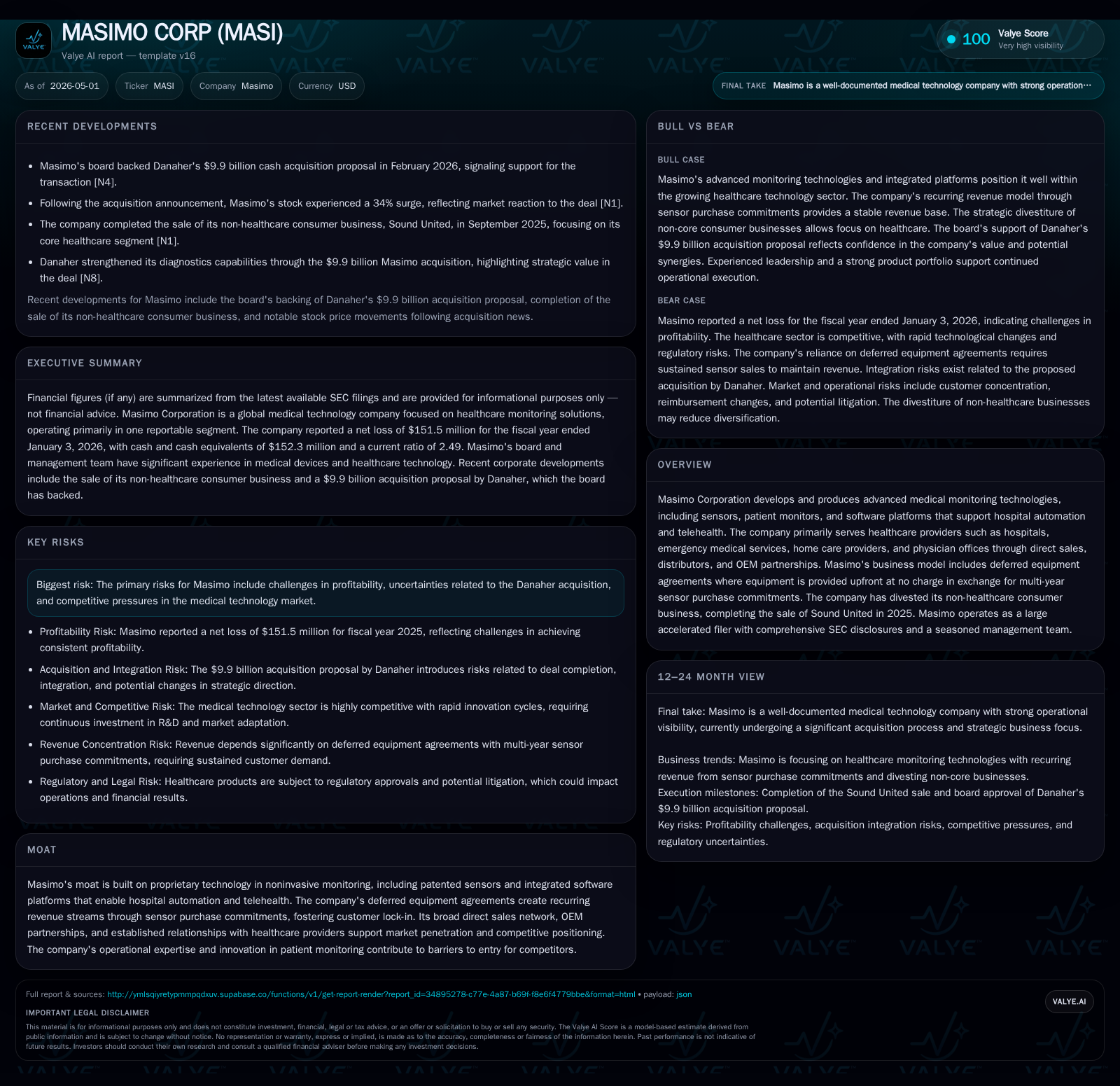
Masimo Corporation’s latest 10-Q filing and subsequent 8-K event reveal a pivotal shift in corporate direction with the board exploring a potential sale. The company’s core business, centered on patented noninvasive monitoring technologies and a recurring revenue model through deferred equipment agreements, remains strategically robust. Competitive strengths are anchored by technology moats, OEM partnerships, and integrated telehealth solutions, but near-term earnings have been impacted by losses from discontinued operations and ongoing market dynamics. The pending acquisition talks with Danaher frame the upcoming quarters as critical for validating Masimo's operational resiliency and strategic value.
Recent Strategic Developments and Board-Level Discussions
Masimo’s most recent quarterly report filed on November 4, 2025, marked a significant step in clarifying the company’s near-term operating landscape. The 10-Q detailed substantial reclassifications in its financial statements to properly reflect discontinued operations tied primarily to the divestiture of its Sound United consumer audio business segment. These reclassifications not only altered presentation but materially impacted the reported net income figures — the company posted a net loss of $219.8 million for the nine months ended September 27, 2025, sharpened by a $365.6 million loss from discontinued operations [S2].
Subsequently, an April 23, 2026, Form 8-K explicitly disclosed that Masimo’s Board held an executive session on November 30, 2025, involving key advisers Centerview Partners and legal counsel White & Case LLP. Discussions centered around Masimo's long-range financial planning alongside preparations for an investor day event. Crucially, the board also deliberated the potential sale of the company. Centerview applied transaction valuation multiples referencing Masimo’s adjusted LTM EBITDA of approximately $455 million (as of February 13, 2026), subtracting net debt estimated at $372 million to derive equity value ranges underpinning the proposed transaction strategy [S3].
This development transforms the narrative from pure operational execution toward strategic corporate restructuring with acquisition prospects now front and center.
Masimo’s Business Model and Product Innovation
As outlined in their annual filing amendment dated May 1, 2026, Masimo specializes in advanced medical monitoring technologies integrating proprietary noninvasive sensor hardware with sophisticated patient monitors and software platforms enabling hospital workflow automation as well as telehealth deployment [S1]. These offerings include pulse oximetry sensors—particularly their patented SET technology—and connected platforms used broadly in hospitals, EMS services, homecare settings, and physician offices.
A notable aspect of Masimo’s revenue mechanics is their deferred equipment agreement model. Under this structure, Masimo provides key monitoring equipment upfront at no initial charge to healthcare customers. In exchange, these customers commit to purchasing consumable sensors from Masimo over multi-year periods. This creates a recurring revenue stream tied to sensor sales rather than one-time equipment transactions—effectively embedding high switching costs due to proprietary sensor compatibility requirements [S1].
The recent strategic move to divest Sound United in 2025 has allowed Masimo to refocus exclusively on its core healthcare monitoring business lines that leverage stronger patent protections and healthcare-specific expertise [S1]. Operating as a large accelerated filer with seasoned management further supports disciplined capital allocation aligned with growth imperatives.
Competitive Positioning within Medical Monitoring Industry
Within the broader medical technology ecosystem, Masimo guards a distinct moat rooted in its pioneering noninvasive patient monitoring technology patents complemented by integrated software suites that aid hospital automation processes. The combination offers a comprehensive solution difficult for competitors to replicate due to regulatory hurdles on medical devices paired with entrenched clinical acceptance cycles [S1].
OEM partnerships further solidify this position; Masimo supplies sensor modules which form critical components in other manufacturers' monitoring systems. This dual-channel approach through direct sales plus OEM licensing widens market reach while reinforcing dependency on Masimo's proprietary technology platform [S1].
Pricing power stems from embedded sensor consumable revenue streams guaranteed through contractual commitments inherent in deferred equipment agreements. Healthcare providers face substantial retraining costs and technical integration challenges to switch suppliers once embedded within Masimo’s ecosystem—a classic example of sticky customer dynamics.
From an industry perspective (analysis), adoption curves for such technologies are steady but benefit structurally from accelerating trends in remote patient monitoring heightened by expanding telehealth reimbursement policies and hospital digitization mandates.
Growth Drivers Fueling Future Expansion Opportunities
Key growth drivers emerge from both demand-side macro trends and incremental product innovation avenues:
- Telehealth Expansion: As remote patient care grows beyond pandemic-driven acceleration phases into permanent adoption cycles worldwide, demand for home-based monitoring solutions linked to Masimo’s platform expands materially.
- Hospital Automation: Pressure on hospitals to reduce manual intervention fuels investments into integrated patient monitoring systems capable of delivering richer real-time data streams into Electronic Health Records (EHR) systems.
- Newborn Pulse Oximetry Innovations: Recent studies showcased by Nasdaq highlight Masimo SET's ability to accurately monitor oxygen saturation across varied newborn skin tones—addressing previous accuracy disparities in pulse oximetry technologies which could spur adoption rates in neonatal care units globally [N2].
- OEM Partnership Extensions: Continued collaboration expansions allow penetration into adjacent device categories or geographic markets where OEM distributors have local advantages.
- Emerging Market Penetration: Growth opportunities exist in developing countries investing increasingly in telehealth infrastructure where noninvasive cost-effective solutions are attractive [S1],[N2].
Measureable KPIs linked to these drivers include growth rates of sensor unit volumes bound under deferred purchase contracts and pipeline expansion seen during investor presentations.
Risks and Constraints Impacting Growth Trajectory
Despite strategic strengths, risks remain notable:
- Profitability Pressures: The recent quarterly loss magnitudes highlight short-to-midterm profitability stress driven largely by divested segments’ losses booked as discontinued operations [S2]. Operational leverage may take time to recalibrate post-divestiture.
- Acquisition Uncertainty: While management engages seriously with Danaher regarding a merger agreement implementation (announced post-quarter), complications including regulatory approvals or competing bids pose execution risk [S3],[S19].
- Competitive Technology Advances: Market players in pulse oximetry or wearable device fields may introduce alternate noninvasive modalities challenging Masimo's entrenched sensor offerings.
- Regulatory Environment: Medical device compliance regimes remain stringent; any shifts increasing certification timelines impact swift product rollouts.
- Governance Constraints: Insider trading policies limiting equity pledging ensure executive alignment but may constrain certain financing maneuvers [S1].
Understanding these constraints frames realistic expectations around operational pacing ahead of strategic transaction closure.
Key Near-Term Milestones and What to Watch Next
Critical upcoming events include:
- Investor Day Outcome: Follow-up disclosures expected relating to updated long-range plans articulated during late-2025 board meetings informing market assumptions about standalone performance viability versus acquisition benchmarks [S3].
- Acquisition Process Developments: Given ongoing discussions announced early 2026 around merger agreement timing and regulatory submissions with Danaher stakeholders–monitor proxy filings or SEC disclosures for update cadence [S3].[N1]
- Q4 Earnings Release: Early 2026 results will shed light on operating profit recovery trends post-Sound United divestiture revealing progress toward improved earnings quality absent discontinued operation drag [S21].[N3]
Tracking sensor unit backlog growth or contract renewals within healthcare providers will provide granular signal clarity on demand sustainability.
Current Financial Snapshot and Capital Structure Overview
Latest financial snapshot
| Metric | Value | Period |
|---|---|---|
| Cash & equivalents | $152mm | |
| 2026-01-03 | ||
| Current assets | $926mm | |
| 2026-01-03 | ||
| Current liabilities | $372mm | |
| 2026-01-03 | ||
| Current ratio | 2.49x | |
| 2026-01-03 |
Source: SEC companyfacts cache [F1].
The positive net cash position (zero reported gross debt per current filings) provides flexibility for ongoing operational investments or strategic initiatives without immediate refinancing concerns [F1],[S2],[S3]. Operating income reached $310 million by year-end according to annual accounts reflecting underlying core business profitability once discontinued segments are excluded.
This analysis reflects information available from MASIMO CORP's latest SEC filings through April/May 2026 combined with sector context provided by recent news sources. It neither constitutes investment advice nor forecasts future stock performance but aims to clarify company positioning amid dynamic industry shifts.
Disclaimer: This is research-only, informational analysis and not investment advice. It may include AI-generated interpretation and general industry context. Always verify important details using primary sources.

Comments