
Business First Bancshares Strengthens Regional Lending Foothold with Q1 2026 Advances
The latest quarterly results reveal Business First Bancshares’ focused growth in sophisticated SME lending, driven by organic expansion and strategic acquisitions across key Southern markets.
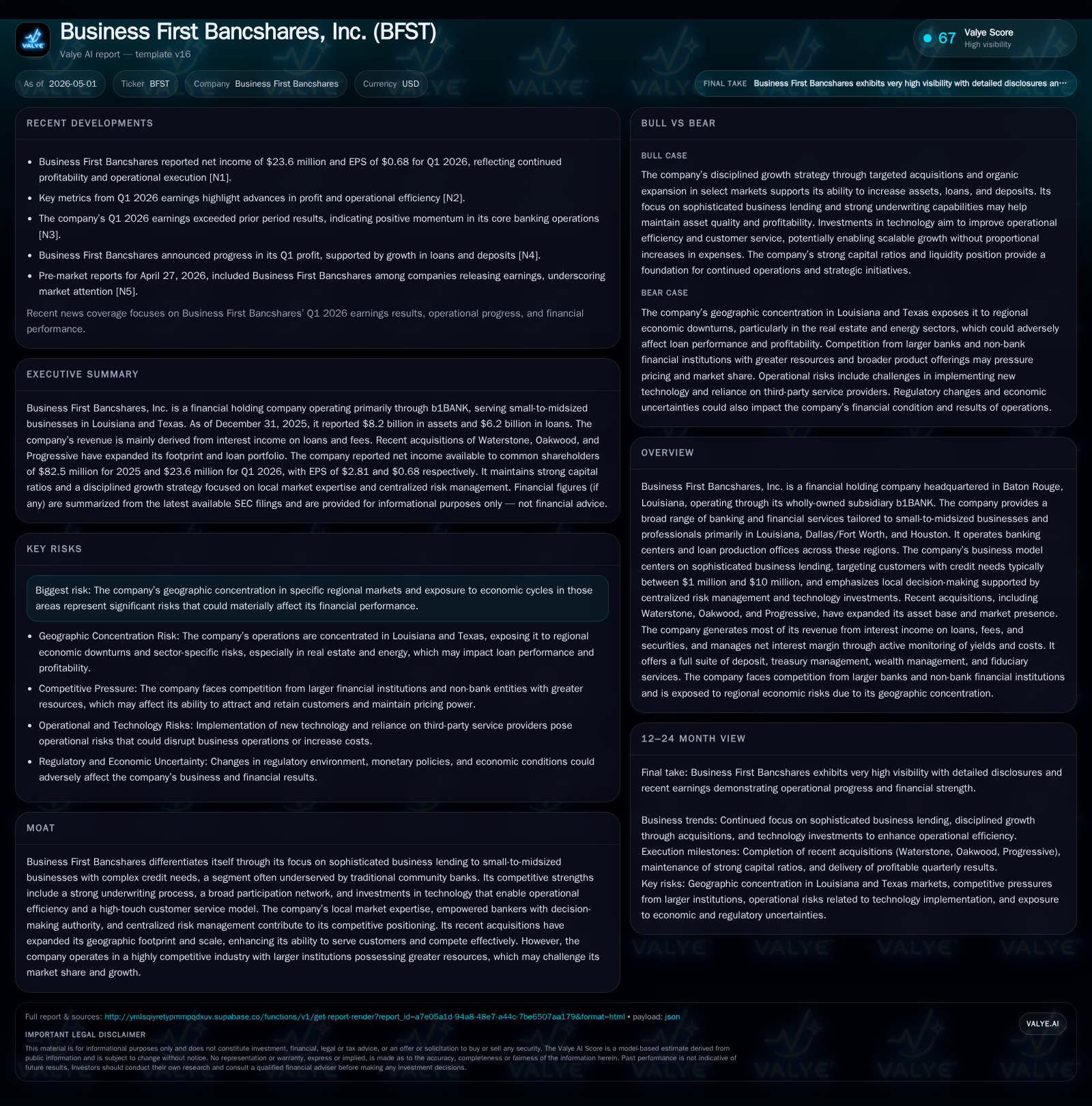
Business First Bancshares reported solid operational momentum in Q1 2026, highlighted by sustained loan portfolio growth and a maintained dividend, reflecting the strength of its regional business banking model. The company’s emphasis on serving small-to-midsized businesses with complex credit needs through empowered local bankers and centralized risk controls remains central to its competitive edge. Expansion along the I-10/12 and I-20 corridors, combined with recent acquisitions, supports a clear growth trajectory amidst competitive pressures and geographic concentration risks. Looking ahead, deposit growth, banker recruitment, and loan quality metrics will be critical to monitor execution effectiveness.
Q1 2026 Operating Highlights and Strategic Momentum
The company’s bank (b1BANK) continues to emphasize disciplined loan portfolio growth primarily within Louisiana and the Texas metroplexes of Dallas/Fort Worth and Houston. It sustains efforts to recruit entrepreneurial banking teams with local market expertise—an organic expansion vector complemented by recent acquisitions such as Waterstone (2024), Oakwood (2024), and Progressive [S1], which have contributed to increasing asset scale.
Deposit growth remains a focal point since loan funding capability is closely tied to core deposits under Business First’s funding model. The reported cash and equivalents stood at approximately $590 million as of March 31, 2026 [F1], supporting liquidity for credit origination. While total debt is negligible at around $2.4 million (best-effort figure from prior years) relative to cash levels [F1], the company selectively uses Federal Home Loan Bank advances to supplement funding where necessary [S5].
Business Model: Serving Complex Lending Needs of Small-to-Midsized Businesses
Business First Bancshares operates as a financial holding company headquartered in Baton Rouge, Louisiana. Through b1BANK, its wholly owned subsidiary, it offers full-service banking primarily targeting small-to-midsized enterprises (SMEs) with borrowing requirements typically between $1 million and $10 million—customers often underserved by standard community banks [S1]. Revenue streams are heavily weighted toward net interest income generated from this loan portfolio complemented by fee income from ancillary services and investment securities [S10].
A key strategic pillar is the empowerment of local bankers who possess deep regional knowledge paired with decision-making authority tailored to their markets. This is coupled with centralized risk management controls that apply standardized underwriting rigor ensuring balanced credit quality amidst geographic expansion [S1]. The firm’s branch-lite model limits physical footprint costs while maintaining customer touchpoints via banking centers and loan production offices that support client relationships across Louisiana and Texas corridors.
Loan products are largely commercial & industrial (C&I) loans including working capital lines of credit, term loans, equipment financing, real estate loans backed largely by commercial real estate properties within footprint markets [S10]. The underwriting approach incorporates comprehensive collateral evaluation—ranging from real estate liens to business assets—with an emphasis on borrower financial condition stability. This specialization requires sophisticated credit assessment capabilities due to increased complexity and risk relative to typical consumer or residential lending.
Competitive Positioning in Regional Banking Markets
Within its core regional markets encompassing Louisiana plus Texas's Dallas/Fort Worth metroplex and Houston area, Business First occupies a niche focused on complex SMEs requiring tailored credit solutions [S1]. The company leverages localized market intelligence via bankers empowered with loan decision authority—a significant competitive advantage against larger regional or national banks where lending decisions may be routinized or centralized away from the market.
Participation networks enhance capital deployment flexibility by enabling syndicated loan structures reducing individual credit exposure while preserving relationship continuity. This network effect also supports deal flow sourcing and referral strength within local ecosystems. Although smaller than superregional lenders competing in the same corridors, Business First’s depth of market knowledge allows it to identify attractive clients missed by broader institutions prioritizing scale over customization.
However, geographic concentration exposes the company to region-specific economic cycles affecting SMEs dependent on industries like energy services, manufacturing, and real estate development prevalent in these hubs [S18][S20]. Moreover, the relatively constrained branch-lite physical presence limits top-line reach compared to competitors with broader retail footprints.
Key Growth Drivers: Market Expansion, Talent Acquisition, and Technology Investments
Business First’s growth blueprint balances organic expansion primarily through recruiting seasoned banking teams aligned culturally to bolster market share within existing core regions [S1][S3]. Recent acquisitions such as Waterstone and Oakwood have added scale while integrating complementary customer bases enhancing cross-sell potential. Opportunistic acquisitions enable accelerated entry into new submarkets along the I-10/12 east-west corridor stretching toward Mississippi as well as deepening presence along the I-20 corridor connecting Dallas-Fort Worth eastward.
Technology investments form another pillar improving operational efficiency via streamlined credit approval workflows and enriched customer experience through digital service platforms. These initiatives promote margin preservation even amid pricing competition.
Deposit-gathering efforts remain critical given their direct link to funding capacity for new lending; accelerating deposit inflows enable balance sheet expansion without recourse to more expensive wholesale funding sources [S2][N2]. Additionally, robust retention rates among commercial clients anchored by high-touch service models underpin steady fee-based revenue streams.
Risks and Challenges: Geographic Concentration and Competitive Pressures
Despite clear strengths in meeting niche SME lending needs across targeted geographies, Business First confronts notable risks related principally to its concentrated exposure within specific Southern regional economies [S2]. Economic downturns impacting energy sector dynamics or commercial real estate cycles could lead to elevated credit losses or reduced loan demand given borrower sensitivity.
Competition from larger banks endowed with broader resource pools poses an ongoing threat especially if those institutions recalibrate strategies toward mid-sized borrower segments benefiting from superior funding costs or digital infrastructure advantages. Regulatory capital constraints also shape pace of growth due to capital allocation priorities ensuring compliance at both holding company and bank levels [S13][S14].
Seasonal volatility in public fund deposits introduces additional liquidity management considerations given that municipal deposits comprise materially over 10% of total deposit base; fluctuations therein may compel reliance on costlier borrowings impacting net interest margins [S19]. Loan portfolio quality demands continual vigilance especially as nonperforming assets increased substantially at year-end 2025 versus prior periods indicating potential stress points within select borrower cohorts [S25].
Monitoring Forward-Looking Indicators and Upcoming Milestones
Key metrics warrant close watch include quarterly deposit growth trends which directly affect loan originations capacity as well as emerging data on loan credit quality shifts gauged via delinquency rates or reserve allocations highlighted in quarterly disclosures [N2][S2]. Incremental banker hires or team acquisitions post-Q1 would signal ongoing execution strength supporting geographic expansion plans outlined along vital commercial arteries.
Dividend declarations remain an important barometer signaling management confidence in sustained cash flows; announced dividends through May suggest continued profitability reinforcement despite competitive headwinds [S3]. Pipeline health commentary provided during earnings calls provides qualitative insight into future booking momentum particularly relating to large C&I credits requiring deeper underwriting analysis [N1].
Potential M&A activity remains a wildcard albeit disciplined acquisition strategy is communicated centrally; any deals should align tightly culturally given integration complexity inherent in relationship-driven banking models.
Concise Financial Snapshot Supporting Operational Insights
From a financial standpoint, Business First closes Q1 2026 with approximately $590 million in cash and cash equivalents ensuring ample liquidity for immediate operational needs including lending cadence ramp-up [F1][S2]. Reported total debt carries minimal weight relative to balance sheet size enhancing financial flexibility although utilization of Federal Home Loan Bank advances supplements short-term funding when warranted without excessive leverage buildup [S13][S14].
Reported net income stood near $87.9 million on a trailing annual basis [(F1)] reflecting healthy profitability although quarterly numbers are not explicitly cited here. Capital adequacy ratios comfortably exceed regulatory minimums maintaining well-capitalized status supportive of dividend payments observed consistently since late 2025 [S14][S15]. This conservative capital posture underpins optionality for measured growth investments while maintaining resilience against sector cyclicality.
-- This analysis synthesizes Business First Bancshares’ recently filed regulatory disclosures together with sector insights relevant to regional commercial banking dynamics serving small-to-midsized enterprises. It highlights evidence-based operational developments without extrapolating undisclosed financial metrics or speculative forward guidance. No investment recommendations are offered herein.
Disclaimer: This is research-only, informational analysis and not investment advice. It may include AI-generated interpretation and general industry context. Always verify important details using primary sources.

Comments