
Heidmar Maritime’s Compliance Hurdle and Asset-Light Pool Strategy
Heidmar Maritime confronts Nasdaq listing risks while leveraging its diversified vessel pools and proprietary digital platform to sustain operational resilience.
In April 2026, Heidmar Maritime Holdings Corp. disclosed non-compliance with Nasdaq’s minimum bid price requirement, triggering a 180-day grace period to regain listing standards. Despite this near-term regulatory challenge, the company’s asset-light business model underpinned by pooled tanker and dry-bulk fleets across multiple classes, supported by its eFleetWatch® platform, continues to offer operational scale and flexibility. Growth opportunities hinge on fleet utilization optimization alongside expanding commercial management contracts in volatile tanker markets, though financial performance weaknesses and governance structure constraints remain material risks.
Nasdaq Non-Compliance Notification: What It Means Now
On April 24, 2026, Heidmar Maritime Holdings Corp. announced via Form 6-K that it received written notice from The Nasdaq Stock Market indicating non-compliance with the minimum $1.00 bid price requirement for continued listing [S2]. This notification activates a 180-day grace period lasting until October 19, 2026 during which Heidmar must restore its share price above the threshold for at least ten consecutive business days to maintain Nasdaq listing status. Failure to do so could lead to delisting or transfer to an over-the-counter market.
This development introduces an immediate regulatory challenge affecting shareholder confidence and potentially the company's market liquidity dynamics. While trading will continue uninterrupted during the grace period, management expressly stated intent to monitor pricing closely and take appropriate corrective measures if needed [S2]. The non-compliance reflects broader financial pressures evidenced in recent earnings disclosures.
Heidmar’s Business Model: Asset-Light Pools and Integrated Services
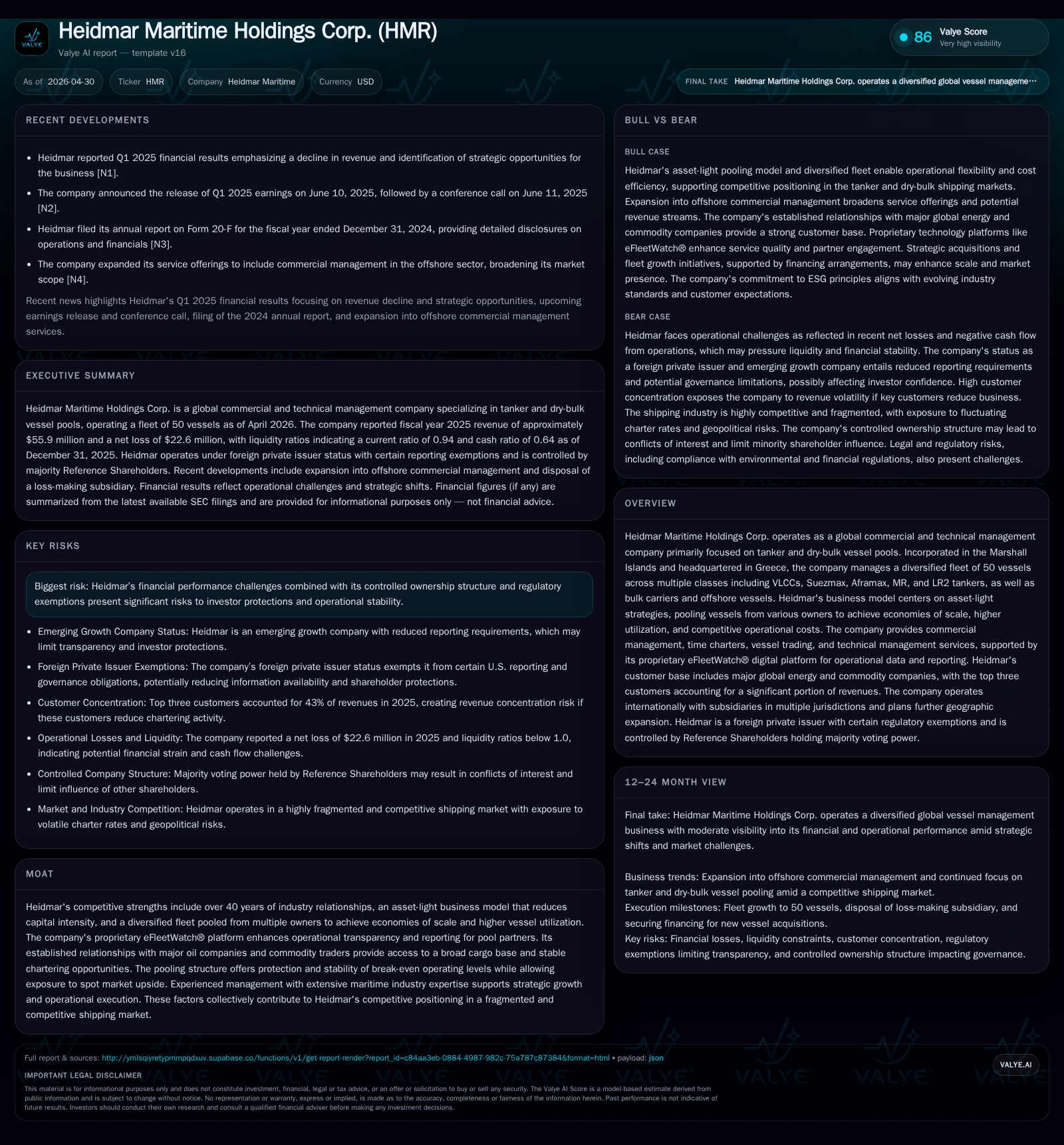
Heidmar operates primarily as a global commercial and technical management firm for tanker and dry-bulk vessel pools [S1]. Rather than owning vessels directly in bulk, the company pools ships from various third-party owners across multiple tanker classes—very large crude carriers (VLCCs), Suezmax, Aframax, medium-range (MR) tankers—and dry bulk carriers plus offshore support vessels.
Through this asset-light approach, Heidmar circumvents heavy capital intensity typical of traditional shipowning models while generating revenue from time charter hire agreements, commercial and technical management fees, and vessel trading commissions [S1][F1]. Such pooling arrangements enable economies of scale by aggregating demand and optimizing vessel deployment leading to improved utilization rates and reduced per-vessel operating costs for participants.
Each pool is operated through consolidated subsidiaries that hold credit facilities secured against the receivables of those pools with Macquarie Bank Limited serving as primary lender—totaling a combined facility limit of $85 million [S1][S4]. These credit lines support working capital requirements crucial for daily pool operations.
Fleet Composition and Operational Excellence: Digital Edge with eFleetWatch®
Heidmar manages approximately 50 vessels spanning VLCCs down to LR2 tankers along with dry bulk carriers and offshore vessels [S1]. This diversity enables exposure to multiple shipping segments simultaneously mitigating concentrated market risk.
A competitive edge is gained through Heidmar’s proprietary eFleetWatch® digital platform that consolidates real-time operational data from vessels in the pools enhancing transparency around vessel status, earnings reporting, voyage tracking, and environmental compliance [S1]. This system facilitates better-informed decision-making on deployment and supports customer confidence by delivering verifiable pool performance metrics.
Such technical sophistication is especially valuable given increasing regulatory scrutiny on emissions (GHG reduction targets outlined toward 2050) and cost containment challenges affecting shipping operators globally.
Competitive Context: Pooling vs Traditional Ship Ownership in Tanker Markets
The global tanker industry remains highly fragmented with many owner-operators managing isolated fleets that incur higher fixed costs and struggle with volatile spot rates [S1]. In contrast, Heidmar’s pooling structure allows shared risk distribution among participants where break-even cost thresholds stabilize performance even amid spot market fluctuations.
Moreover, customers—primarily major energy firms and commodity traders—value reliable capacity with transparent cost structures that pooled arrangements can deliver due to aggregated scale benefits [S1]. This builds switching costs where logistic continuity matters amid increasing sophistication around supply chain resilience.
Yet challenges persist as pricing power is limited in a commoditized market facing cyclical downturn risks tied closely to global energy demand fluctuations.
Near-Term Growth Drivers: Fleet Utilization, Charter Contracts, and Market Cyclicality
Recovery in global oil transport demand combined with long-term time charter contracts secure steady revenue streams supporting near-term growth potential [S3][S1]. Heidmar has recently expanded its service footprint into offshore commercial management—signified by new multi-year agreements for platform supply vessels active in North Sea regions—diversifying revenue base beyond core tanker pools [S9].
Enhanced fleet utilization facilitated by eFleetWatch® helps maximize earnings per vessel day while minimizing unpaid ballast movements. Further fleet expansion or acquisition opportunities could arise should market conditions warrant upward investment appetite.
Despite cyclical headwinds inherent in shipping economics driven by macro energy flows and geopolitical factors influencing crude exports/imports patterns remain important demand drivers underpinning Heidmar’s business model resilience.
Risks and Constraints: Financial Performance, Share Structure, and Regulatory Exemptions
Heidmar faces ongoing financial headwinds evidenced by operating losses totaling approximately $4.9 million for full fiscal year 2025 against $55.9 million revenue [F1], resulting in net income loss exceeding $22 million for the same period [F1]. Stock-based compensation and fair valued earnout shares further burden adjusted EBITDA metrics despite some positive adjustments [S11][S19].
Liquidity remains a watchpoint as indicated by a current ratio of roughly 0.94 reflecting current liabilities slightly surpassing current assets at year-end [F1], accentuating constrained short-term flexibility.
Governance complexity attributed to Heidmar being a "controlled company" under Nasdaq rules—with majority voting power concentrated among Reference Shareholders Rhea Marine Ltd. and Maistros Shipinvest Corp.—results in exemptions from certain independent director requirements potentially limiting minority shareholder safeguards [S1][S6].
Additionally, U.S.-based holders could encounter adverse tax treatments linked to passive foreign investment company (PFIC) considerations inherent in Heidmar's corporate structure restricting broader investor appeal or complicating tax compliance [S1].
Overall investor perception suffers from lack of analyst research coverage dampening visibility within capital markets despite strategic positioning initiatives.
Key Upcoming Milestones and Market Signals to Monitor
Critical near-term milestones include tracking stock price recovery ahead of the October 2026 Nasdaq compliance deadline alongside assessment of quarterly earnings updates which may shed light on momentum in charter renewals or utilization improvement [S2][S3][S9].
Monitoring usage levels of Macquarie-backed credit facilities supporting individual pools informs financial stability given fluctuating receivables collateral dynamics impacting borrowing base calculations [S4].
New contract awards or expansions in offshore commercial management services represent incremental growth avenues warranting close observation as part of diversification efforts beyond pure tanker exposures [S9].
Management commentary on strategic responses addressing operational cost efficiencies or fleet mix adjustments amid tightening environmental regulations will also provide insight into execution risks.
Latest Financial Snapshot Supporting Operational Analysis
Latest financial snapshot
| Metric | Value | Period |
|---|---|---|
| Cash & equivalents | $19mm | |
| 2025-12-31 | ||
| Current assets | $27mm | |
| 2025-12-31 | ||
| Current liabilities | $29mm | |
| 2025-12-31 | ||
| Current ratio | 0.94x | |
| 2025-12-31 |
Source: SEC companyfacts cache [F1].
| Metric | Value (USD) | Period End |
|---|---|---|
| Revenue | 55.9 million | |
| 2025-12-31 | ||
| Operating Income | –4.9 million | |
| 2025-12-31 | ||
| Net Income | –22.6 million | |
| 2025-12-31 | ||
| Cash & Equivalents | 18.6 million | |
| 2025-12-31 |
Heidmar's financial results reflect typical risks associated with an asset-light marine pooling operator navigating cyclical tanker markets where fixed overheads co-exist with volatile charter rates. The operating loss highlights margin pressures but available cash equivalents afford some cushion while striving for fleet utilization enhancements and optimized pool management underlying future earnings stability.
This analysis synthesizes publicly filed disclosures without intention or implication of investment advice. Readers should independently verify information before forming any conclusions about the company or industry outlook.
Disclaimer: This is research-only, informational analysis and not investment advice. It may include AI-generated interpretation and general industry context. Always verify important details using primary sources.

Comments