
Cannae Holdings Reframes Governance While Expanding Shareholder Returns
Recent SEC filings reveal Cannae's intensified focus on governance reforms, shareholder capital returns, and strategic sports asset concentration amid an ongoing proxy contest.
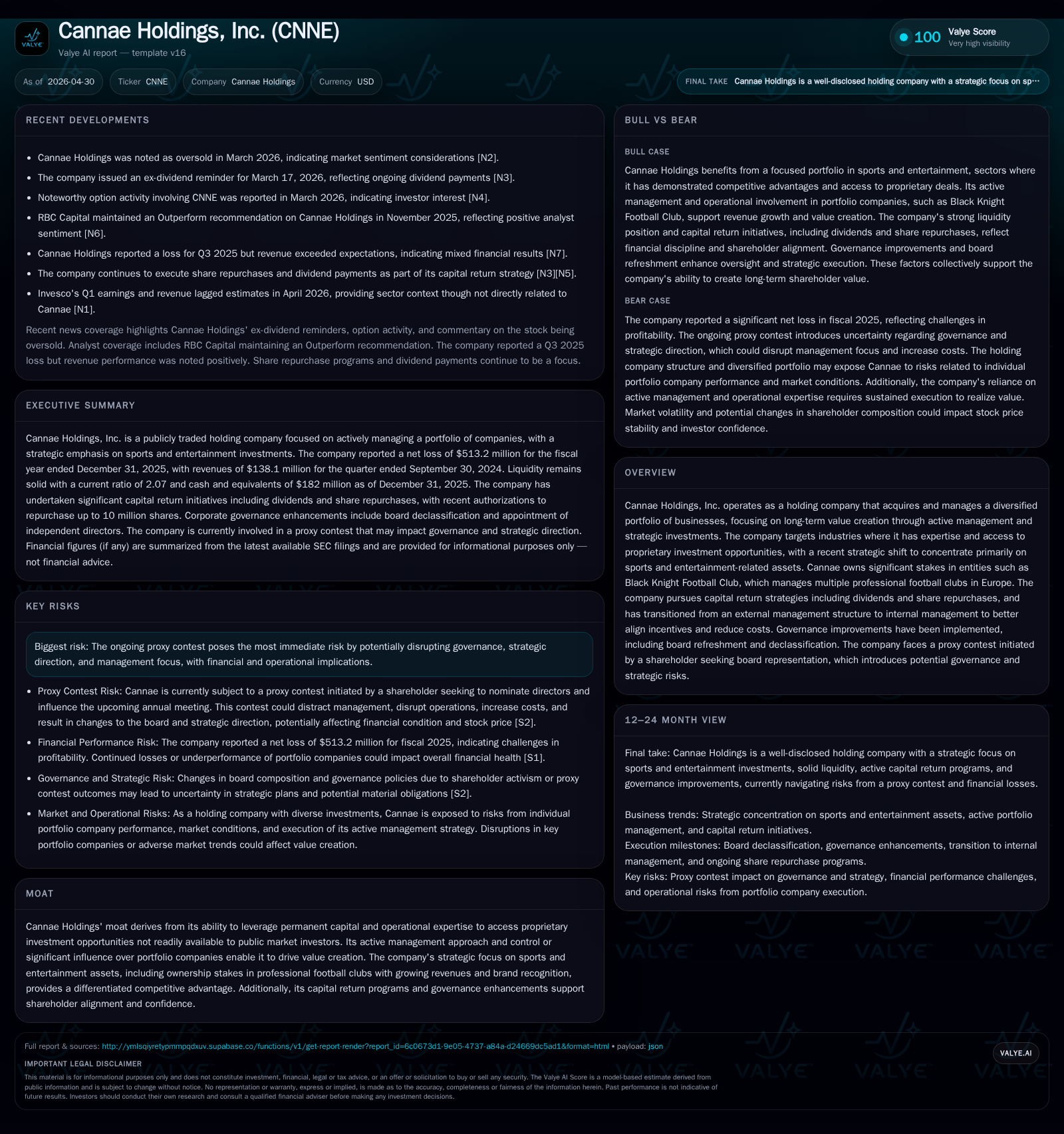
Cannae Holdings has recently accelerated share repurchases and settled margin loan obligations following an active proxy contest that poses governance and strategic risks. The company’s evolved business model highlights a shift towards sports and entertainment investments, with significant stakes in entities like Black Knight Football Club, leveraging operational expertise to enhance long-term value. Governance improvements including board declassification and internalized management aim to align interests while sustaining capital return programs through dividends and buybacks. Key risks center on proxy-related disruption and market perception challenges, with capital adequacy supported by a solid net cash position as of year-end 2025.
Latest Operating Developments Highlight Proxy Contest Impact
Cannae Holdings’ latest quarterly filings present a business navigating notable near-term disruption tied to an ongoing proxy contest initiated by a shareholder aiming to nominate directors and influence the company's strategic direction [S2]. The proxy solicitation has already prompted material financial impacts: legal and advisory fees related to this effort reached approximately $5.9 million during Q3 2025 alone, reflecting a significant administrative burden and potential distraction for management and the Board. Despite these headwinds, Cannae actively pursued share repurchases during this period, buying back roughly 6.2 million shares at an average price near $19.38 per share — underscoring management's confidence in intrinsic value even amid contested control dynamics [S2][S7].
Supplementing balance sheet strength, the company preemptively prepaid all outstanding obligations under its Margin Loan Agreement in March 2026, eradicating $0.4 million of recurring commitment fees without material impact on liquidity—an action that improves financial flexibility amid uncertain governance waters [S3][S29]. Collectively, these moves highlight Cannae’s dual approach of defending operational focus while deploying capital opportunistically during activist pressures.
Business Model Focused on Active Management of Sports-Related Assets
Cannae Holdings operates as a diversified holding company that chooses investments where it can exert control or significant influence coupled with operational involvement—departing from passive holding-company models that rely solely on capital allocation returns [S1]. Over recent years, the company has internalized management functions once outsourced externally, allowing closer alignment of incentives with shareholders, cost reduction, and more agile decision-making processes [S1][S23].
The firm's current portfolio reflects this strategy with a pivot towards sports and entertainment-related assets as cornerstone holdings. Central among them is Black Knight Football Club (BKFC), through which Cannae retains interests in multiple professional European football clubs including Athletic Football Club Bournemouth (AFCB) and FC Lorient (FCL). Notably, BKFC achieved nearly 30% revenue growth for AFCB over three years—ascending from £141 million in FY22/23 to £182 million in FY24/25—and cemented its value proposition with placement among Sportico’s World’s 50 Most Valuable Clubs ($630 million valuation as of the 2023/24 season) [S1][S24].
Monetization strategies are paired with capital return initiatives such as dividends and share repurchases aimed at enhancing shareholder value beyond purely speculative asset appreciation. This integrated business model leverages permanent capital alongside active portfolio optimization—balancing long-duration investment horizons against liquidity considerations.
Industry Landscape and Competitive Positioning in Diversified Holdings
Within the broad set of diversified holding companies, Cannae distinguishes itself through focused expertise in operationally intensive sectors of sports and entertainment investments—which often require nuanced understanding of brand management, regulatory compliance within professional sports leagues, and deal origination capabilities inaccessible to generic public market investors [S1]. Its moat derives largely from access to proprietary investment opportunities afforded by permanent capital structure plus hands-on stewardship of portfolio entities.
Unlike conglomerates with fragmented holdings or passive private equity funds constrained by fund life cycles, Cannae's indefinite holding horizon enables patient value creation. Additionally, its substantial ownership stakes provide governance discretion—critical for driving multi-club operational synergies (e.g., marketing rights consolidation across BKFC-owned teams) and for pursuing organic revenue growth like sponsorship expansions or media rights renegotiations aligned with evolving broadcast landscapes.
Growth Drivers: Capital Return Programs and Strategic Asset Deployment
Capital returns remain a pillar of Cannae’s strategy to create shareholder value alongside portfolio growth initiatives. Since inception of dividend payments in May 2024 at $0.12 per share quarterly—which was boosted by 25% in August 2025—the company has distributed approximately $60 million cumulatively to shareholders through dividends alone [S24]. Complementing this yield is aggressive share repurchase activity: from 2021 through April 2026, over $1.1 billion worth of common stock has been repurchased at accretive prices across multiple authorized programs including a fresh authorization announced March 6, 2026 for up to an additional 10 million shares alongside remaining prior authorizations totaling nearly 12.7 million shares [S24][S5].
Strategically, Cannae is streamlining its portfolio toward higher-return segments consistent with demonstrated competitive advantage. The incremental acquisition within BKFC (44.5% ownership reported) plus newly closed full ownership acquisition of FCL underscore this focus on scaling sport-related holdings synergistically within the multi-club football model [S23][S24]. Alongside these moves is a growing partnership with JANA Partners—now held at a majority stake—which acts both as an investment vehicle and deal sourcing engine poised to drive new opportunities [S23].
Disciplined monetization of non-core assets further fuels capital redeployment toward these strategic bets. This combination supports durable growth morphology rooted less in cyclical M&A waves than in structural repositioning leveraging core expertise.
Key Risks: Proxy Contest Disruption and Market Perception Challenges
The most proximate risk clearly stems from the pending proxy contest described at length in the November 10, 2025 quarterly filing: management acknowledges potential disruption arising from this event including distractions impacting execution; escalated legal/advisory costs (~$5.9 million documented); possible changes to board composition; uncertainty regarding future strategic orientation; heightened stock price volatility; loss of key personnel; adverse stakeholder perception; reputational damage; strained investor relations; and risk of protracted activism episodes leading to further complications [S2][S22].
While management emphasizes constructive engagement intent with shareholders, outcome uncertainty remains high—and any successful activist changes might not coincide fully with existing strategy or operational plans leading to potential misalignment or policy shifts.
Additional risks include reliance on the performance within a relatively narrow sector focus (sports/entertainment) which exposes Cannae to sector-specific regulatory regimes (league governance rules), media rights environment fluctuations, and economic variables affecting discretionary consumer spending on spectator sports.
Upcoming Catalysts and Milestones to Monitor
Several measurable events could serve as pivotal indicators of Cannae’s trajectory:
- Outcome of the annual shareholders meeting(s), particularly regarding board elections under the newly approved plan for three-year phased declassification concluding in 2028 after overwhelmingly supportive votes (~98.9%) show strong governance modernization endorsement [S26][S21].
- Progress in executing accelerated share repurchase programs given remaining buyback authorization size vs actual volume purchased post-April 2026; pace will signal management conviction about valuation levels during residual proxy tension phases [S5][S2].
- Updates on dividend policy adaptations or increases reflecting free cash flow generation trends amid evolving portfolio earnings profiles.
- Realization milestones related to monetization of non-strategic holdings enabling redeployments into core sports/entertainment ventures.
- Any resolution developments surrounding the proxy fight that could influence strategic continuity or unsettle investor confidence.
- Operational integration success of recently acquired entities such as full FCL ownership into BKFC multi-club ecosystem.
Current Financial Position and Liquidity Overview
As of December 31, 2025, Cannae reports a robust liquidity position characterized by cash and cash equivalents totaling approximately $182 million juxtaposed against total debt near $71 million—a net cash surplus approximating $111 million reflecting fiscal prudence amid contested governance scenarios [F1][S3]. This sizable buffer supports ongoing share repurchase capacity along with quarterly dividend commitments (~$28 million annualized).
The current ratio stands healthy above two (2.07), indicating sound short-term solvency backed by current assets relative to liabilities [F1]. Although operating income declined substantially (-$119.6 million) resulting in corresponding net losses (-$513.2 million) last reported for FY2025 primarily due to recognized impairments or investment write-downs associated with portfolio restructuring efforts [F1], these losses should be interpreted contextually given holding company accounting norms emphasizing balance sheet strength over periodic profitability.
Prepayment of the margin loan facility early in Q1 2026 eliminates recurring financing costs thus marginally enhancing future net income trajectories indirectly while signaling conservative risk appetite within capital structure management [S3][S29].
This analysis is based solely on publicly filed information through April 30, 2026, without any speculative forecasts or investment recommendations.
Disclaimer: This is research-only, informational analysis and not investment advice. It may include AI-generated interpretation and general industry context. Always verify important details using primary sources.

Comments