
Schneider National Reinforces Operational Resilience Despite Regulatory Pressures
Q1 2026 results and strategic incentives highlight Schneider’s capacity to adapt amid regulatory and technological challenges in North American trucking.
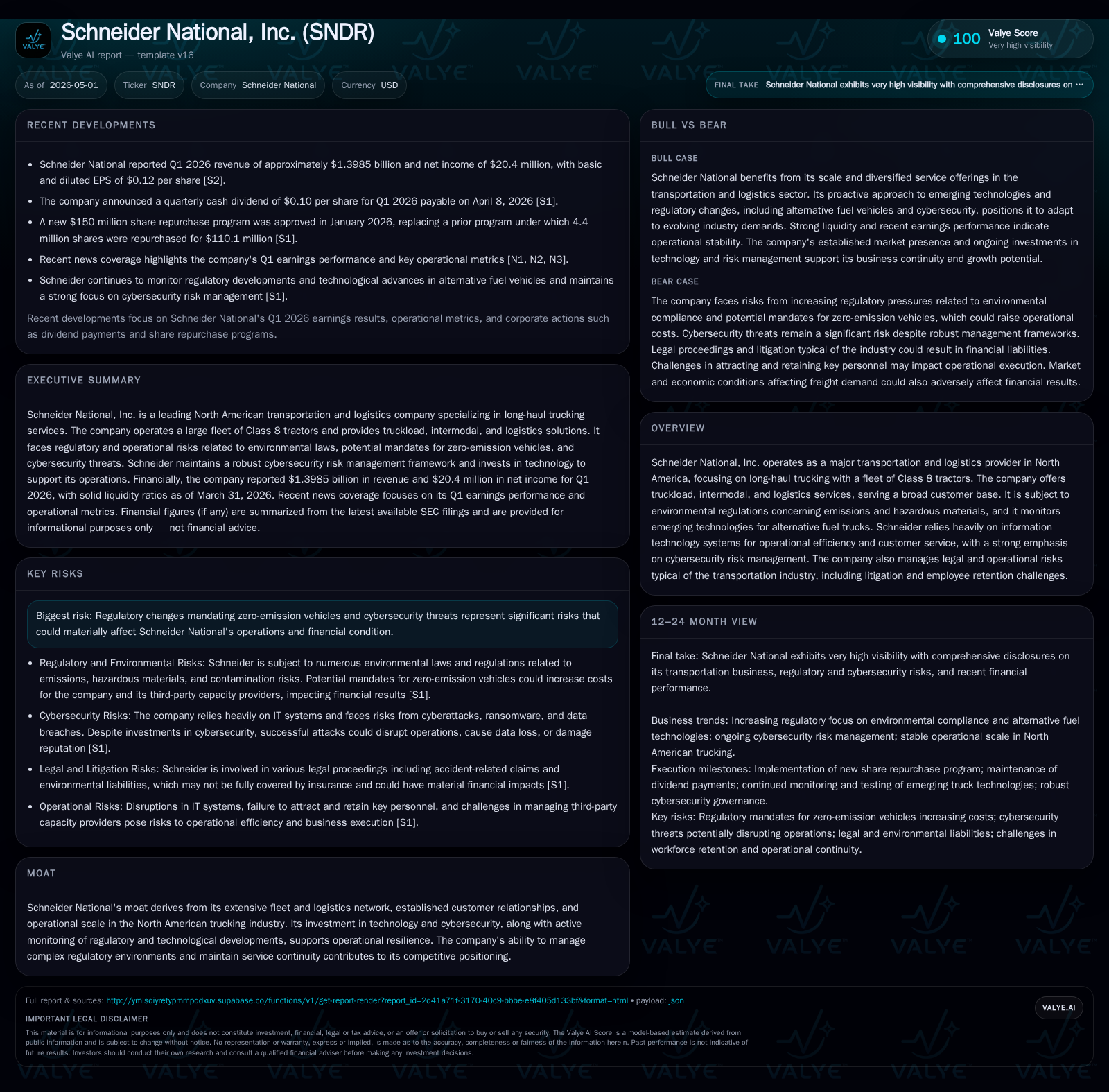
Schneider National’s Q1 2026 disclosures reveal solid operational performance supported by a broad fleet of Class 8 tractors, complemented by ongoing investments in technology and cybersecurity. Recent amendments to its Omnibus Incentive Plan aim to align management incentives with long-term execution priorities. While facing mounting regulatory pressures around emissions and the transition to zero-emission vehicles (ZEVs), the company leverages scale, technology, and logistics integration to maintain competitive positioning. Key risks remain tied to environmental mandates and cyber threats, but financial liquidity and capital structure provide a foundation for navigating these challenges.
Latest Quarterly Operating Update: Key Takeaways from Q1 2026
Schneider National’s first quarter of fiscal 2026, as reported in the May 1, 2026 Form 10-Q [S2], exhibits operational steadiness amid a complex operating environment. The company continues to generate significant revenue from its core long-haul trucking business complemented by intermodal transport and logistics services. Recent event filings [S3] indicate an amendment to its Omnibus Incentive Plan adopted January 27, 2026, pending shareholder approval. This move signals deliberate alignment of executive compensation with evolving strategic priorities, emphasizing operational excellence and long-term shareholder value.
Market commentary following the Q1 earnings release notes that Schneider marginally exceeded consensus revenue metrics amidst cautious macroeconomic freight growth projections [N1][N3]. The transcript from the earnings call reveals management’s focus on cost discipline and incremental gains from technology deployment [N2]. Collectively, these operational updates suggest Schneider is maintaining resilience against rising fuel costs, fluctuating freight demand, and emerging regulatory constraints.
Business Model and Service Portfolio: Truckload, Intermodal, and Logistics
Schneider National operates primarily as a provider of transportation services centered on Class 8 tractor trucking—vehicles characterized by high gross vehicle weight capacity suited for long-haul freight. Its revenue base is diversified across three segments: truckload services carrying full shipments over vast distances; intermodal operations integrating rail with trucking; and value-added logistics solutions including supply chain management [S1]. Customers range broadly across industrial sectors requiring reliable goods movement.
Revenue mechanics revolve around contracted haulage fees complemented by brokerage commissions in certain markets. Pricing power largely depends on freight market tightness but is enhanced by Schneider’s ability to bundle services with technology-driven customer support platforms. Operational efficiency gains stem from investments in AI-enhanced route optimization and telematics systems that improve utilization rates of equipment. Technological competences amplify asset productivity while enhancing service consistency—key competitive differentiators in what remains a commoditized transportation market [S1][N2].
Competitive Positioning and Industry Structure in North American Trucking
Within the fragmented North American trucking industry characterized by numerous small carriers alongside major players, Schneider excels through scale economies backed by an extensive fleet exceeding thousands of Class 8 tractors [S1]. This scale affords bargaining leverage with original equipment manufacturers (OEMs), favorable fuel procurement arrangements, and the ability to absorb regulatory compliance costs more readily than smaller operators.
Environmental regulations targeting emissions impose significant compliance hurdles but also raise barriers to entry due to capital intensity. Schneider’s geographic footprint benefits from established terminals strategically placed near major industrial corridors facilitating seamless intermodal handoffs. The company's active monitoring of regulatory shifts—including California Air Resources Board (CARB) developments—is critical given the uncertain enforcement landscape related to zero-emission vehicle (ZEV) mandates [S1][N4].
Fuel price volatility remains an ongoing margin pressure point offset only partially through fuel surcharges. The scarcity of qualified drivers industry-wide amplifies employee retention challenges, prompting investment in workforce development programs.
Growth Drivers: Technology Adoption, Network Scale, and Market Dynamics
Schneider’s immediate growth levers include expanding AI applications across dispatching to improve asset utilization rates—a key leading indicator for volume-driven revenue uplift [S2]. Management commentary highlights scaling predictive analytics tools for maintenance scheduling reducing downtime [N2]. Intermodal capabilities continue growing as customers seek integrated multimodal solutions enhancing supply chain flexibility.
Sustainable fleet innovation presents both a growth opportunity and challenge. While commercial-scale electric or hydrogen Class 8 tractors remain technologically unfeasible over long distances today due to payload-range tradeoffs and lack of charging infrastructure, Schneider actively pilots such technologies preparing for medium- to longer-term adoption mandated by federal/state initiatives [S1][S24]. This aligns with broader industry movements toward decarbonization but is tempered by economic feasibility constraints.
Demand drivers are currently shaped by macroeconomic patterns in manufacturing output and consumer spending influencing freight volumes. Price mix improvements arise from bespoke logistics contracts offering higher-margin solutions versus pure truckload brokerage transactions.
Risks and Constraints: Regulatory Headwinds, Environmental Mandates, and Cybersecurity Threats
Regulatory uncertainty regarding the timing and extent of ZEV mandates crystallizes as a material risk factor. Compliance entails potential capital expenditure escalation for fleet upgrades or reliance on third-party purchased transportation subject to cost inflation if carriers face higher ZEV compliance costs without corresponding rate pass-throughs [S24]. Moreover, infrastructure deficits—lack of charging/refueling stations nationwide—compound operational feasibility challenges.
Cybersecurity represents another salient operational risk given Schneider’s dependence on sophisticated IT systems underpinning fleet management and customer interfaces. The company’s enterprise risk management framework is overseen closely at senior executive levels with Audit Committee involvement ensuring continuous assessment of cyber threats and control effectiveness [S1]. Escalating digital threats across transport sectors reinforce the need for robust defense postures.
Legal exposure due to accident litigation or cargo claims continues as an industry norm despite insurance coverage—reputational damage is a significant intangible risk.
Upcoming Catalysts and What Investors Should Monitor
Key near-term milestones include the scheduled shareholder vote on amendments to the Omnibus Incentive Plan which could recalibrate executive motivation towards sustained profit improvement [S3]. Additionally, progress updates on electrification pilot programs will signal technical viability advancements or cost trajectory adjustments critical for medium-term capex planning.
Quarterly freight volume trends will remain pivotal benchmarks reflecting underlying demand strength or contraction cues relevant to pricing power realization. Cost inflation management particularly related to fuel prices or labor expenses deserves close scrutiny especially if passed incompletely through rate structures.
Operational metrics such as network utilization rates or intermodal segment growth can offer timely visibility into execution effectiveness regarding technology adoption initiatives [N2]. Monitoring regulatory developments at state/federal levels concerning emissions remains foundational given evolving compliance timelines impacting capex cadence.
Financial Snapshot: Balance Sheet Strength, Liquidity, and Capital Structure
Latest financial snapshot
| Metric | Value | Period |
|---|---|---|
| Cash & equivalents | $228mm | |
| 2026-03-31 | ||
| Total debt | $388mm | |
| 2026-03-31 | ||
| Net debt | $160mm | |
| 2026-03-31 | ||
| Current assets | $1328mm | |
| 2026-03-31 | ||
| Current liabilities | $682mm | |
| 2026-03-31 | ||
| Current ratio | 1.95x | |
| 2026-03-31 |
Source: SEC companyfacts cache [F1].
| Metric | Value (USD) | Period End |
|---|---|---|
| Cash & Equivalents | $227.8 million | |
| 2026-03-31 | ||
| Total Debt | $388.1 million | |
| 2026-03-31 | ||
| Net Debt (Est.) | $160.3 million | |
| 2026-03-31 | ||
| Current Assets | $1.33 billion | |
| 2026-03-31 | ||
| Current Liabilities | $681.8 million | |
| 2026-03-31 | ||
| Current Ratio | 1.95 | |
| 2026-03-31 |
Schneider maintains solid liquidity positioned for capital expenditures required by regulatory-driven fleet modernization as well as opportunistic technology investments [F1]. Moderate net debt levels provide room for financing growth initiatives while avoiding excessive leverage.
Overall, Schneider's financial posture underpins its ability to absorb transitional regulatory costs while sustaining competitive operations aligned with technological evolution demands in North American trucking.
This analysis draws exclusively from disclosed SEC filings dated through May 1, 2026 ([S1], [S2], [S3], [S24]) supplemented with relevant market commentary ([N1], [N2], [N3], [N4]). No forward-looking statements or speculative forecasts have been included beyond those explicitly stated in sourced documents.
Disclaimer: This is research-only, informational analysis and not investment advice. It may include AI-generated interpretation and general industry context. Always verify important details using primary sources.

Comments