
BrightSpring Health Services Streamlines to Boost Growth in Complex Senior Care
Recent first-quarter results affirm BrightSpring's strategic focus on integrated pharmacy and provider services for medically complex seniors.
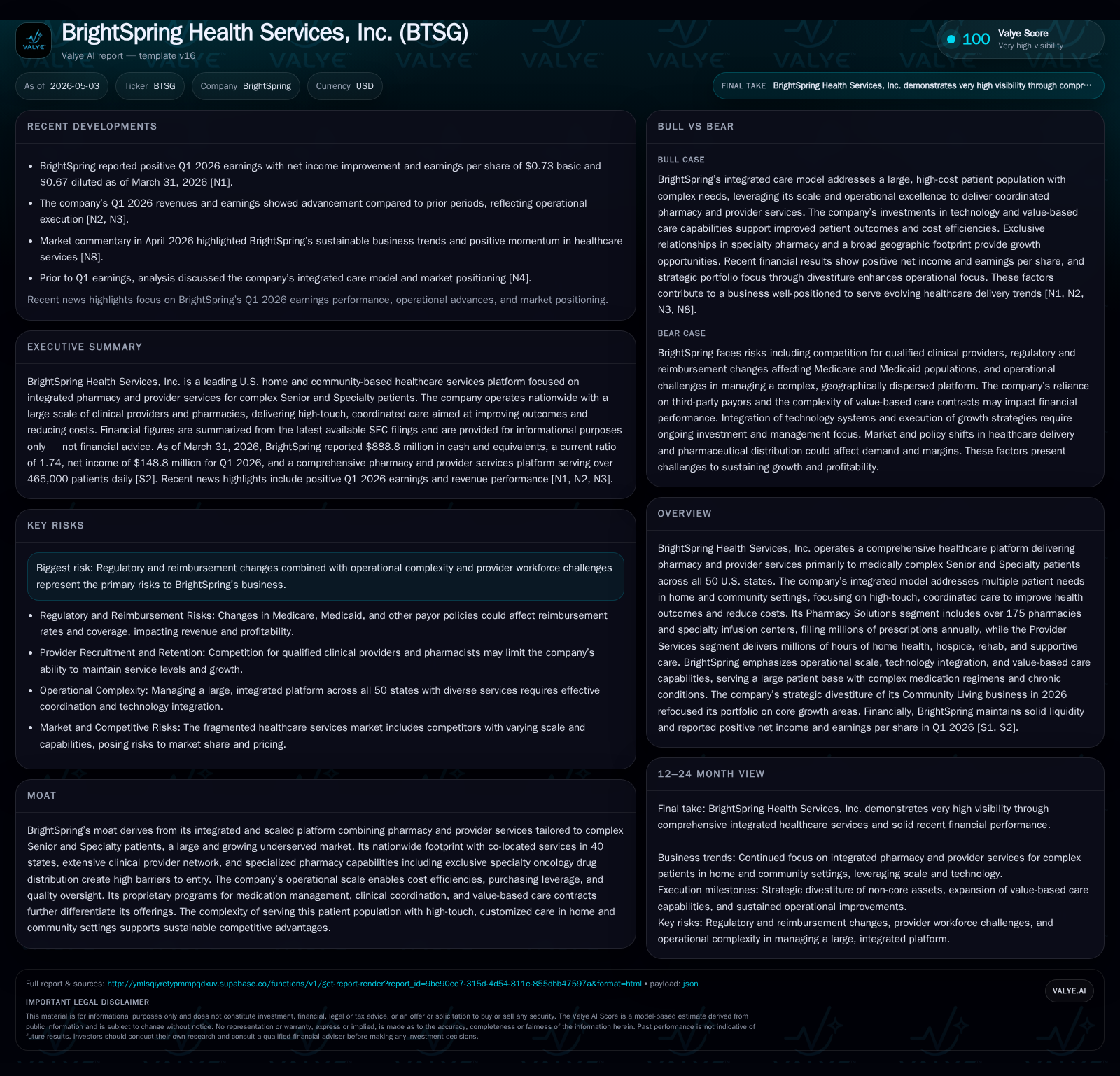
BrightSpring Health Services, Inc. reported its latest quarterly results on May 1, 2026, highlighting progress following the divestiture of its Community Living business, which sharpens its focus on higher-growth home health, hospice, rehab, and primary care markets. The company operates a national, integrated platform delivering coordinated pharmacy and provider services primarily to complex Senior and Specialty patients across all 50 states. Its scale, clinical integration, and technology capabilities create a defensible position in a large, underserved segment projected to drive substantial healthcare spending. Regulatory risks and operational complexity remain key challenges. Growth momentum hinges on leveraging their optimized service mix and expanding value-based care contracts.
Recent Operating Update
BrightSpring Health Services released its Q1 2026 earnings on May 1 [S2][S16], marking a pivotal juncture following the completion of its previously announced divestiture of the Community Living business—a set of services including home and community-based waiver programs—which formally closed earlier this year. This divestiture represents a major strategic refinement by exiting lower-growth or non-core segments to sharpen focus on complementary pharmacy and provider services primarily serving medically complex Senior and Specialty patients in home and community settings.
Management highlighted that the streamlined portfolio is designed to drive greater operational efficiency and clinical integration across the Provider Services segment—encompassing home health care, hospice, rehabilitation therapy, primary care in senior communities—aligning with ongoing shifts towards value-based care reimbursement [S1][S25]. The removal of Community Living operations from continuing operations has improved reported growth rates in Revenue and Adjusted EBITDA by concentrating resources on higher-demand markets.
The company reported serving more than 465,000 patients daily through an extensive network of approximately 10,500 clinicians and pharmacists nationwide [S1]. Early commentary suggests positive momentum in patient volume alongside stabilizing payor contracts amid industry-wide reimbursement volatility [N1][N2]. These operational cues reinforce confidence that the firm’s integrated model is gaining traction within the large population of chronic-condition seniors requiring multifaceted care coordination.
Business Model Overview
BrightSpring’s business centers on delivering comprehensive healthcare services to medically complex populations primarily defined as Senior (largely Medicare/Medicaid insured) and Specialty (patients with severe or rare diseases including behavioral health) populations. The company earns revenue through two principally reportable segments:
- Pharmacy Solutions: Operating over 175 pharmacies and specialty infusion centers distributed nationwide. This segment manages millions of prescriptions annually catering to diverse treatment needs—from home infusion therapies for chronic diseases to exclusive specialty oncologic drug distribution. Revenue drivers here include prescription volume, reimbursement rates under various insurance plans (including government payors), medication mix (specialty drugs command higher margins), and patient adherence programs [S1].
- Provider Services: Delivering clinical home health care (medical nursing visits), hospice care (end-of-life support), rehabilitation therapy (physical, occupational), supportive care (assistive daily living support), and home-based primary care particularly focused in senior living communities. It operates mainly under fee-for-service and increasingly value-based payment models emphasizing patient outcome optimization while controlling costs through coordination [S1].
Key elements distinguishing BrightSpring’s model are its integrated approach that bridges pharmacy dispensing with live clinical/provider interactions complemented by robust technology platforms enabling medication management alerts, clinical coordination workflows, utilization review processes, and comprehensive patient analytics. This interconnected delivery is crucial because their target patient cohort typically juggles multiple chronic conditions requiring precise medication regimens alongside frequent clinical assessments.
The ability to provide both pharmaceutical supplies (especially costly specialty meds) alongside qualified clinical visits positions BrightSpring as a valuable partner for insurers aiming to reduce hospital readmission rates through proactive outpatient management.
Industry Structure & Competitive Position
BrightSpring occupies a critical niche within the fragmented U.S. healthcare ecosystem: home- and community-based services targeting high-cost/high-need seniors with multiple comorbidities. This market is valued at over $2 trillion according to RAND Health Care estimates cited by management [S1]. The company competes against a mix of regional providers specializing either in pharmacy or clinical service lines but few combine both at scale nationally with integrated data-driven clinical support.
Competitive advantages include:
- National footprint: Presence in all 50 states with co-located pharmacy plus provider assets in about 40 states enables seamless cross-referrals and better patient retention.
- Specialty pharmacy expertise: Exclusive access arrangements for certain oncology drugs along with expertise in infusion therapies provide differentiated service offerings commanding premium reimbursement.
- Operational scale & purchasing leverage: Large volumes enhance cost efficiencies ranging from drug procurement discounts to shared administrative infrastructure.
- Clinical program innovation: Proprietary protocols for medication adherence monitoring coupled with certified staff training processes enhance quality oversight compared to smaller competitors.
However, barriers are not insurmountable; larger integrated health systems expanding into value-based community care or tech-enabled startups innovating telehealth could pose competitive threats if they successfully replicate coordinated pharmacy-provider linkages at scale.
Growth Drivers
Several structural tailwinds underpin BrightSpring’s growth prospects:
- Aging population surge: The U.S. demographic wave sees increasing numbers of seniors living longer with complex chronic conditions necessitating frequent medication management plus skilled home care.
- Rising prevalence of multi-morbidity: Approximately 12% of Americans have five or more chronic illnesses accounting for significant healthcare expenditures; these patients disproportionately need comprehensive coordinated services that BrightSpring specializes in addressing [S1].
- Shift to lower-cost home/community setting: Payors incentivize moving care away from hospitals toward cost-effective ambulatory environments through reimbursement reforms favoring home health/hospice services.
- Expansion of value-based contracts: Growing adoption by Medicare Advantage plans and Managed Care Organizations includes risk-sharing deals where providers like BrightSpring benefit financially by improving outcomes while lowering total cost of care.
- Technology-enabled integration: Investment in digital platforms enhances real-time medication reconciliation and case management improvements raising both quality metrics and cost control.
BrightSpring also benefits from partnerships/referral networks spanning senior living facilities, rehabilitation centers, MCOs (Managed Care Organizations), discharge planners—critical conduits feeding steady patient inflows [S1].
Risks & Watchpoints
Despite favorable trends several risk factors warrant scrutiny:
- Regulatory uncertainties: Changes to Medicare Parts A,B,C,D or Medicaid payment models could reduce reimbursement rates or impose new compliance burdens; regulatory audits remain common sources of potential recoupments or fines [S4][S5][S10][S29].
- Anti-Kickback & Stark Law exposure: The company's relationships with physicians subject it to complex fraud-and-abuse statutes leading to investigations if alleged inducements or improper referrals are detected [S4][S6][S10][S21][S27].
- Operational complexity & workforce shortages: Delivering coordinated multi-service community healthcare demands reliable clinician availability; recruitment/retention challenges threaten service continuity especially amid tight labor markets [S6].
- Data privacy risks: HIPAA compliance combined with rising cybersecurity expectations require constant vigilance; breaches could result in penalties and reputational harm [S7][S29].
- Reimbursement audit risk: Government payors periodically review claims increasing risk of payment clawbacks especially under false claims allegations linked to coding errors or billing practices [S21][S29].
Monitoring how well BrightSpring manages regulatory compliance rigor while scaling operations efficiently is essential for sustaining margins.
What To Watch Next
Future updates should specifically track:
- Clinical outcome benchmarks supported by newly implemented integration programs impacting contract renewals.
- Patient volume trends across key Provider Services lines post-divestiture showing uptake gains or losses.
- Progress expanding value-based arrangements—a leading indicator of sustainable top-line growth.
- Regulatory developments influencing Medicare/Medicaid payments or legal exposure related to fraud-and-abuse statutes.
- Quarterly liquidity movements providing insights into free cash flow generation amid investment cycles.
Additionally, management guidance revisions tied explicitly to revenue growth rates or Adjusted EBITDA margin improvements will be crucial checkpoints for validating strategic execution digestion post-transformation phase [N1][N2].
Financial Profile Snapshot
Latest financial snapshot
As of Q1 ended March 31, 2026 ([F1]):
Liquidity metrics suggest adequate short-term financial flexibility; however elevated gross debt underscores dependence on strong cash flow generation amid ongoing transformation efforts. Operating income latest available at $295 million for previous full year indicates profitable core operations but closely watched going forward given sector margin pressures [F1][S2].
This analysis incorporates publicly available SEC filings including the quarterly Form 10-Q dated May 1, 2026 ([S2]), recent Form 8-K filings ([S3], [S16]), the annual Form 10-K dated February 27, 2026 ([S1]), as well as supplemental news transcripts ([N1], [N2]) without making investment recommendations or forecasts. It aims to present a grounded assessment of BrightSpring Health Services’ strategic positioning within the evolving U.S. home healthcare landscape.
Disclaimer: This is research-only, informational analysis and not investment advice. It may include AI-generated interpretation and general industry context. Always verify important details using primary sources.

Comments