
WSFS Financial Boosts Earnings and Liquidity Amid Regional Banking Competition
Q1 2026 results and strategic refinancing underline WSFS's solid financial footing and reinforce growth momentum in a competitive regional banking landscape.
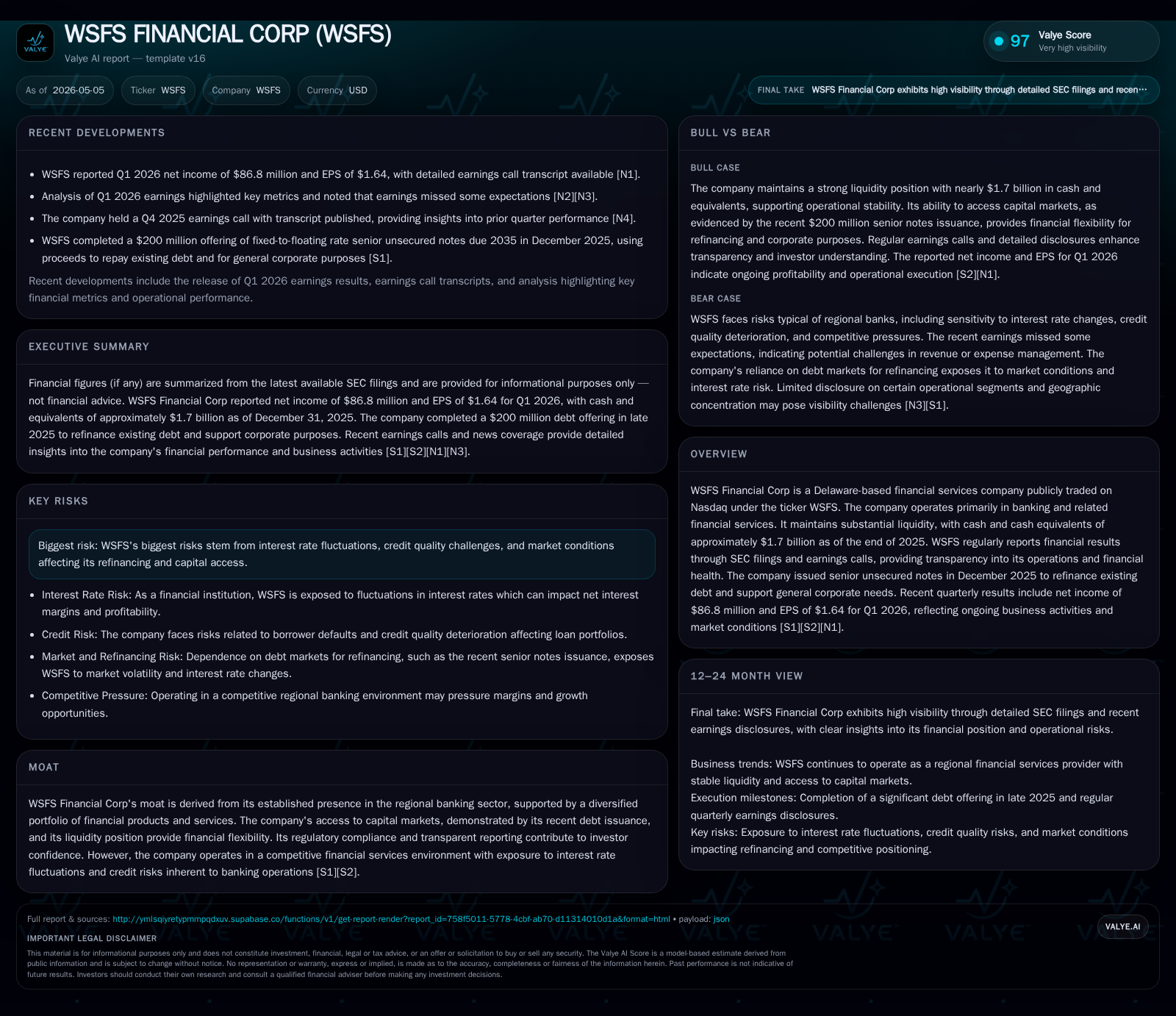
WSFS Financial Corp reported net income of $86.8 million and EPS of $1.64 in Q1 2026, driven by diversified banking services and effective asset-liability management. The December 2025 issuance of $200 million in senior unsecured notes for refinancing has strengthened liquidity and capital flexibility. Operating primarily across Delaware, Pennsylvania, New Jersey, Florida, Nevada, and Virginia, WSFS leverages its Cash Connect® operations and wealth management to sustain stable revenue streams. Competitive pressures in its regional footprint shape cautious optimism on growth amid interest rate volatility and credit risk challenges.
Latest Quarterly Operating Update: Key Changes in Q1 2026
WSFS Financial Corp’s latest quarterly filing dated May 4, 2026, reveals solid financial performance with net income of $86.8 million and earnings per share (EPS) of $1.64 for the quarter ended March 31, 2026 [S2][N1]. This marks a continuation of profitability supported by diversified revenue streams despite ongoing market uncertainties. A pivotal capital event was the issuance of $200 million in senior unsecured notes in December 2025 with a fixed coupon of 5.375% transitioning to floating after five years [S25]. Proceeds from this issuance were deployed chiefly to repay $150 million of older debt maturing in 2030, enhancing WSFS's debt maturity profile and maintaining liquidity flexibility [S25].
The company retained approximately $1.7 billion in cash and cash equivalents as of year-end 2025 [F1], a substantial liquidity buffer supporting operational needs and investment capacity. This robust liquidity position mitigates immediate refinancing risk concerns despite the broader interest rate cycle's impact on banking margins.
Business Model Overview: Banking Services and Revenue Drivers
WSFS generates revenue through multiple synergistic channels including retail banking deposits and loans, commercial lending services, Cash Connect® - its cash logistics platform servicing retail environments - and wealth management/trust offerings [S1]. Its branch network comprises 87 banking offices concentrated mainly in Delaware, southeastern Pennsylvania, and southern New Jersey – key markets with entrenched customer bases [S1]. Complementary loan production offices expand operational reach into Florida, Nevada, and Virginia where full branches may not be justified yet demand for mortgage or commercial loans sustains presence [S1].
The Cash Connect® operation differentiates WSFS from many peers by offering recurring fee income from servicing cash infrastructure for retailers nationally – diversifying away from pure interest income dependence. Wealth and trust services provide additional fee-based revenue with less sensitivity to economic cycles. Asset quality management is highlighted through disclosures demonstrating conservative credit risk policies balancing growth with prudent underwriting [S1].
Cross-selling among segments drives increases in wallet share per customer, supporting stable pricing power despite competitive pressures common in regional banking.
Competitive Positioning within Regional Banking Sector
WSFS operates in a moderately concentrated regional bank market where local brand recognition affords some protection against large national banks but intensifies competition among comparable regional peers [S1][S2]. The company’s footprint includes dense urban/suburban corridors where customers value relationship-based offerings combined with digital convenience.
Pricing power is challenged by institutional competitors employing advanced digital platforms; however, WSFS benefits from switching costs linked to physical branch accessibility and personalized service models [S2]. Regulatory compliance emphasizes maintaining Common Equity Tier 1 (CET1) capital ratios near targeted thresholds (~12%) to preserve "well-capitalized" status facilitating higher lending capacity without triggering restrictions [S1].
These regulatory mandates influence WSFS’s lending strategies, requiring capital-efficient product mixes that sustain profitability while adhering to supervisory expectations.
Growth Drivers: Expansion, Capital Strength, and Service Diversification
Growth is supported by WSFS’s multi-state presence leveraged through loan production offices expanding geographic reach beyond the core branch regions [S1][S3]. Digital initiatives supplement physical expansions but available real estate capacity remains limited given the leased nature of many locations alongside owned assets [S1]. Thus physical branch proliferation is constrained which shifts focus toward optimizing existing footprints.
The recent refinancing via senior unsecured notes issued at attractive terms extends the company's runway for selective inorganic investments or technology upgrades without pressuring leverage [S25][N1]. Additionally, growing fee income from Cash Connect® mitigates cyclicality inherent in traditional net interest margin revenues.
Service diversification across wealth management offers non-interest revenue resilience helping smooth earnings across economic cycles as affluent clients maintain asset allocations even amid market volatility.
Risks and Constraints: Interest Rate Sensitivity and Credit Quality
WSFS highlights interest rate volatility as the principal risk affecting its net interest margin (NIM), especially given its mix of variable versus fixed-rate loans on the books [S2][S21]. Rising rates can compress margins if deposit repricing lags or funding costs outpace asset yield adjustments. Conversely, declining rates threaten income stability.
Credit risk remains prominent given exposures across commercial real estate loans typical for regional lenders as well as consumer loan portfolios susceptible to economic downturn effects [S2][S21]. Although asset quality metrics remain sound currently, economic shocks could trigger delinquencies increasing provisions expense.
Refinancing risks are deemed low due to strong liquidity but remain under watch particularly if capital markets volatility restricts future debt issuance conditions or increases borrowing costs unexpectedly.
Upcoming Milestones and Market Signals to Watch
Forward-looking focus will center on WSFS’s next quarterly earnings releases which will clarify loan growth dynamics particularly within high-demand commercial segments [N7][N8][S2]. Monitoring guidance updates around net interest margin projections amid evolving Fed policy will provide insight into margin trajectory.
Regulatory developments pertaining to capital adequacy or consumer lending regulations could influence strategic planning. Given limited branch expansion availability noted internally [S1], innovations around digital client acquisition will be indicators of WSFS’s ability to compensate for any physical footprint constraints.
Leadership’s adoption of a Rule 10b5-1 stock trading plan signals confidence while providing transparent insider activity cues ahead of potential trading periods [S26].
Brief Financial Profile: Earnings, Liquidity, and Capital Strategy
WSFS closed 2025 with cash & equivalents near $1.7 billion underpinning its liquidity robustness crucial for both operational agility and strategic optionality [F1]. Net income totaled $287 million for full year 2025 confirming sustainable profitability trends underpinning recent quarterly strength [F1][S2].
Capital strategy targets maintain CET1 ratios around the 12% benchmark ensuring compliance with regulatory safety nets coupled with disciplined share repurchase programs balancing dividends and buybacks without sacrificing solvency metrics [S1].
Disclaimer: This is research-only, informational analysis and not investment advice. It may include AI-generated interpretation and general industry context. Always verify important details using primary sources.

Comments