
GAIA, Inc. Confronts Margin Pressure Amid Liquidity Challenges in 2026
Latest quarterly results expose sustained net losses and a strained liquidity profile challenging GAIA’s near-term operational stability.
GAIA’s Q1 2026 10-Q reveals continued operating losses alongside liquidity constraints highlighted by a suboptimal current ratio and considerable current liabilities exceeding current assets. The company’s business model, centered on subscription-driven digital content and wellness offerings, faces pressure amid evolving customer demand and competitive content platforms. While GAIA maintains a revolving credit facility supporting working capital needs, structural challenges in margin management and cash flow conversion compound near-term risk. Monitoring execution on growth initiatives and potential refinancing activity will be critical to assessing operational recovery momentum.
Key Takeaways from the Latest Quarterly Filing
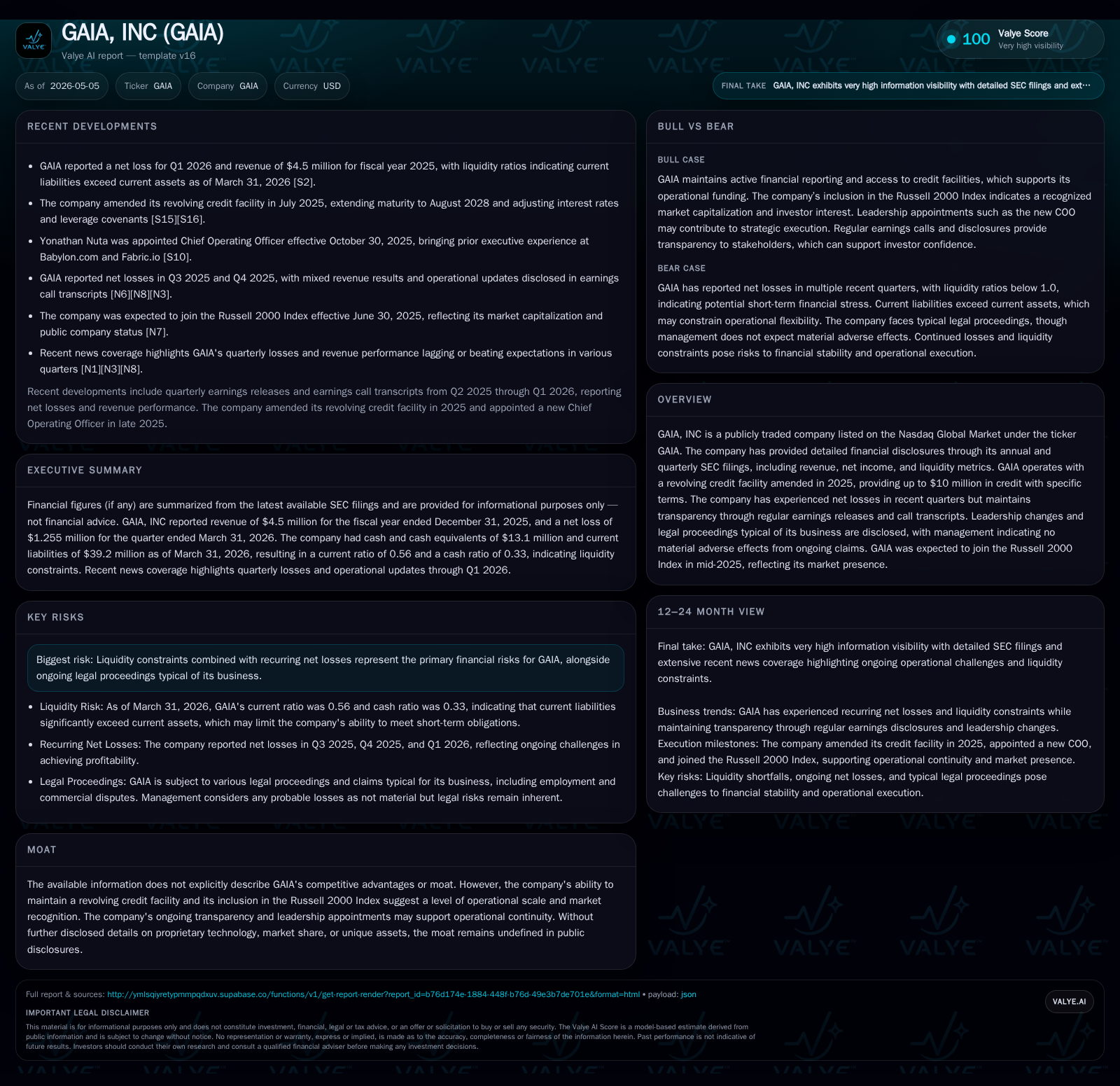
GAIA, Inc.'s first quarter 2026 earnings report filed on May 4, 2026 ([S2]) presents a continuation of notable financial headwinds for the company. Despite maintaining $13.1 million in cash and equivalents as of quarter-end ([F1]), GAIA reported ongoing net losses consistent with its recent historical pattern ([N1]). Its current liabilities stand at approximately $39.2 million versus current assets of $22.0 million ([F1]), resulting in a current ratio well below healthy thresholds at roughly 0.56—indicating potential short-term liquidity stress.
This imbalance is compounded by total outstanding debt of about $5.6 million ([F1]). Recent disclosures ([S3]) affirm ongoing transparency about operational losses but contain limited commentary on immediate plans to rebalance the balance sheet or adjust cost structures.
The quarterly press release also flagged revenue shortfalls relative to analyst expectations ([N1]), reinforcing cautious investor sentiment about near-term top-line momentum. Collectively, these figures frame a company grappling with operating margin pressure during constrained liquidity buffers.
GAIA’s Business Model: Revenue Streams and Customer Value
As detailed in the March 2026 annual filing ([S1]), GAIA operates primarily as a digital subscription service offering curated wellness-focused video content across lifestyle, mind-body balance, and personal growth genres. Revenue generation centers on direct-to-consumer monthly or annual subscription fees complemented by selective partnerships leveraging content licensing.
The company's value proposition hinges on differentiating itself through an extensive library tailored toward niche wellness audiences rather than mass-market entertainment consumers. This thematic focus fosters moderate switching costs based on curated content exclusivity and niche engagement.
However, margins remain under pressure given significant ongoing investments required for continuous content development and platform maintenance. Subscriber acquisition costs, driven by digital marketing spend, also weigh heavily on operating profitability. The company's recurring net loss trajectory suggests these expense items presently outpace revenue inflows, reflecting challenges in scaling subscriber base profitably.
Industry Competition and GAIA’s Market Position
While not explicitly characterized as possessing a durable competitive moat (), GAIA’s ongoing ability to sustain a revolving credit line alongside inclusion in the Russell 2000 Index demonstrates operational scale beyond pure startup phase. However, this scale does not inherently translate into market dominance within its sector.
The digital wellness and streaming content landscape is intensely fragmented, with large incumbent platforms such as Netflix, Apple TV+, and niche competitors investing heavily in wellness-related programming or user engagement tools. This ecosystem dynamic limits pricing power due to ample substitution options for consumers willing to shift spend across platforms.
Further complicating the competitive environment are technological shifts that raise consumer expectations regarding interface quality, personalized recommendations, and mobile accessibility—all requiring sustained capital deployment from GAIA to remain relevant.
Regulatory constraints appear minimal at present but indirect exposure exists through intellectual property rights management for streaming content distribution.
Growth Drivers: Opportunities and Execution Challenges
GAIA has targeted growth through expanding its subscriber base via strategic marketing campaigns alongside launching innovative content verticals aligned with emerging wellness trends ([S2], [S3], [S1]). Recent leadership additions—particularly the appointment of Yonathan Nuta as COO—highlight emphasis on product innovation and operational efficiency improvements ([S16]).
Potential upstream catalysts include leveraging partnerships for branded content licensing deals and geographic expansion to less penetrated markets with growing demand for wellness streaming.
Nevertheless, execution hurdles are considerable. The continued pattern of quarterly operating losses underscores difficulty converting growth initiatives into scalable margin enhancement within the context of heightened competition and evolving consumer behaviors. Additionally, limited balance sheet flexibility restricts aggressive investment pacing.
KPIs worthy of attention for gauging progress include subscriber growth rates relative to churn levels, average revenue per user metrics reflecting pricing power sustainability, backlog or pipeline indicators for new content launches, and any disclosed updates on customer retention programs.
Risks and Constraints Highlighted by Recent Results
Liquidity is arguably the most pressing risk area facing GAIA currently—current assets cover only slightly more than half of current liabilities with no indication yet that this gap is closing ([F1], [S2]). Operationally, repeated net losses threaten cash flow sufficiency absent material margin improvements or cost restructuring efforts over the near term ([N1]). While legal proceedings exist as part of normal business operations ([S11]), management maintains these do not presently pose material financial threats; however, such contingencies should be monitored as part of overall risk assessment.
A further constraint arises from competitive pressures compressing pricing options and elevating customer acquisition costs—both factors diminish scalability prospects without clear differentiation gains.
Leadership transitions add moderate uncertainty around strategic continuity but recent appointments appear aimed at stabilizing execution capability ([S16]).
Monitoring Points: What Investors Should Watch Next
Looking ahead, upcoming quarterly earnings releases will provide critical visibility into whether GAIA can arrest net loss momentum through improved subscriber economics or cost controls ([S2], [S3]).
Specific operational markers include:
- Changes in subscriber counts along with churn rates signaling demand trajectory.
- Announcements relating to price adjustments or bundling strategies improving ARPU.
- Updates on refinancing efforts related to the revolving credit facility or alternative capital raises addressing liquidity constraints.
- Progress reports on content pipeline robustness or geographical expansion plans.
- Early signs from enhanced product initiatives driven by newly appointed executive leadership enhancements.
Collectively these checkpoints offer insight into potential inflection points that could alleviate structural strains highlighted in Q1 results.
Latest Financial Snapshot
Latest financial snapshot
| Metric | Value | Period |
|---|---|---|
| Cash & equivalents | $13mm | |
| 2026-03-31 | ||
| Total debt | $6mm | |
| 2026-03-31 | ||
| Net debt | $-7mm | |
| 2026-03-31 | ||
| Current assets | $22mm | |
| 2026-03-31 | ||
| Current liabilities | $39mm | |
| 2026-03-31 | ||
| Current ratio | 0.56x | |
| 2026-03-31 |
Source: SEC companyfacts cache [F1].
| Metric | Amount (USD) | Period End |
|---|---|---|
| Cash & Equivalents | 13,098,000 | |
| 2026-03-31 | ||
| Total Debt | 5,622,000 | |
| 2026-03-31 | ||
| Current Assets | 22,036,000 | |
| 2026-03-31 | ||
| Current Liabilities | 39,198,000 | |
| 2026-03-31 | ||
| Current Ratio | 0.56 | |
| 2026-03-31 | ||
| Revenue | ~4,500,000 (annual) | |
| 2025-12-31 | ||
| Net Income | -4,494,000 (annual) | |
| 2025-12-31 |
This snapshot substantiates narrative themes around constrained liquidity given markedly negative working capital dynamics despite modest debt levels relative to cash holdings. The latest figures reinforce focus areas around improving cash generation while strategically managing liabilities given recurring losses.
Disclaimer: This analysis is based solely on published SEC filings and public news reports as referenced. It is intended for informational purposes without providing investment advice.
Disclaimer: This is research-only, informational analysis and not investment advice. It may include AI-generated interpretation and general industry context. Always verify important details using primary sources.

Comments