
Vitesse Energy Strengthens Williston Basin Position Despite Quarterly Net Loss
Q1 2026 results show operational steadiness amid commodity headwinds and a leadership transition.
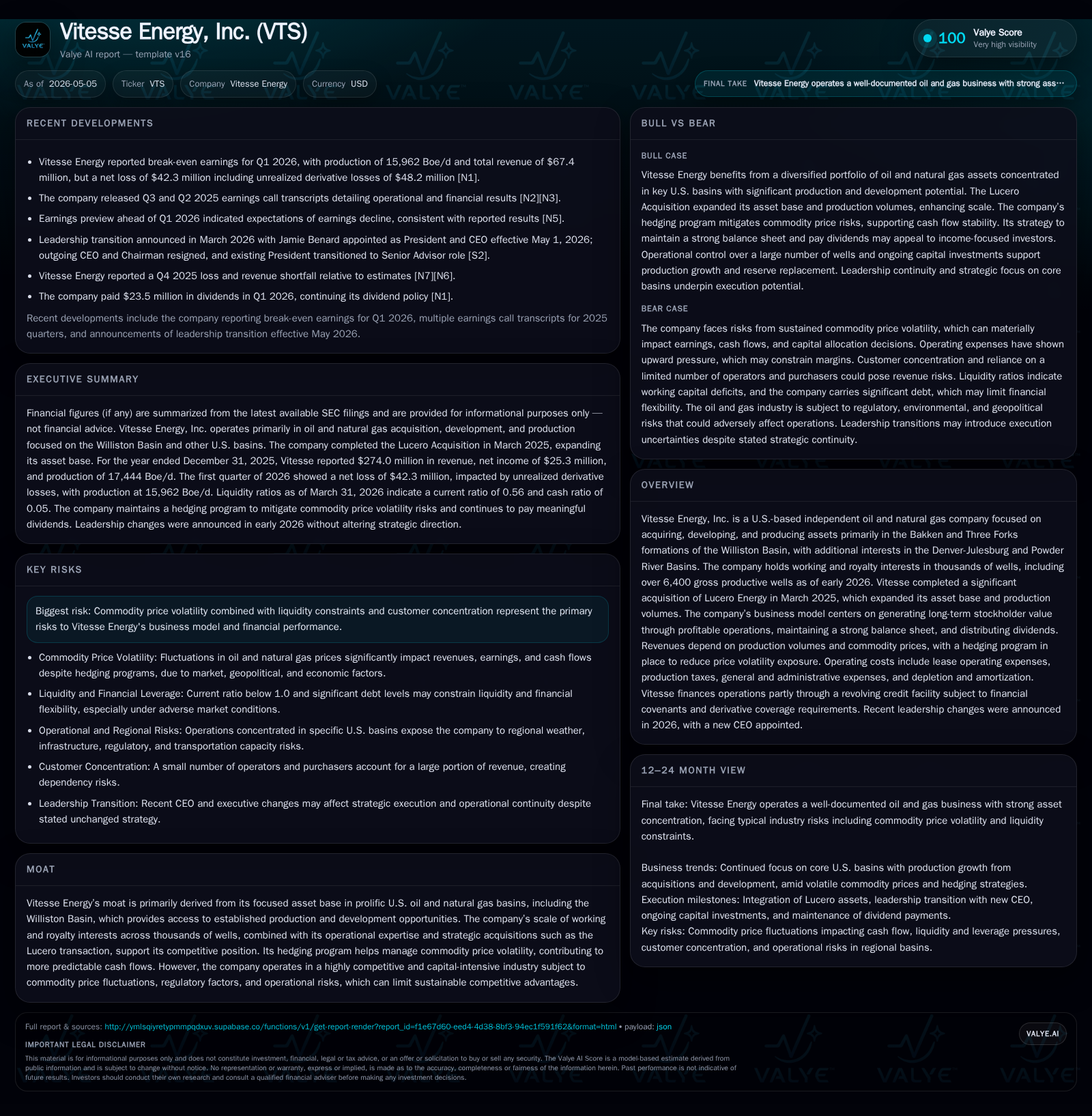
Vitesse Energy reported a Q1 2026 net loss of $42.3 million, primarily driven by a $48.2 million unrealized loss on commodity derivatives despite positive operational cash flow of $24.0 million. Production held relatively steady at about 15,962 Boe/d with a continued focus on the Bakken and Three Forks formations following the transformative Lucero acquisition in early 2025. Leadership changes affirm strategy continuity as the company navigates commodity price volatility, liquidity pressures, and capital allocation dynamics to drive growth in prolific U.S. onshore basins.
Q1 2026 Operating Update and Strategic Leadership Transition
Vitesse Energy's first quarter of 2026 was marked by a notable net loss of $42.3 million, substantially influenced by an unrealized loss of $48.2 million related to commodity derivative instruments used for hedging exposure [S2]. Despite this headline earnings pressure, operating cash flows were a positive $24.0 million, reflecting underlying production cash generation during the period [S2]. Total revenue for the quarter stood at $67.4 million.
Production averaged 15,962 barrels of oil equivalent per day (Boe/d), with approximately 63% weighted to oil — consistent with prior periods and underscoring stable operational output from key assets primarily in North Dakota and Montana's Bakken and Three Forks formations [S2]. Capital expenditure outlays amounted to $18.7 million (net of divestitures), indicating ongoing investment in development activities and expansion capacity [S2].
During the quarter, Vitesse announced a leadership transition effective May 1, 2026: Jamie Benard assumed the roles of President and Chief Executive Officer while former CEO Robert Gerrity resigned [S3]. Brian Cree, previously Interim CEO, will remain as Senior Advisor through year-end before retiring. The company emphasized that this transition does not alter its overarching business strategy focused on shareholder value creation through disciplined asset management [S3].
Business Model: Asset Focus and Revenue Drivers
Vitesse's revenue model hinges fundamentally on production from its portfolio of working and royalty interests across prolific U.S. basins, predominately the Bakken/Three Forks in the Williston Basin but also including positions in Denver-Julesburg and Powder River Basins [S1],[S2]. The pivotal March 2025 acquisition of Lucero Energy notably expanded Vitesse's footprint, increasing gross productive wells to over 6,400 as of early 2026 and enhancing proved reserves to roughly 47.8 million barrels of oil equivalent (MMBoe) with an estimated PV-10 valuation of $473 million as of year-end 2025 [S1].
Revenues fluctuate directly with production volumes and prevailing commodity prices; Vitesse partially mitigates price risk through a structured hedging program covering a substantial portion of anticipated production, although residual market exposure remains significant as manifest in recent derivative losses [S1],[S2]. Lease operating expenses (LOE), production taxes, transportation costs, and general and administrative overhead comprise primary operating costs impacting margins.
The company's business model integrates disciplined capital allocation between acquisitions—like Lucero—and internal development activity targeting long-term shareholder returns complemented by quarterly dividends (~$23.5 million paid in Q1) [S2]. This model underscores balancing growth with financial prudence given sector cyclicality.
Product Quality, Development Activity, and Operating Efficiency
Vitesse manages interests in thousands of wells producing predominantly high-quality light sweet crude typical of Bakken/Three Forks formations, which command favorable market differentials relative to heavier grades [S1]. The count of gross productive wells increased slightly post-Lucero acquisition to more than 6,400 with additional wells permitted or under completion totaling several hundred [S2].
Investment levels in drilling and completion ($18.7 million in Q1) align with maintaining production base while seeking incremental reserve additions and sustaining well productivity metrics key to controlling unit costs [S2]. Operating efficiencies are influenced by service cost inflation pressures common across the North American E&P sector along with logistical considerations unique to the expansive Williston Basin geography.
Competitive Position within U.S. Onshore Basins
Vitesse’s concentrated asset base situates it competitively among mid-tier independent producers specializing in U.S. tight oil plays. The Williston Basin offers proven resource richness coupled with established infrastructure — factors underpinning Vitesse's moat via scale across thousands of wells alongside diversified basin exposure via Denver-Julesburg and Powder River holdings [S1],[S2].
Competitors ranging from larger integrated firms to smaller operators vie for acreage position or partnership opportunities.
Commodity Price Volatility and Hedging Impact
Volatility remains an overarching theme shaping Vitesse’s financial performance. The recent unrealized mark-to-market loss of $48.2 million on derivative contracts illustrates material earnings swings driven by global macroeconomic events—such as Middle East tensions affecting supply risk—and shifts in OPEC+ production dynamics impacting pricing curves [S2],[S1].
While Vitesse maintains a sizable hedged book covering future production volumes, these instruments introduce accounting volatility reflecting changing forward curve valuations rather than realized economic cash flows. This necessitates careful investor interpretation when reconciling non-cash earnings impacts versus operational cash generation.
Growth Catalysts and Expansion Opportunities
Growth avenues include continued capital deployment into drilling programs targeting infill locations within existing fields where incremental reserves sustain output or enhance recovery rates [S2]. Near-term permit activity and well completion backlog data suggest a pipeline supporting steady development momentum.
Additional acquisition opportunities analogous to the Lucero transaction remain potential catalysts but depend on favorable valuation environments aligning with disciplined return thresholds [S1],[S2]. Optimization initiatives around production enhancement techniques may also yield cost efficiencies aiding margin resilience.
Risks and Constraints Including Liquidity and Market Dynamics
Key risks extend beyond commodity swings to include liquidity constraints highlighted by a current ratio near 0.56 (current assets at about $48.7 million vs current liabilities nearing $87.0 million as of March quarter-end), underscoring tight working capital conditions [F1].[S2] This could pressure short-term flexibility especially if commodity prices weaken further or capital markets tighten.
Customer concentration risk exists due to reliance on limited midstream or sales partners intrinsic to regional corridors. Environmental regulatory developments could impose incremental compliance costs or slow permitting cycles affecting development timelines.
Additionally, the capital-intensive E&P environment requires careful balancing between exploration/development spending against free cash flow generation; deviations can restrict dividend sustainability or necessitate additional external financing efforts.
Upcoming Milestones and Metrics to Monitor
Market participants should track subsequent quarterly guidance updates focusing on:
- Production volume trends relative to guidance reflecting drilling execution efficacy;
- Changes in hedging coverage ratios or derivative valuations signaling shifts in risk management posture;
- Progression through leadership transition assessing any strategic recalibrations under new CEO Jamie Benard;
- Capital expenditure pace aligned versus budget reflecting adaptive response to commodity price signals;
- Balance sheet metrics especially liquidity ratios and debt covenant compliance given current tight working capital positioning.
Concise Financial Snapshot Supporting Operational View
Latest financial snapshot
| Metric | Value | Period |
|---|---|---|
| Current assets | $49mm | |
| 2026-03-31 | ||
| Current liabilities | $87mm | |
| 2026-03-31 | ||
| Current ratio | 0.56x | |
| 2026-03-31 |
Source: SEC companyfacts cache [F1].
These figures confirm operational cash generation despite reported net losses accounted for largely by unrealized derivative valuations—a critical distinction for interpreting ongoing business health [S2],[F1].
This report is prepared for informational purposes only based on publicly available filings without providing investment advice.
Disclaimer: This is research-only, informational analysis and not investment advice. It may include AI-generated interpretation and general industry context. Always verify important details using primary sources.

Comments