
Aviat Networks’ Post-NEC Integration Challenges and Its Path to Wireless Market Expansion
Following the acquisition of NEC's wireless transport business, Aviat Networks contends with integration headwinds and margin pressures while seeking growth in a competitive global wireless infrastructure market.
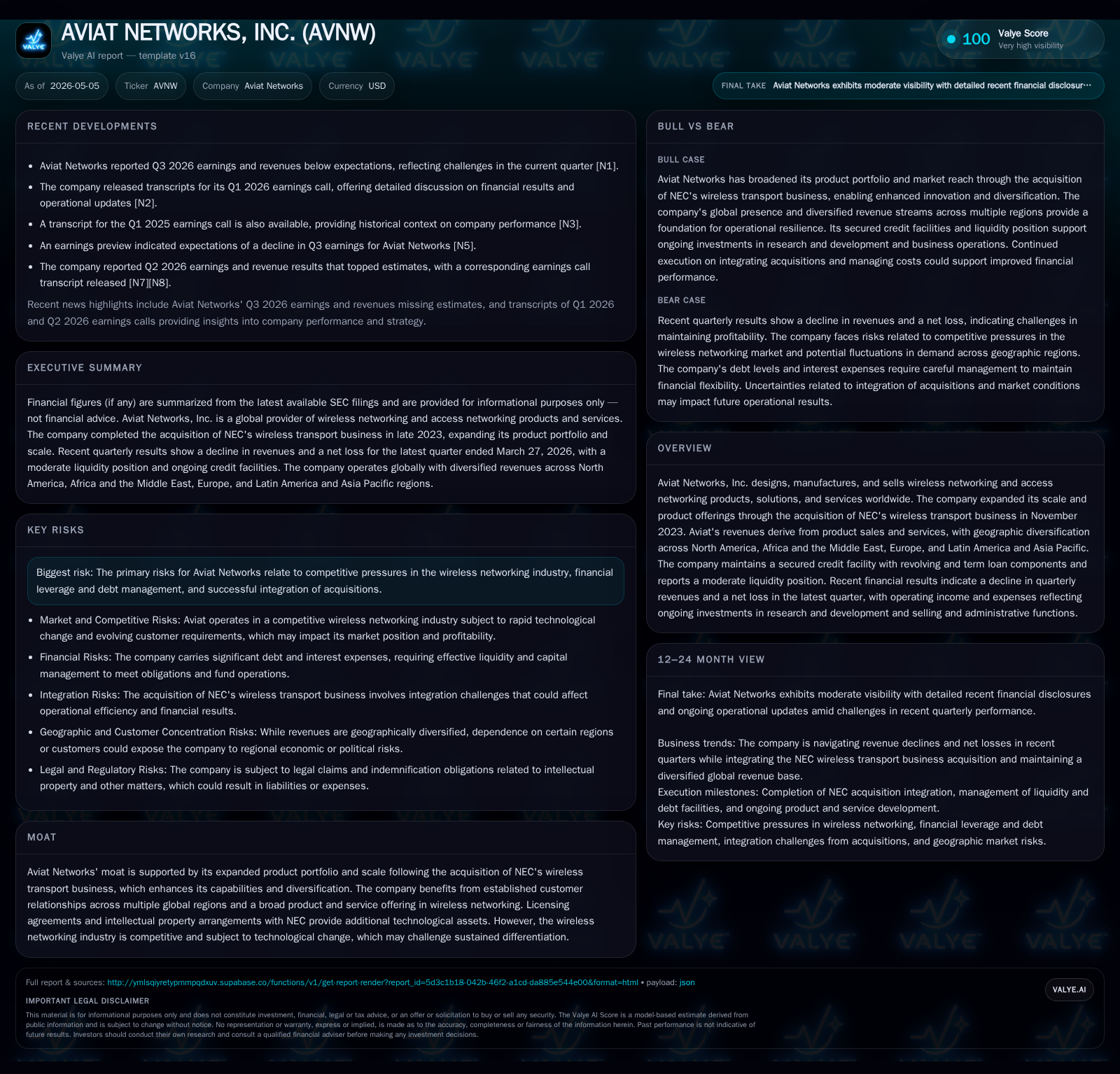
In its Q3 2026 report, Aviat Networks disclosed revenue shortfalls and a net loss amid ongoing investments and working capital adjustments tied to the November 2023 NEC acquisition. The company’s expanded product portfolio and scale aim to support long-term growth, but elevated debt levels and integration complexities weigh on near-term performance. Aviat’s broad geographic footprint and intellectual property licensing underpin a defensible competitive position, though fierce industry dynamics and technological shifts pose recurring challenges. Monitoring execution on synergy realization, order backlog trends, and liquidity management will be critical in the upcoming quarters.
Q3 2026 Operating Update: Integration and Earnings Misses
Aviat Networks' latest 10-Q filing for the quarter ended March 27, 2026 [S2] reveals a complex operating environment shaped heavily by the recent acquisition of NEC Corporation’s wireless transport business completed in November 2023. The aggregate purchase price was approximately $54.5 million, funded primarily via term loan borrowings under Aviat’s secured credit facility [S2]. Notably, the company incurred further payments related to post-closing working capital adjustments amounting to $5.8 million and $12.7 million in the second and fourth quarters of fiscal year 2025 respectively [S2].
These acquisition-related costs contribute to margin pressures and delayed profitability despite continued investment in research & development (R&D) and sales functions [S9]. Revenue for the quarter fell short of estimates with reported declines in both product sales ($68.4 million vs prior year $76.8 million) and services ($31.6 million vs prior $35.8 million) reflecting challenges in top-line traction following integration [N1], [S2]. This weakness drove a net loss for the period despite some operational cash flow generation described below.
Further compounding short-term strain are inventory reductions and adjustments amid evolving product mix post-acquisition with inventories decreasing to about $72.6 million from $84 million a year earlier [S2], highlighting efforts to align supply chains amid product transitions. Aviat also detailed ongoing arbitration with NEC over component purchase demands without current loss accruals but noting uncertainty around outcomes [S19].
Business Model and Product Quality: Wireless Networking Solutions Overview
Aviat Networks’ core business model centers on designing, manufacturing, and selling wireless networking equipment alongside complementary access network solutions to diverse end-markets including telecom operators, private network users (such as utilities), government entities, public safety agencies, transportation sectors, and broadcast operators worldwide [S2]. Revenue is principally derived from product sales – notably wireless transmission systems – complemented by service contracts including installations, maintenance, software updates, and managed solutions, [S24].
The strategic acquisition of NEC's wireless transport business enhances Aviat’s portfolio substantially by integrating Pasolink-series established products which enjoy considerable installed base credibility. This bolsters Aviat's technology capabilities through licensing arrangements that grant perpetual royalty-free rights to patents critical for mobile backhaul applications globally except Japan where NEC retains rights [S20]. Concurrently, manufacturing supply agreements allow continued production efficiency leveraging NEC's contracted capabilities.
Such intellectual property exchanges support differentiation in an otherwise commoditized market; however, sustaining innovation momentum remains essential as competing providers roll out next-gen alternatives emphasizing integrated fiber-wireless hybrids or cloud-native management platforms. Customer loyalty derives partly from entrenched relationships used by global telcos but price sensitivity limits pricing power.
Competitive Position Within the Global Wireless Infrastructure Industry
Post-NEC acquisition Aviat has augmented scale relative to peers yet confronts intense competition from larger incumbents such as Ericsson, Nokia, Huawei (outside U.S.), Comtech Telecommunications (a sector peer), plus emerging private 5G infrastructure firms,[N7]. While Aviat benefits from broad regional exposure across North America; Africa & Middle East; Europe; Latin America; Asia Pacific providing resilience against localized downturns, these markets differ considerably in maturity and regulatory environments complicating uniform go-to-market tactics.
Aviat's advantage lies in niche expertise around microwave backhaul solutions favored for cost-effective deployments in rural/remote areas or where fiber optic build-outs lag. The company retains longstanding contracts with government/public safety sectors that impose switching costs favoring customer retention.
Nevertheless pricing pressures are acute given alternative provider scale advantages combined with supply-chain cost volatility impacting margins negatively—factors reflected in the operating income softness despite increased asset base post acquisition [N1],.
Key Growth Drivers: Acquisition Benefits and Market Expansion
The NEC deal opens cross-selling avenues leveraging complementary product lines targeting industrial wireless access needs including Private LTE/5G routers recently reinforced by the July 2024 acquisition of New Zealand-based 4RF Limited specializing in narrowband point-to-point/multipoint radios for industrial sectors [S25]. This diversifies offerings into high-growth verticals responding to digital transformation trends within utilities and critical infrastructure segments.
Additionally, greater geographic diversification permits expansion into emerging markets hungry for reliable wireless backhaul solutions amidst limited fiber penetration – particularly Africa/Middle East where Aviat holds notable presence. Ongoing R&D expenditures (~mid-single-digit millions quarterly) are channelled into enhanced software-defined radio platforms enabling flexible spectrum use – an industry pivot point fostering potential new revenue streams [S9].
Backlog data is not explicitly disclosed but advance payments and unearned revenues totaled approximately $9.6 million recognized during Q3 with $56.8 million over nine months indicating moderately steady project pipeline execution currently concentrated on field services contracts extending beyond one year [S24].
Risks and Constraints: Leverage, Integration, and Competitive Pressures
Elevated financial leverage is an immediate concern stemming from term loans raised primarily to finance acquisition cash consideration (~$32.2 million) plus subsequent working capital payments resulting in total debt exceeding $104 million as of March 2026 with net debt approximating $27 million after cash balances ~$78 million [F1],[S4],[S5]. Despite compliance with credit facility covenants imposing leverage ratio ceilings near max thresholds (2.75x EBITDA current), liquidity remains moderately tight given revolving credit availability ($71.3 million less outstanding borrowings) relative to current liabilities around $226 million creating potential constraints if cash flow deteriorates unexpectedly [F1],[S4],[S21].
Integration execution risk persists given ongoing harmonization of manufacturing operations with NEC under supply agreements alongside unresolved legal arbitration disclosures involving component purchase disputes posing contingent liabilities albeit currently unaccrued by management pending resolution outcomes [S19],[S20]. Moreover rapid technological change requires continual innovation lest Aviat’s expanded portfolio loses ground against larger competitors investing heavily in cloud-native network functions virtualization (NFV) or AI-powered automation tools.
Margin expansion is challenged by competitive bidding norms particularly for service contracts embedded with multi-year pricing commitments limiting upside despite volume growth potential.
Upcoming Catalysts: Guidance, Milestones, and Demand Indicators
Investor focus should monitor any updates on near-term financial guidance revisions communicated during earnings calls or investor presentations filed contemporaneously with results disclosures [N2],[S3] for signals about recovery pace post-integration headaches. Other watchpoints include measurable synergy realization updates stemming from combined operations efficiencies or cost savings initiatives described partially in restructuring disclosures focused on workforce optimization expected through fiscal 2026 completion timelines [S7],[S21].
Order intake momentum within industrial wireless segments accelerated by acquisitions such as 4RF could serve as leading indicators alongside contract renewals or new licensing deals involving patented IP usage recently highlighted between NEC collaborations helping solidify differentiated product offerings globally [S20],.
Potential further acquisitive activity might also emerge as a strategic lever although constrained by existing covenant terms limiting incremental indebtedness absent lender consent.
Financial Snapshot: Balance Sheet Health and Capital Structure
Latest financial snapshot
| Metric | Value | Period |
|---|---|---|
| Cash & equivalents | $78mm | |
| 2026-03-27 | ||
| Total debt | $105mm | |
| 2026-03-27 | ||
| Net debt | $27mm | |
| 2026-03-27 | ||
| Current assets | $450mm | |
| 2026-03-27 | ||
| Current liabilities | $226mm | |
| 2026-03-27 | ||
| Current ratio | 1.99x | |
| 2026-03-27 |
Source: SEC companyfacts cache [F1].
Aviat Networks maintains moderate liquidity at quarter end March 27, 2026 reflected by cash & equivalents of approximately $78.1 million against total debt nearing $104.9 million creating net debt close to $27 million — a manageable level but necessitating attention given covenant constraints under its revolving credit facility ($95 million max commitment) consisting of a revolving line ($15 million drawn) plus term loan balance (~$89.9 million) maturing in October 2029 [F1], [S4], [S5], [S21].
Current assets stood at about $450.4 million with corresponding current liabilities around $226.3 million yielding an ample current ratio of approximately 1.99 evidencing sufficient short-term coverage though inventory adjustments signal cautious inventory management post-NEC acquisition build-out phase [F1], [S2], [S24].
Investments into intangible assets such as customer relationships ($23.7 million gross), technology patents ($0.7 million amortization quarterly), other trade names (~$1.6 million gross), plus goodwill totaling ~$19.5 million reflect capitalized acquisition intangibles supporting future revenue streams albeit subject to amortization charges over next several years reinforcing the importance of sustaining operational growth to justify carrying values without impairment risk [S13],[S18],[S23].
This analysis synthesizes recent SEC filings alongside secondary news transcripts without making specific investment recommendations. Data points are current as of early May 2026 based on official disclosures including Form 10-Q dated May 4th detailing Q3 fiscal year results.
Disclaimer: This is research-only, informational analysis and not investment advice. It may include AI-generated interpretation and general industry context. Always verify important details using primary sources.

Comments