
RB Global Strengthens Cross-Channel Auction Leadership with Q1 Operating Resilience
RB Global's Q1 2026 update reveals steady auction volume growth and strategic digital investments that support its market leadership despite macroeconomic pressures.
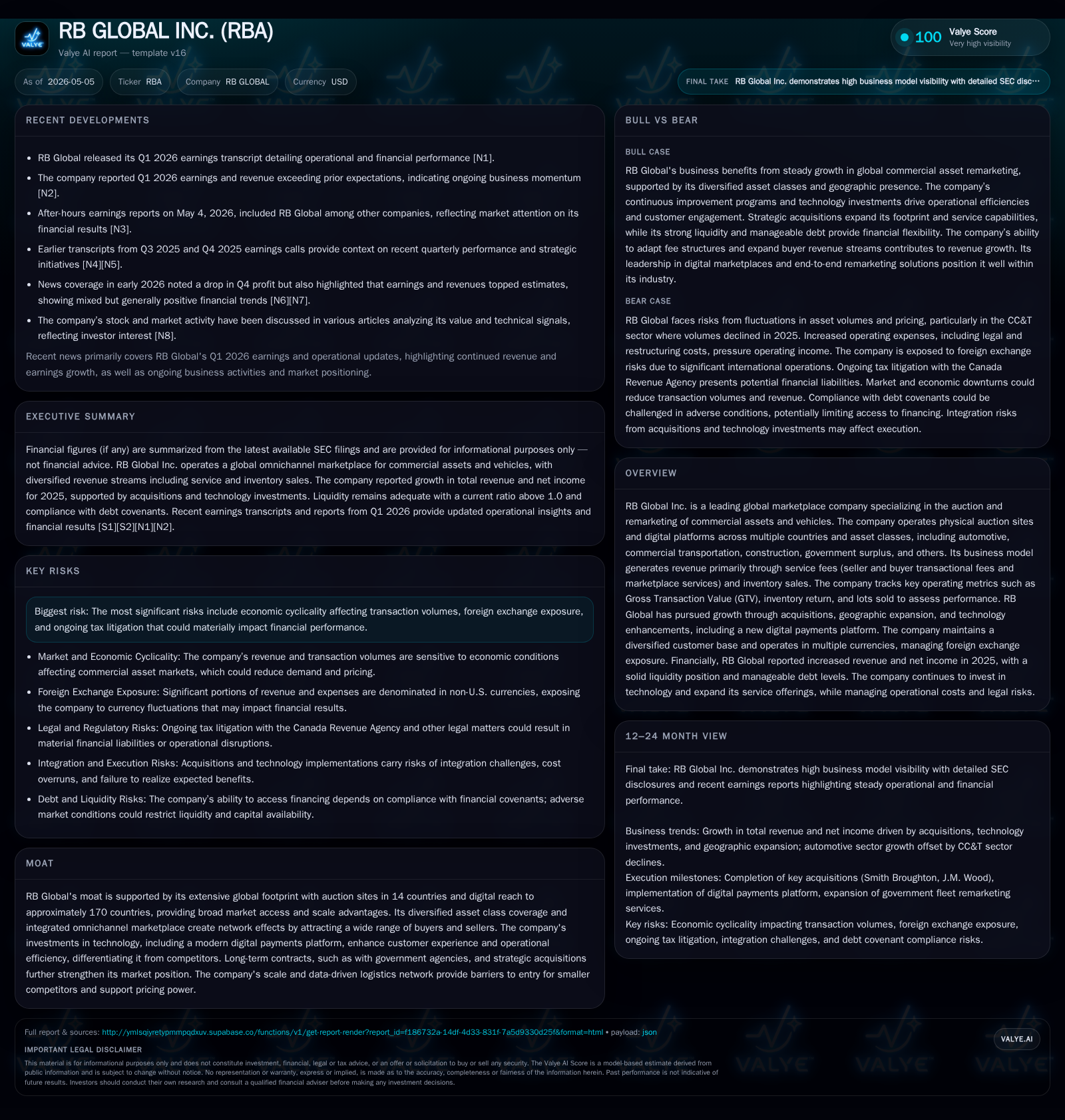
In its 10-Q filing for Q1 2026, RB Global outlined continued operational resilience marked by stable gross transaction value (GTV) and expanded marketplace capabilities, including the rollout of a new digital payments platform. The company’s diversified asset remarketing model, spanning automotive to construction equipment across physical and digital channels, leverages network effects and geographic scale in 14 countries. Ongoing acquisitions and government contracts underpin growth, while economic cyclicality and tax litigation remain material risks. Market watchers should monitor adoption metrics for new digital tools, auction volumes, and management commentary on demand trends in upcoming quarters.
Q1 2026 Operational Highlights and Strategic Moves
RB Global's most recent quarterly filing on May 4, 2026, [S2], provides the foundational update anchoring this analysis. The company reported operational resilience amid a volatile macroeconomic backdrop, sustaining gross transaction value (GTV) levels consistent with prior quarters and maintaining high engagement across its physical auction sites and digital marketplaces. A key near-term development is the wider deployment of a proprietary digital payments platform, launched initially in the United States through the Ritchie Bros. segment in 2025 [S25]. This modern infrastructure replaces legacy manual processes and enables enhanced self-service buyer functionalities alongside expanded financial tools, improving marketplace conversion rates and margin capture potential.
Additionally, RB Global continues its acquisition strategy with the recent integration of Smith Broughton Pty Ltd., completed late in 2025 [S1]. This Australian-based industrial equipment auction house expands RB Global's reach into mining, construction, agriculture, and industrial sectors within an important geographic market. Furthermore, contract gains include augmenting government fleet remarketing services under an expanded relationship with the U.S. General Services Administration—an example of leveraging existing partnerships for incremental volume [S1]. The company also declared a quarterly cash dividend of $0.31 per common share payable June 18, 2026 [S3], signaling financial confidence.
RB Global’s Asset Remarketing Business Model and Customer Value Proposition
The core business revolves around auctioning commercial assets across multiple classes—automotive (passenger vehicles, buses), commercial transportation, construction equipment, government surplus, among others—as outlined in the latest annual report [S1]. Revenue primarily derives from service fees charged to both sellers and buyers during transactions executed via physical auction sites or online marketplaces operated by RB Global or affiliated platforms.
Revenue complexity arises from transactional service fees complemented by inventory sales revenue where RB Global holds assets directly or via consignment models. Key monitored metrics include GTV representing total proceeds of all sales activity (although not directly translated to revenue), inventory returns which quantify gross margin on held inventory sales, and total lots sold reflecting throughput volume—including bundled low-value asset lots frequently used to optimize sale efficiency [S1]. The interplay of these metrics directly affects revenues through price/mix adjustments as well as utilization enhancements at physical sites and digital channels.
Crucially, the company’s omnichannel presence allows robust cross-selling opportunities between traditional live auctions and online bidding platforms accessible globally—over approximately 170 countries—maximizing liquidity pools for assets. This breadth creates tangible network effects: more sellers draw more buyers attracted by scale and diversity options; conversely robust bidding participation incentivizes repeat seller engagements.
Industry Dynamics: Competitive Profile and Market Positioning
RB Global operates within a highly competitive global asset remarketing industry characterized by fragmented regional players supplemented by several large multinational platforms. Its moat stems from extensive scale—with physical operations spanning fourteen countries—and technological leadership exemplified by the new digital payments rollout. By combining data-driven logistics networks for asset handling (e.g., via joint ventures like with LKQ Europe) alongside broad geographic coverage across multiple asset categories, RB Global erects significant barriers to entry for smaller competitors who lack comparable global client bases or integrated platforms [S1].
The company benefits from long-standing contracts including government fleet remarketing agreements that offer operating stability against economic cycles affecting private sector demand [S1]. Pricing power is buttressed by these relationships combined with differentiated technology-enabled customer experiences providing stickiness to clients concerned about asset disposition timing, transparency, and proceeds optimization.
However, the sector is inherently cyclical as end-user demand for commercial vehicles or construction machinery fluctuates with economic expansions or downturns. RB Global manages exposure through diversity of asset classes and geography but remains sensitive particularly in automotive salvage markets where volumes can contract materially during economic slowdowns [S27].
Growth Catalysts: Technology, Geographic Expansion, and Acquisitions
Near-term growth drivers are multifaceted:
Technology: The phased implementation of RB Global's digital payments platform promises higher marketplace efficiency by reducing friction in buyer transactions. Enhanced self-service financial tools may improve buyer conversion rates while also enabling expanded ancillary services such as financing or escrow functions [S25]. Future rollout stages beyond initial U.S. deployment will be critical KPIs.
Geographic Expansion: Acquisitions like Smith Broughton establish footholds in strategic markets such as Australia for heavy industrial auctions connected to resource sectors experiencing growth cycles [S1]. Similarly, expanding service scope with government agencies introduces steadier transaction streams less correlated to private sector cyclicality.
Acquisitions: Continuous targeted M&A activity helps consolidate regional fragmented markets into RB Global's infrastructure benefits. The J.M. Wood acquisition in Alabama further exemplifies deepening local expertise combined with global technological leverage [S24]. Synergies from these deals can drive margin improvements via shared overheads & enhanced supplier/partner networks.
Management has emphasized these initiatives as part of a coherent strategy to raise topline trajectory while incrementally improving margin profile via technology-driven scale efficiencies [N1]. Monitoring incremental bookings from acquired entities alongside adoption rates of new payment technologies will be crucial execution checkpoints.
Risks and Constraints Including Economic Cyclicality and Litigation Exposure
Economic cyclicality remains the principal external risk factor constraining volume growth potential. Given reliance on industrial equipment turnover sensitive to capital expenditure budgets among end users like construction firms or transportation companies, volume declines are foreseeable during macro downturns [S27]. Although geographic diversification tempers this risk somewhat it does not eliminate it.
Foreign exchange exposure constitutes another relevant risk given roughly a third of revenues/expenses are denominated in non-U.S. currencies including Canadian dollars, euros, British pounds sterling, and Australian dollars [S11]. Currency volatility can erode translated revenue figures or cost bases affecting reported margins absent effective hedging strategies.
Tax litigation issues around uncertain tax positions particularly involving Canada Revenue Agency assessments present contingent liabilities potentially affecting earnings volatility going forward [S17][S27]. Resolution outcomes remain uncertain posing downside risks beyond operating fundamentals.
Additionally, elevated legal costs tied to executive transitions plus restructuring charges reflect organizational realignments needed for strategy execution but strain expense lines temporarily [S20]. Capital structure leverage at over $2 billion total debt against $667 million cash demands prudent financial stewardship particularly if acquisition pace accelerates [F1].
Forward View: Key Milestones, Guidance, and Market Signals
Looking ahead into calendar year 2026 management commentary alongside successive quarterly reports will be essential windows into:
- Updating guidance on auction volumes reflected via lots sold trends,
- Adoption velocity for the phased digital payments platform outside initial U.S markets,
- Bookings from pipeline acquisitions or contract renewals especially government-related expansions,
- Dividend continuity amidst competitive capital allocation decisions,
- Foreign exchange impacts given evolving currency environments,
- Development or resolution status of outstanding tax litigations.
Market participants will also gauge incremental margin improvement trends linked to ongoing integration of acquired businesses while sustaining service level agreements critical to maintaining client retention across automotive insurance partners and commercial consignors [N2][N1].
Latest Financial Snapshot
Latest financial snapshot
| Metric | Value | Period |
|---|---|---|
| Cash & equivalents | $667mm | |
| 2026-03-31 | ||
| Total debt | $2.3bn | |
| 2026-03-31 | ||
| Net debt | $1655mm | |
| 2026-03-31 | ||
| Current assets | $2.1bn | |
| 2026-03-31 | ||
| Current liabilities | $1835mm | |
| 2026-03-31 | ||
| Current ratio | 1.14x | |
| 2026-03-31 |
Source: SEC companyfacts cache [F1].
| Metric | Value (USD millions) | Period Ended |
|---|---|---|
| Cash & Equivalents | 667.2 | |
| 2026-03-31 | ||
| Total Debt | 2,322.2 | |
| 2026-03-31 | ||
| Net Debt | 1,655.0 | |
| 2026-03-31 | ||
| Current Assets | 2,088.5 | |
| 2026-03-31 | ||
| Current Liabilities | 1,835.1 | |
| 2026-03-31 | ||
| Current Ratio | 1.14 | |
| 2026-03-31 |
This snapshot reflects a moderately leveraged balance sheet balanced by solid liquidity headroom based on current assets exceeding liabilities slightly at a ratio above one.
Disclaimer: This is research-only, informational analysis and not investment advice. It may include AI-generated interpretation and general industry context. Always verify important details using primary sources.

Comments