
Axsome Therapeutics Scales AUVELITY and SYMBRAVO Commercialization While Managing Debt and Pipeline Expansion
Strong early commercial traction in CNS therapies drives revenue growth amidst ongoing operating losses and strategic capital management.
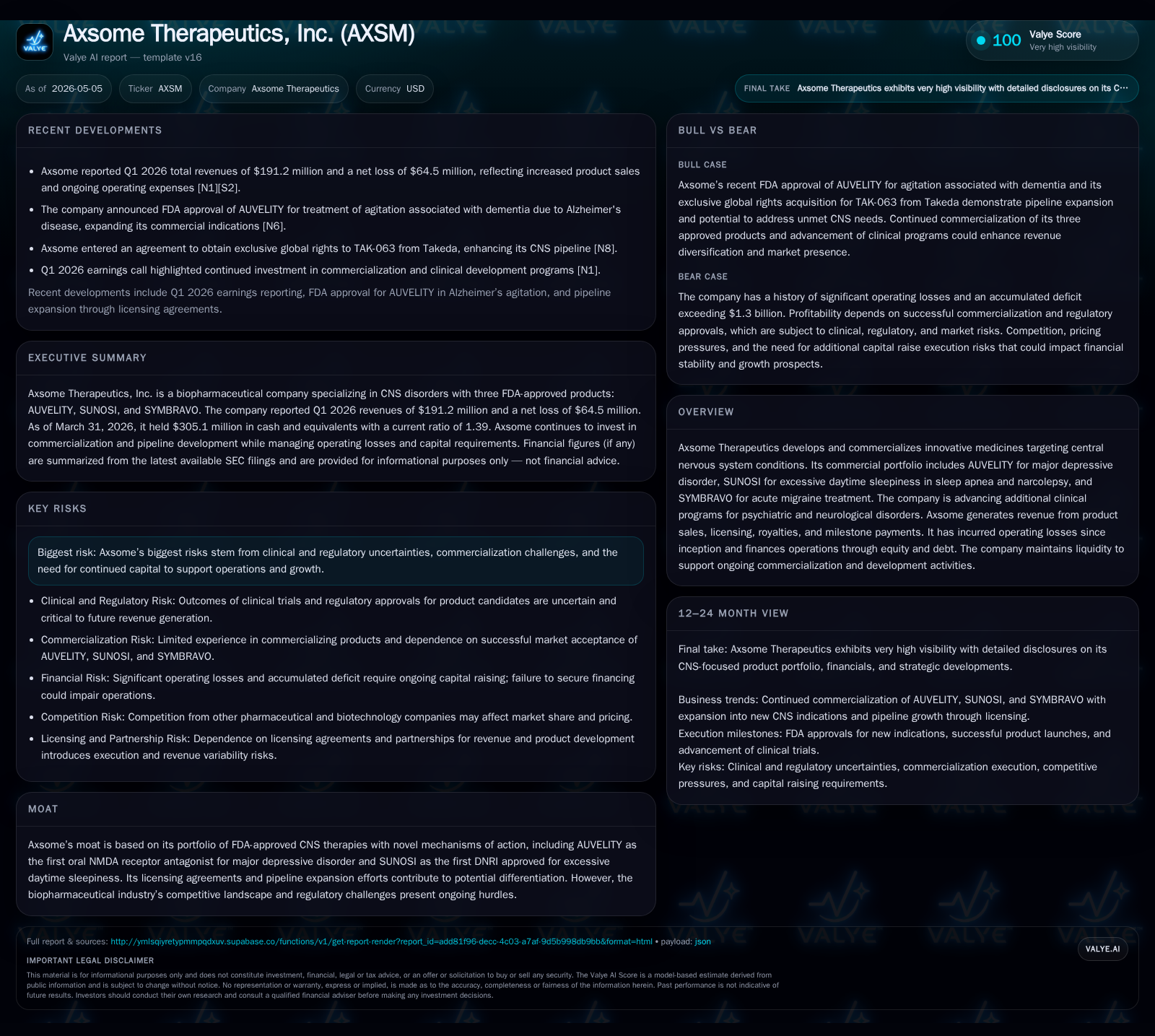
In its latest quarter ended March 31, 2026, Axsome Therapeutics reported continued commercialization progress for its three FDA-approved CNS therapies—AUVELITY, SUNOSI, and SYMBRAVO—with revenues driven by product sales though overall financial profitability remains elusive. The company maintains solid liquidity backed by $305 million in cash against $120 million in term debt, supporting expansive R&D efforts and pipeline advancement including recently acquired assets with promising CNS indications. Axsome's business model hinges on launching differentiated CNS products with novel mechanisms that address unmet clinical needs, but faces risks from regulatory uncertainties, competitive pressures, and the need for continued financing to achieve sustainable profitability.
Recent Operating Update
Axsome Therapeutics’ most recent quarterly report filed on May 4, 2026 ([S2]) highlights continued commercialization efforts for its three core CNS products: AUVELITY® for major depressive disorder (MDD), SUNOSI® for excessive daytime sleepiness related to sleep apnea and narcolepsy, and SYMBRAVO® for acute migraine treatment. The quarter reflects a critical phase where initial product launches transition into scaling revenue streams amid sustained investments in marketing infrastructure and clinical development.
Cash on hand stood at $305 million as of March 31, 2026 ([F1]), sufficient to support operations over the next twelve months despite expected expense increases associated with broadening commercialization activities and pipeline maturation.
Business Model Overview
Axsome generates revenue primarily through the sale of pharmaceutical products targeting CNS disorders—a sector characterized by significant unmet medical needs and challenging treatment paradigms. Its three marketed drugs—AUVELITY (oral NMDA receptor antagonist for MDD), SUNOSI (first DNRI approved for daytime sleepiness), and SYMBRAVO (a novel combination product for migraines)—collectively embody this focus on innovation within neurologic and psychiatric care.
Revenue streams are shaped by unit volumes sold via prescription uptake, pricing negotiations influenced by payer landscapes including insurance formularies, rebates, and contracting strategies. Additional revenue arises from licensing agreements—both royalties from out-licensed territories as seen with SUNOSI—and milestone payments tied to developmental or commercial achievements ([S1], [S23]).
Margins remain pressured by high operating expenditures dedicated to ongoing research & development as well as expanding commercial infrastructure, reflecting the investment-intensive nature typical within emerging specialty pharma companies focused on CNS diseases.
Industry Structure and Competitive Positioning
The CNS pharmaceutical industry Axsome operates within is highly competitive yet fragmented, with incumbent large pharma firms possessing broad portfolios competing alongside smaller innovators pursuing niche or breakthrough treatments. CNS conditions like MDD, migraine, narcolepsy, fibromyalgia, and ADHD represent both vast markets and areas historically underserved due to complex pathophysiology or limited effective treatments.
Axsome differentiates itself via therapy mechanisms of action that diverge from traditional modalities: AUVELITY's designation as the first oral NMDA receptor antagonist approved for MDD marks a disruptive approach in depression pharmacotherapy. Similarly, SUNOSI’s DNRI mechanism fills a gap in treating excessive daytime sleepiness beyond stimulant alternatives. SYMBRAVO’s combination technology leveraging MoSEIC™ delivery provides rapid onset benefits in acute migraine care.
However, competitive pressures manifest across multiple fronts: generic competition looming over time horizons particularly evident with settlements related to SUNOSI's patent protection ([S23]), parallel approvals of alternate CNS agents by other companies addressing overlapping patient populations, payor resistance challenging pricing power especially under worsening public health budget constraints, and stringent FDA regulatory scrutiny requiring robust evidentiary support throughout clinical progression.
Growth Drivers
Commercial Execution of Existing Products
Ramp-up of AUVELITY post its 2022 launch remains foundational for near-term revenue gains given MDD’s large patient population segment inadequately served by current antidepressants. Physician education initiatives emphasizing this novel mechanism alongside expanded indications such as agitation associated with Alzheimer’s dementia could enhance adoption breadth ([N12]).
SYMBRAVO’s recent U.S. commercial entry for acute migraines adds an additional growth vector in a multi-billion-dollar market traditionally dominated by triptans but primed for newer formulations offering improved onset and tolerability profiles.
SUNOSI continues to benefit not only from direct sales but also royalty inflows due to international licensing deals expanding its global footprint.
Pipeline Advancement and Licensing Activity
Axsome’s acquisition of Baergic Bio’s AXS-17 (AZD7325), an orally administered GABAA α2/3 subtype-selective positive allosteric modulator aimed at epilepsy treatment initiation with mid-2026 Phase 2-enabling activities planned ([S23]), signifies strategic vertical integration into epileptology—a lucrative yet complex subset of neurology treatments requiring nuanced safety profiles.
The December 2025 acquisition of worldwide rights to deuterium-stabilized S-bupropion targets expanded neuropsychiatric indications leveraging enhanced pharmacokinetic properties potentially improving efficacy or side effect profiles compared to legacy bupropion compounds ([S23]).
Continued licensing efforts alongside potential collaborations or acquisitions will be critical to deepening Axsome’s clinical pipeline breadth beyond currently commercialized assets.
Risks / Watchpoints / Growth Constraints
- Clinical & Regulatory Uncertainty: Success hinges on favorable trial outcomes as Axsome advances additional CNS indications; setbacks could materially impair prospects.
- Commercial Execution Challenges: Scaling launch infrastructure especially for recently approved SYMBRAVO amid entrenched competitors and payer scrutiny is uncertain.
- Patent Litigation & Exclusivity Risks: Ongoing settlements concerning generic competition rights (e.g., around SUNOSI) expose future revenue erosion risk horizon.
- Capital Requirements: Operating losses persist ($183 million net loss in 2025 [F1]) necessitating continual financing; adverse market conditions could impede favorable funding access.
- Market Dynamics: Pricing pressures from payors alongside evolving standards of care pose margin compression threats; patient adherence variability common in CNS disorders may limit volume growth.
- Legal Proceedings: The company faces derivative litigation stemming from securities class action claims which could divert management focus or yield contingent liabilities ([S10], [S19]).
What To Watch Next
- Clinical updates regarding AZD7325’s progression towards Phase 2 trials throughout 2026 provide insights into pipeline viability beyond marketed products.
- Quarterly sales trends for AUVELITY and SYMBRAVO indicating physician acceptance speed, market penetration velocity, refill rates or switch dynamics versus incumbents.
- Regulatory developments including NDA submissions or expansions annually that might validate broader label applicability enhancing lifetime product value.
- Capital raising activity or debt restructuring signaling sustainability stance amid cash burn dynamics given anticipated rising expenses connected with marketing expansion.
- Outcomes from any pending patent litigation or influence of licensing deals affecting long-term exclusivity windows which directly impact revenue trajectory assumptions.
Brief Financial Profile Summary
Latest financial snapshot
| Metric | Value | Period |
|---|---|---|
| Cash & equivalents | $305mm | |
| 2026-03-31 | ||
| Total debt | $120mm | |
| 2026-03-31 | ||
| Net debt | $-185mm | |
| 2026-03-31 | ||
| Current assets | $611mm | |
| 2026-03-31 | ||
| Current liabilities | $439mm | |
| 2026-03-31 | ||
| Current ratio | 1.39x | |
| 2026-03-31 |
Source: SEC companyfacts cache [F1].
As per the latest Q1 2026 period ending March 31st ([F1], [S2]): FY 2025 |
The solid liquidity position underpins near-term operational resilience amidst substantial operating losses tied to scale-up phases across commercial launches and R&D projects.
Disclaimer: This analysis is based solely on data extracted from publicly available SEC filings and relevant news releases as of May 2026. It does not constitute investment advice or recommendations but aims to provide an informed industry perspective grounded in disclosed facts about Axsome Therapeutics’ business operations and strategic trajectory.
Disclaimer: This is research-only, informational analysis and not investment advice. It may include AI-generated interpretation and general industry context. Always verify important details using primary sources.

Comments