
Inspire Medical Systems Advances Neurostimulation Growth Despite Surgeon Capacity Constraints
The latest quarterly filing highlights operational progress with sustained demand for Inspire’s OSA therapy amid physician capacity limits and reimbursement ambiguities.
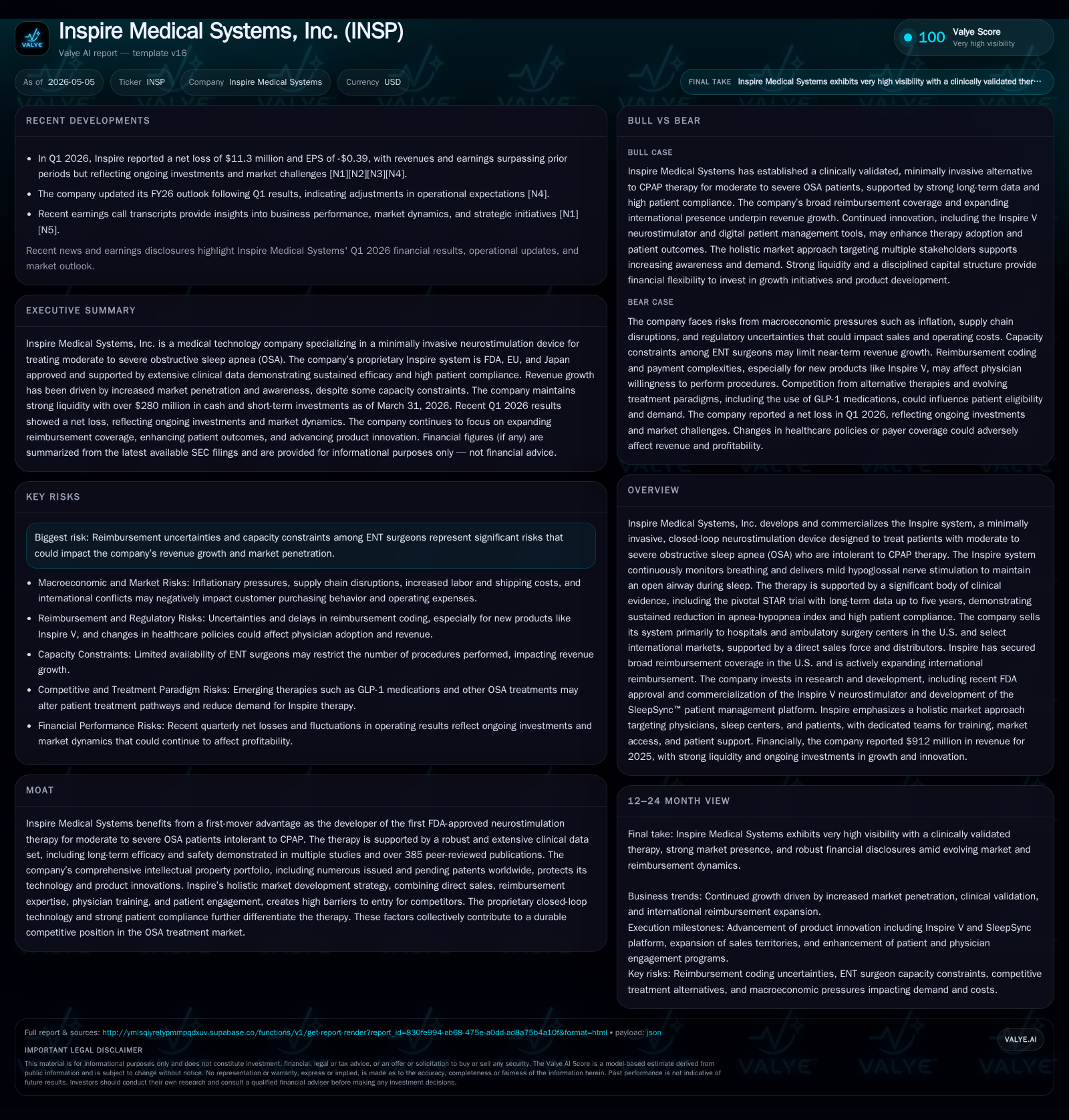
Inspire Medical Systems reported continued expansion in its minimally invasive neurostimulation treatment for moderate to severe obstructive sleep apnea (OSA) in Q1 2026. Growth is supported by clinical adoption and patient awareness despite constraints on ENT surgeon capacity that limit procedure throughput. The company’s business model centers on device sales to hospitals and ambulatory surgical centers with robust reimbursement coverage, primarily in the U.S. Competitive advantages include proprietary closed-loop technology, a comprehensive patent portfolio, and a strong clinical evidence base. While growth drivers include market penetration, regulatory approvals, and international expansion, risks from physician capacity bottlenecks and evolving reimbursement coding remain. Financially, Inspire maintains strong liquidity with over $98 million in cash and a current ratio above 6, positioning it well for ongoing commercialization and R&D investment.
Recent Operating Update
Inspire Medical Systems’ first quarter 2026 filings reaffirm its leadership position in the obstructive sleep apnea (OSA) treatment market while revealing persistent operational challenges.
The company's Q1 10-Q dated May 4, 2026, notes no material changes to existing risk factors but continues to highlight a critical constraint: limited capacity among ear-nose-throat (ENT) surgeons trained to perform the implant procedures that deliver Inspire’s therapy [S2]. This surgeon bottleneck restricts procedure volume despite sustained patient demand. Concurrently, some payer-related reimbursement complexities linger due to evolving Current Procedural Terminology (CPT) coding guidance for the newer Inspire V device implantation [S1]. Nonetheless, broad Medicare local coverage determinations and major commercial insurer contracts covering over 300 million lives in the U.S. underpin revenue visibility.
Business Model
Inspire Medical Systems generates revenue exclusively from selling its Inspire system neurostimulator device primarily to hospitals and ambulatory surgery centers (ASCs). Hospitals/ASCs act as customers purchasing the device to implant it in suitable OSA patients. The procedure requires specialized ENT surgeons who implant the device surgically during an outpatient visit. Revenue realization hinges on device sales volume driven by procedure counts and successful reimbursement claims.
The company employs a direct sales force in key markets (U.S., Europe, Japan), complemented by distributors in select Asia Pacific countries such as Singapore and Thailand [S1]. Efforts focus on engaging ENT physicians and sleep centers via education, while simultaneously conducting patient-directed marketing campaigns that aim to boost awareness of non-CPAP therapeutic alternatives.
Reimbursement complexity is central: Inspire benefits from favorable FDA medical device approvals (FDA PMA since 2014; EU MDR compliance; Japan MHLW approval) which support payer coverage policies. However, transition between CPT codes for different device generations (e.g., codes 64582 for Inspire IV and 64568 for Inspire V) has caused some coding ambiguity requiring time for claims data accumulation and payer standardization [S1]. Despite this noise, nearly all large U.S. commercial payers have adopted favorable coding for Inspire V.
Industry Structure and Competitive Position
The OSA treatment space is dominated by CPAP therapy as standard of care but suffers from poor patient compliance due to mask discomfort or inconvenience.
Inspire established a formidable first-mover advantage as the only FDA-approved neuromodulation implantable device specifically designed for moderate to severe OSA patients intolerant of CPAP. Its closed-loop hypoglossal nerve stimulation technology uniquely monitors breathing patterns night-by-night to maintain airway patency.
Extensive clinical validation supports this position—decades of data culminating in landmark trials like STAR demonstrate sustained reductions in apnea-hypopnea index (AHI) up to five years post-implant alongside high patient adherence rates unmatched by CPAP or surgical tissue-resection options [S1].
Intellectual property protection is comprehensive with over 119 issued U.S. patents alongside foreign counterparts securing product innovations including hardware design and stimulation algorithms. Patent litigation risk exists but is early-stage with ongoing defense against competitor Nyxoah SA’s infringement claims without financial accruals anticipating loss [S15][S16][S27].
Growth Drivers
- Market Penetration: Despite supply-side constraints on implantation capacity, the company is actively expanding both anatomical regions where ENT surgeons operate as well as raising awareness among referring physicians and patients which continues driving demand.
- Product Innovation: Launch of Inspire V device in May 2025 incorporates manufacturing improvements leading to higher gross margins (~85% gross margin driven partly by improved product costs versus prior generations) and enhances user experience [S1][S12][S14]. The SleepSync™ platform under development promises improved patient management via cloud connectivity.
- Reimbursement Expansion: Securing private payer policies beyond CMS administrative jurisdictions ensures payment confidence accelerating adoption.
- International Market Entry: Extending distribution into additional European countries and Asia Pacific markets supplements U.S.-centric revenue base although these remain nascent compared with domestic sales volumes [S1][S13].
- Patient Awareness Campaigns: Direct-to-consumer marketing heightens therapy consideration among CPAP-intolerant OSA population segments.
Risks and Growth Constraints
Key risks underscore investor vigilance:
- Surgeon Capacity Limits: Availability of qualified ENT surgeons constrains procedural throughput crucially limiting top-line growth potential especially given surgical learning curves requiring training programs.
- Reimbursement Coding Ambiguity: Recent shifts between CPT codes for different device versions inject short-term uncertainty affecting hospital billing processes limiting revenue recognition until resolution.
- Competition from Pharmaceutical Advances: Emerging GLP-1 receptor agonists like tirzepatide gaining FDA indication for obesity-related OSA possibly reduce target patient pools who might otherwise seek Inspire therapy [S28].
- Patent Litigation Exposure: Several lawsuits between Inspire and competitors concerning infringement claims could lead to protracted litigation costs or licensing impacts although outcomes remain uncertain.
- Supply Chain Inflation: Manufacturing cost pressures or component shortages could erode gross margins if not offset by scale efficiencies or price increases.
What To Watch Next
Stakeholders should monitor these key milestones:
- Updates on CPT coding consensus across CMS MACs and private payers clarifying precise billing requirements for Inspire V procedures.
- Progression in trained surgeon numbers facilitating increased implants per period signaling reduction of procedural bottlenecks.
- Commercial ramp-up results from recent launches especially channels outside U.S.
- Regulatory milestones facilitating expanded geographic footprint particularly in Europe where MDR compliance now sets standards.
- Clinical developments around SleepSync™ platform influencing future therapy enhancements.
- Any settlement or rulings related to ongoing patent litigations impacting competitive landscape or intellectual property protections.
Financial Profile Summary
Latest financial snapshot
| Metric | Value | Period |
|---|---|---|
| Cash & equivalents | $99mm | |
| 2026-03-31 | ||
| Current assets | $567mm | |
| 2026-03-31 | ||
| Current liabilities | $89mm | |
| 2026-03-31 | ||
| Current ratio | 6.34x | |
| 2026-03-31 |
Source: SEC companyfacts cache [F1].
As of March 31, 2026, Inspire holds $98.9 million in cash & equivalents alongside $566.8 million in current assets versus $89.4 million in current liabilities delivering a robust current ratio of approximately 6.34 indicative of strong short-term liquidity [F1][S2]. Total debt reported was $21.4 million as of mid-2022 but net debt effectively negative reflecting healthy cash buffers well covering obligations at present [F1].
Despite substantial investments increasing SG&A related headcount and marketing outlays alongside R&D spending supporting next-gen innovation initiatives—partly reflected in Q4 2025 figures—the company delivers growing revenues with an operating income exceeding $50 million annually pre-Q1 conceivably reflecting ongoing operating leverage gains [S21][F1].
No repurchases occurred during Q1 2026 but a sizeable $200 million share repurchase authorization remains outstanding through August 2027 reflecting optional capital return flexibility once organic investments normalize [S2][S6].
This analysis synthesizes facts drawn directly from recent regulatory disclosures augmented by contextual industry commentary relevant as of mid-2026. It excludes any trading recommendations or price forecasts. Investors should evaluate independently considering individual risk tolerance.
Disclaimer: This is research-only, informational analysis and not investment advice. It may include AI-generated interpretation and general industry context. Always verify important details using primary sources.

Comments