
Backblaze Rides AI-Driven Cloud Demand but Battles Profitability Headwinds
Backblaze’s Q1 2026 results reflect strong revenue growth driven by AI workload adoption, tempered by continued challenges in achieving profitability amid competitive pressures.
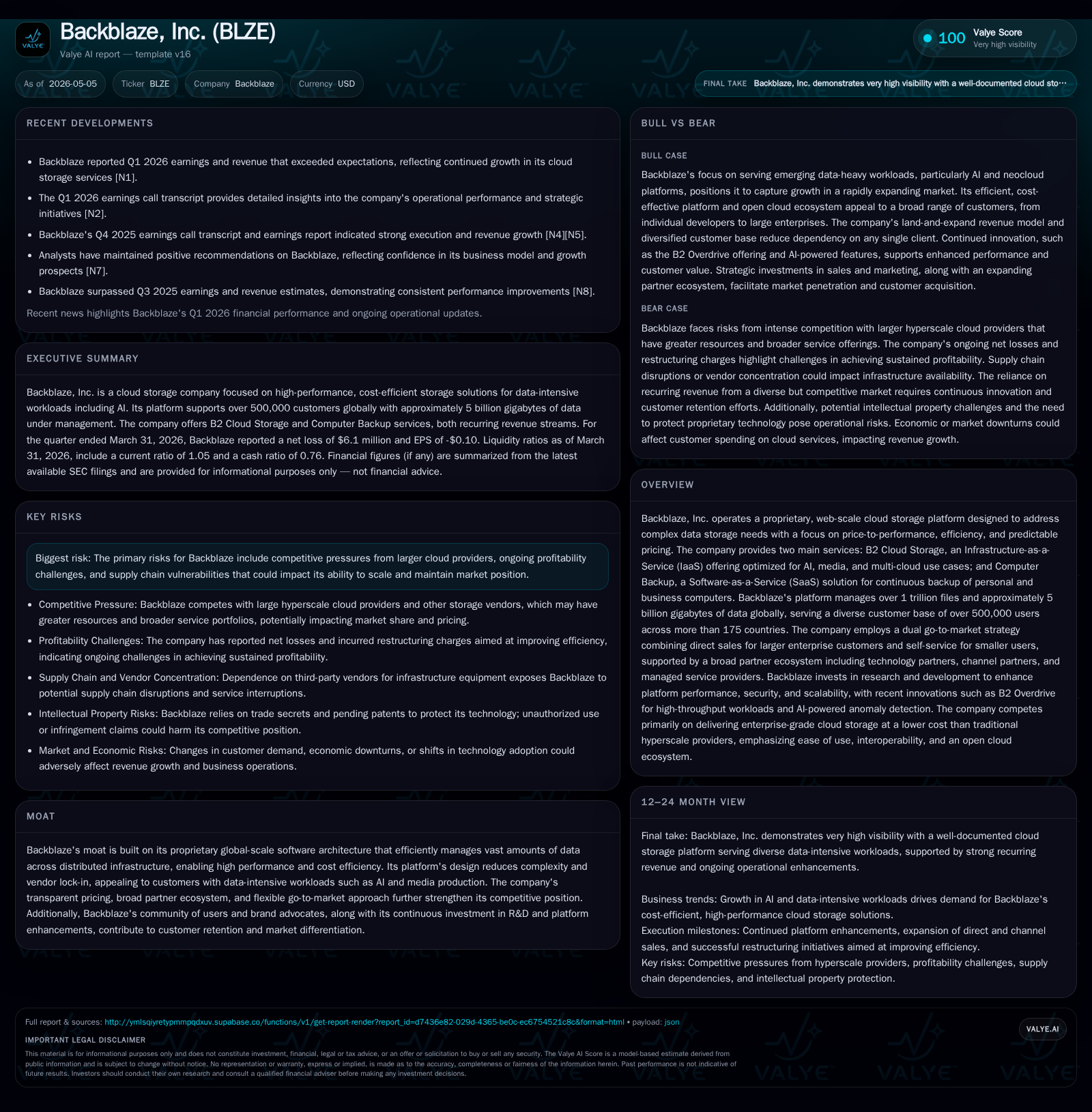
In its latest quarter, Backblaze reported better-than-expected revenue and earnings results, fueled by robust demand for its cloud storage platform optimized for AI and media workflows. The company’s proprietary web-scale software infrastructure underpins cost-efficient and scalable storage services, notably its B2 Cloud Storage and Computer Backup offerings. While Backblaze continues to grow its customer base and expand channel partnerships, it faces ongoing margin constraints and supply chain challenges that complicate profitability improvements. Investors should monitor execution of the Powered by Backblaze up-market strategy and potential margin inflection points tied to scale.
Q1 2026 Operating Highlights: Outperformance and Key Developments
Backblaze’s first quarter financial results filed on May 4, 2026 (10-Q) showed notable operational momentum with revenues exceeding market expectations. The Management Discussion highlighted strong uptake of their B2 Cloud Storage solutions particularly among AI-focused users requiring scalable, high-throughput platforms for machine learning workloads [S2][N1]. Adjusted EBITDA improved markedly on prior periods reflecting operating leverage benefits despite continued investments in go-to-market initiatives. Concurrently filed 8-K disclosures reaffirmed strategic emphasis on expanding the Powered by Backblaze program aimed at attracting larger enterprise and neocloud customers through white-label offerings [S3][N2]. This dual filing angle underscores the company's transition from a largely self-serve SMB origin toward more direct sales engagements in high-value verticals.
Backblaze’s Business Model and Service Quality: Price, Performance, and Ease of Use
Backblaze monetizes primarily through two distinct but complementary offerings: the B2 Cloud Storage Infrastructure-as-a-Service (IaaS) platform, designed with a web-scale proprietary software stack running on commodity hardware, and the Computer Backup Software-as-a-Service (SaaS) solution targeting personal and business endpoint backup needs [S1]. The company’s value proposition hinges on a clear 'price-to-performance' advantage achieved by minimizing operational complexity while offering transparent pricing structures — Computer Backup employs a flat-rate subscription without data caps or speed constraints, whereas B2 services predominantly operate on pay-as-you-go or committed capacity contracts tailored for flexibility.
Their platform’s unique architecture enables efficient management of over one trillion files across roughly five billion gigabytes globally with broad geographic reach spanning more than 175 countries [S1]. This scale supports use cases from AI training requiring up to terabit-per-second throughput (via B2 Overdrive) to continuous automated data backup via lightweight local agents embedded in Computer Backup. The integration of direct sales for large accounts alongside expansive channel partnerships—including technology integrators embedding Backblaze storage into packaged solutions—and reseller programs strengthens customer acquisition channels while enhancing retention through ecosystem momentum.
Industry Positioning: Competitive Dynamics and Supply Chain Realities
Operating inside the highly competitive cloud storage market dominated by hyperscalers like AWS S3, Google Cloud Storage, and Microsoft Azure Blob Storage, Backblaze distinguishes itself through lower service complexity, predictability of costs, and less onerous vendor lock-in [S1][S2]. Its proprietary software stack reduces reliance on costly proprietary hardware systems that often burden larger providers.
However, price competition remains intense as hyperscale providers continuously push pricing down leveraging vast capital resources. This dynamic pressures commercial terms across customer segments challenging Backblaze’s ability to maintain margin expansion sustainably [S2]. Additionally, supply chain issues—specifically surrounding procurement of commodity hard drives—pose tangible execution risks given limited global supply sources which can delay capacity expansions crucial for scaling storage volumes inherent to AI-driven workloads [S3].
Growth Catalysts: AI Workloads, Channel Partners, and Platform Extensions
Demand drivers are anchored in the ongoing acceleration of artificial intelligence workloads requiring massive data ingestion, training datasets storage with ultra-high bandwidth demands supported by B2 Overdrive’s up to 1 Tbps throughput capabilities paired with unlimited free egress – a critical differentiator mitigating hidden exit fees common elsewhere in cloud environments [S1][N2]. Meanwhile, the Powered by Backblaze program facilitates white-label enterprise deals with neocloud platforms seeking turnkey scalable storage without diverting resources into building their own infrastructure.
Simultaneously Backblaze nurtures its self-service developer user base who experiment with emerging AI models relying on cost-effective storage provisioning. Expansion within media production workflows leveraging reliable large-file content management also continues to add incremental sales volume. Efficiency gains from channel resellers at discounted rates broaden geographic penetration particularly in emerging markets where flexible pricing prompts trial engagements converting eventually to committed contracts [S1][N2].
Risks and Constraints: Profitability Challenges, Competitive Intensity, and Supply Dependencies
The company discloses a continued history of net losses driven by significant reinvestments into sales & marketing expansion (especially direct sales), R&D for feature innovation (including AI platform enhancements), coupled with costs tied to quarterly restructuring initiatives designed to improve efficiency [S2][F1]. Despite growing adjusted EBITDA—$31.8 million annually as per latest year-end figures—the operating income remains negative (-$23.6 million), reflecting persistent profitability headwinds typical in capital-intensive SaaS/IaaS scaling phases [F1].
Pricing pressure from entrenched hyperscalers alongside relatively modest balance sheet scale limits leverage against sustained competition. Additionally, material dependence on third-party vendors supplying hard drives introduces supply risk that can stall growth capacity or escalate procurement costs adversely affecting gross margins. Cybersecurity threats remain an omnipresent risk given criticality of customer data retention affecting reputation if breached [S1][S2].
What Investors Should Monitor Next: Guidance, Sales Execution, Feature Rollouts
Key indicators to track include quarterly guidance updates on revenue acceleration rates tied specifically to enterprise direct sales pipeline progression under the Powered by Backblaze initiative. Progress in expanding partner integrations quantitatively via bookings or renewal rates will signal ecosystem vitality supporting sustainable penetration beyond core self-serve channels.
Observation of operating margin trends will reveal whether scale efficiencies or pricing adjustments offset rising investment cadence planned for R&D enhancements including AI tooling integration within product roadmaps. Announcements related to new platform certifications or expanded features aimed at data-heavy verticals like media could validate competitive differentiation efforts conveyed during earnings calls [N2][S2].
Latest Financial Snapshot: Liquidity, Leverage, and Profitability Overview
Latest financial snapshot
| Metric | Value | Period |
|---|---|---|
| Cash & equivalents | $26mm | |
| 2026-03-31 | ||
| Current assets | $63mm | |
| 2026-03-31 | ||
| Current liabilities | $60mm | |
| 2026-03-31 | ||
| Current ratio | 1.05x | |
| 2026-03-31 |
Source: SEC companyfacts cache [F1].
| Metric | Latest Value | Period End Date |
|---|---|---|
| Cash & Equivalents | $26.28 million | |
| 2026-03-31 | ||
| Current Assets | $62.84 million | |
| 2026-03-31 | ||
| Current Liabilities | $59.94 million | |
| 2026-03-31 | ||
| Current Ratio | 1.05 | |
| 2026-03-31 |
As of March 31, 2026, Backblaze holds approximately $26.3 million in cash reserves with a current asset base fairly matched against current liabilities yielding a stable current ratio slightly above one indicating moderate short-term liquidity sufficiency [F1]. Total debt was recorded at about $6.1 million as of September 2023—a low absolute figure relative to cash stock providing net cash positive leverage albeit dated but consistent with filings confirming conservative balance sheet usage [F1]. Operating losses remain material (around $23.6 million annually) reinforcing ongoing investment mode despite improving operating cash flow generation potential as business scales [F1][S2].
This analysis synthesizes the latest publicly available SEC filings including the Q1 2026 Form 10-Q alongside recent event disclosures providing a current view on Backblaze’s operational execution amid evolving market opportunities tied to artificial intelligence workloads while contending with entrenched profitability challenges characteristic of cloud infrastructure businesses during scale up phases.
All statements are grounded directly in referenced SEC filings () and validated numeric facts from companyfacts ([F1]) or official news transcripts (). This report does not constitute investment advice but aims to deliver detailed industry-rooted insights for internal or professional evaluation purposes.
Disclaimer: This is research-only, informational analysis and not investment advice. It may include AI-generated interpretation and general industry context. Always verify important details using primary sources.

Comments