
COHU INC Expands AI Analytics Amid Semiconductor Industry Volatility in Q1 2026
COHU INC’s latest quarter highlights strategic AI integration within its test and inspection portfolio, reinforcing its competitive moat amid semiconductor market cyclicality.
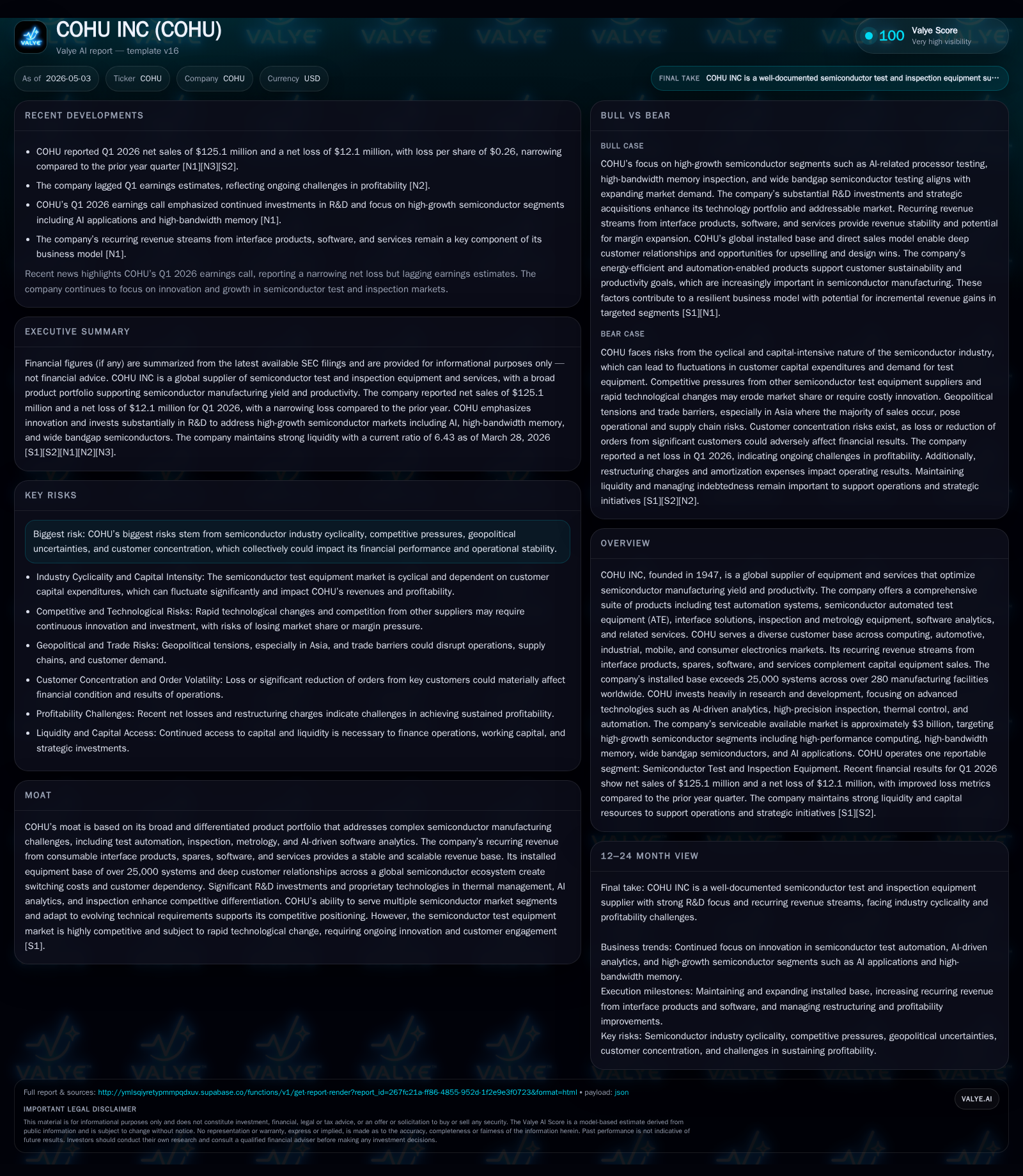
In its Q1 2026 filing, COHU INC advanced its semiconductor manufacturing solutions by integrating Tignis AI-based analytics to augment process control, reflecting a push into higher-value software offerings. The company’s broad product suite targets yield optimization across various high-growth semiconductor segments, supporting resilience through recurring revenue streams from consumables and services. Despite facing industry cyclicality, supply chain uncertainties, and concentrated customer risks, COHU leverages substantial R&D investment and an extensive installed base of over 25,000 systems worldwide to maintain differentiation. Financially, the company exhibits strong liquidity with a current ratio above 6.4 and manageable net debt while navigating operating losses. Monitoring execution on AI software adoption, order inflows from key semiconductor segments, and capital allocation will be critical near-term indicators.
Recent Operating Update
Cohu Inc's Q1 2026 10-Q filing [S2] notably highlights the integration of Tignis Inc., acquired in January 2025 for its artificial intelligence (AI) process control software capabilities. This move enables COHU to expand its analytics offerings specifically for semiconductor process control through Tignis’ PAICe Monitor and PAICe Maker platforms. These leverage machine learning and physical phenomena insights to deliver predictive automation solutions addressing manufacturing yield optimization during complex device architectures. This strategic addition underscores COHU's pivot towards embedding AI-driven software into its traditionally hardware-centric portfolio.
Concurrent with this, the company reported a modest increase in allowance for credit losses tied to trade receivables ($0.5 million as of March-end versus $0.1 million prior), reflecting conservative credit risk management amidst sector volatility [S2]. Customer bases span semiconductor manufacturers and subcontractors globally.
An April 30 event filing [S3] reiterates industry challenges including rapid technology change risks, cyclicality in demand patterns, supply chain dependencies sensitive to geopolitical tensions, inflationary pressures on costs/pricing power, high customer concentration risks (notably from major foundries), talent acquisition under competitive labor markets especially in AI sectors, and regulatory/export controls uncertainties.
Business Model
Founded in 1947, COHU operates as a global supplier of semiconductor test automation equipment along with interface products, inspection/metrology platforms, thermal management subsystems, and increasingly sophisticated AI-based software solutions designed to optimize yield and throughput in semiconductor manufacturing [S1]. Revenue streams accrue from both capital equipment sales driven by OEM customers’ CAPEX cycles (semiconductor manufacturers and outsourced test houses) and recurring revenues from consumables such as interface products (test sockets), spare parts/services contracts, software licensing/upgrades including analytics applications.
This dual-revenue model lends resilience by smoothing out cyclicality inherent to capital equipment sales. The company's installed base surpasses 25,000 systems spanning over 280 manufacturing facilities worldwide across about 108 customers in more than 31 countries [S1]. Recurring revenues not only bolster margin stability but also enhance customer lock-in through embedded interface tooling compatibility and ongoing software/service ecosystems.
Key product groups include:
- Test Automation: Systems automating device handling during testing processes with patented active thermal control (ATC) technology enhancing precision temperature regulation critical for high-end processors (CPUs/GPUs/ASICs).
- Semiconductor Test Equipment: Automated Test Equipment (ATE) supporting mixed-signal devices as well as emerging wide-bandgap semiconductors like silicon carbide (SiC) and gallium nitride (GaN).
- Interface Solutions: Consumable yield-enhancing contactor technologies that serve as interface points between device under test (DUT) and test systems.
- Inspection & Metrology: Vision-based inspection platforms targeting high-bandwidth memory (HBM) stacks integrating fine-pitch layers requiring nanometer-level accuracy.
- Software Analytics: Recently augmented by Tignis’ AI-infused process control offerings intended to provide predictive insights beyond traditional statistical process control methods.
Industry Structure & Competitive Position
COHU plunges into a highly concentrated yet technologically advanced semiconductor ecosystem characterized by rapid innovation cycles and cyclical end-market demand swings. Its competitors reside in several tightly contested segments:
- Test & Automation: Competing against giants like Teradyne and Advantest who boast scale advantages but often target different package types or test methodologies.
- Inspection & Metrology: KLA dominates here; however Cohu has carved niches aided by system integration capabilities focused on automotive-grade GaN/SiC devices.
The company’s moat emerges from:
- A holistic product portfolio enabling cross-selling across complementary stages of the test/inspection value chain,
- Proprietary thermal management technologies vital for testing accelerating compute-intensive chips whose performance is temperature-sensitive,
- Embedded AI analytics fostering smarter process control,
- Recurring consumables driving steady revenue streams,
- Well-entrenched relationships yielding switching costs among major IDMs (Integrated Device Manufacturers) and OSATs (Outsourced Semiconductor Assembly & Test providers).
Beyond scale advantages competitors hold elsewhere, Cohu’s mid-sized agility facilitates faster adaptation to emerging market requirements such as physical AI accelerators or automotive ADAS chipsets demanding tailored thermal/test sophistication.
Growth Drivers
Several structural growth vectors underpin COHU's outlook:
- Advanced Device Complexity: Increased heterogeneity across chip architectures propels demand for integrated inspection plus adaptive thermal/test automation systems tailored for HBM stacks or SiC/GaN power devices.
- AI & Analytics Integration: The Tignis acquisition aligns with broader industry transitions toward machine learning-powered process monitoring poised to reduce defect densities sustainably.
- Recurring Revenue Expansion: Penetration into spares/services/software upgrades insulates earnings against cyclical CAPEX downturns while deepening customer engagement.
- End-Market Diversification: Strong presence across computing/data center CPUs/GPUs aiding machine learning workloads; expanded footprint in automotive safety chips due to stringent reliability needs further broadens addressable markets.
- Smart Manufacturing Trends: Increasing adoption of robotics interfaces (AGVs/OHTs/AMRs) indicate rising demand for automation-enabled test cells where COHU’s solutions integrate seamlessly reducing manual intervention/labor risk.
Risks & Growth Constraints
COHU remains exposed to several notable risks:
- Semiconductor Cyclicality: Market downturns can lead to deferred capital spending cascading into reduced new equipment orders.
- Geopolitical Risks & Supply Chain Disruptions: Sourcing complexities amidst China-U.S. tensions or raw material shortages add uncertainty.
- Customer Concentration: Significant revenue dependence on large customers like STMicroelectronics increases vulnerability to shifts in their sourcing strategies or production volumes [S16].
- Rapid Technology Shifts: The need to constantly innovate thermal/test capabilities at accelerating cadence demands sustained R&D spending—failure leads to competitive erosion.
- Acquisition Integration Execution Risk: Expansion into AI analytics via Tignis requires effective technology integration without distracting core hardware focus or incurring costly misalignments.
- Talent Competition: Attracting data science talent critical for AI roadmap success competes intensively with larger tech firms willing to pay premiums.
What To Watch Next
Critical upcoming indicators to monitor include:
- Execution effectiveness post-Tignis acquisition—adoption rates of PAICe Monitor/PAICe Maker among existing/customers;
- backlog trends indicating momentum shifts in capital equipment orders aligned with new product launches targeting HBM or wide bandgap markets;
- recurring revenue growth rates reflecting success cross-selling consumables/software licenses;
- gross margin trajectory amid potential pricing pressures or mix changes;
- operating expenses especially R&D spend efficiency balancing innovation drives vs cost discipline;
- external factors such as semiconductor industry capacity expansions/consolidations impacting demand intensity;
- any guidance updates related explicitly disclosed in headlines or filings concerning FY26 outlook revisions.
Financial Profile Overview
Latest financial snapshot
| Metric | Value | Period |
|---|---|---|
| Cash & equivalents | $211mm | |
| 2026-03-28 | ||
| Total debt | $305mm | |
| 2025-12-27 | ||
| Net debt | $94mm | |
| 2025-12-27 | ||
| Current assets | $754mm | |
| 2026-03-28 | ||
| Current liabilities | $117mm | |
| 2026-03-28 | ||
| Current ratio | 6.43x | |
| 2026-03-28 |
Source: SEC companyfacts cache [F1].
As of March 28, 2026 [F1], Cohu reported cash and equivalents totaling approximately $211 million. Total debt was about $305 million at fiscal year-end December 27, 2025, implying net debt near $94 million. Current assets substantially outpace current liabilities, supporting a current ratio of 6.43x as of March 28, 2026 [F1].
However, the most recent full fiscal year ended December 27 showed operating losses around $70 million and net losses near $74 million [F1], reflecting ongoing investment phases combined with prevailing macro headwinds impacting top-line expansion pace. The company amortizes deferred debt issuance costs connected with convertible notes issuing interest expense burdens (~$0.4 million quarterly) [S2].
Operating cash flow improved sequentially compared to prior periods per the MD&A sections [S2], pointing to gradual stabilization efforts. Management employs non-GAAP measurement frameworks excluding share-based comp/amortization/severance charges that suggest adjusted profitability nearer break-even per recent disclosures [S3].
Overall financial positioning supports operational flexibility including continued R&D expenditures critical for defending technological leadership yet necessitates vigilant expense management if market softness prolongs.
Disclaimer: This analysis is solely informational without investment advice or recommendations. It relies strictly on publicly available SEC filings and verified sources as of early May 2026.
Disclaimer: This is research-only, informational analysis and not investment advice. It may include AI-generated interpretation and general industry context. Always verify important details using primary sources.

Comments