
Evolus Charts a Commercial Course Amidst Market Pressure and Regulatory Complexities
Evolus’ Q1 2026 results highlight revenue growth and operational scaling amid intense competition and regulatory dependencies in medical aesthetics.
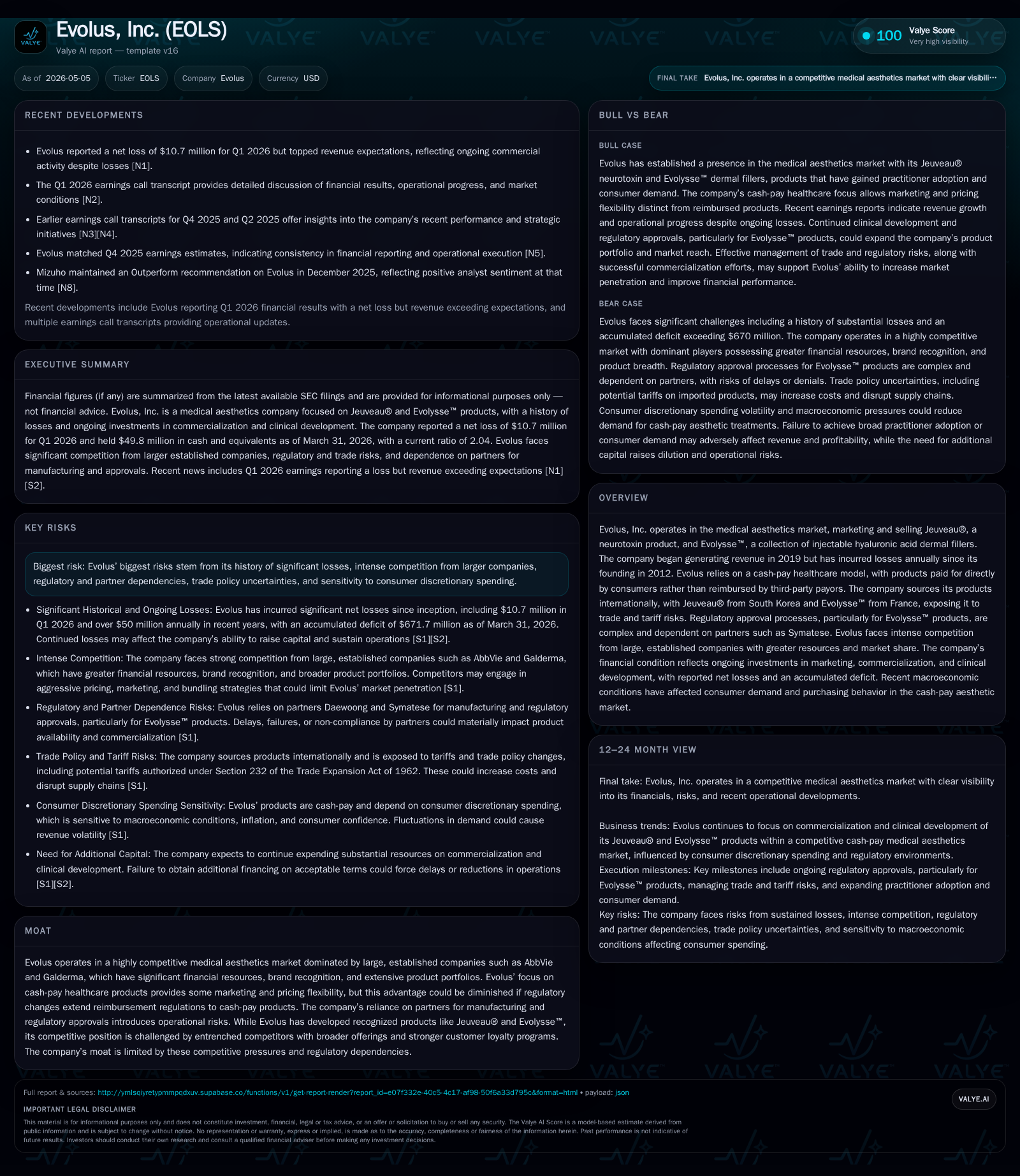
In its latest quarter, Evolus extended its commercial traction with Jeuveau® and Evolysse™ products, delivering revenue that outpaced expectations despite ongoing net losses tied to marketing investment. The company operates under a cash-pay model focused on neurotoxin and dermal fillers sourced internationally, facing stiff competition from entrenched incumbents like AbbVie and Galderma. Regulatory complexities, partner reliance for product approvals, and international supply risks shape its operational landscape. Evolus seeks growth through expanding brand awareness, geographic reach, and product approvals while managing capital structure pressures with $49.8 million cash against $160 million debt as of Q1 2026.
Latest Quarterly Performance and Operational Highlights
Evolus announced its Q1 2026 financial results on May 4, 2026, showing revenue notably above consensus expectations primarily fueled by increased demand for its flagship neurotoxin Jeuveau® alongside early commercial rollouts of its hyaluronic acid dermal filler line Evolysse™ [S2][N1]. The company reported top-line momentum reflective of enhanced channel development with aesthetic providers expanding usage rates. However, despite this topline progress, the quarter closed with a net loss of approximately $10.7 million—a figure consistent with ongoing operating expenses related to marketing expansion efforts aimed at cementing broader brand awareness and practitioner engagement [S2][N1].
Importantly, management commentary during the earnings call underscored an emphasis on building sustainable routes-to-market for both Jeuveau® and Evolysse™ injectables while advancing regulatory processes particularly around the latter product family [N2]. This signals active commercial scaling amidst increasing competition within the cosmetic neuromodulator and injectable filler sectors.
Underlying Business Model and Product Portfolio Quality
Evolus participates in a cash-pay medical aesthetics market segment where consumers directly pay out-of-pocket for cosmetic neurotoxin (Jeuveau®) and injectable dermal filler (Evolysse™) procedures rather than relying on insurance reimbursement frameworks [S1]. This model grants pricing flexibility but also makes demand susceptible to discretionary spending trends.
Jeuveau®’s manufacturing is outsourced to partners in South Korea (Daewoong Pharmaceutical), while Evolysse™ products originate from French manufacturer Symatese under regulatory partnerships which involve complex approval hurdles—critical points that expose Evolus to supply chain disruptions and geopolitical tariff risks impacting costs or availability [S1]. The product profiles position Evolus competitively in terms of efficacy equivalency to market leaders but remain challenged by relatively smaller scale operations.
Margins reflect typical medical aesthetics dynamics where direct costs are matched by substantial selling, general & administrative expenditures required for provider education programs, marketing campaigns targeting end consumers, and establishing distribution networks. This operating cost intensity contributes to continued losses despite growing volumes.
Competitive Dynamics in Medical Aesthetics
The competitive landscape is dominated by industry giants such as AbbVie—owner of BOTOX—and Galderma who command entrenched market share positions due to extensive product portfolios spanning neurotoxins and fillers with superior brand equity [S1][N2]. These players benefit from sizable R&D budgets enabling innovation pipelines alongside robust sales forces capable of bundling multi-product solutions offering price incentives to clinics.
This dominance creates high entry barriers for Evolus given it must compete on brand recognition while lacking economies of scale. Entrenched competitors can also leverage loyalty programs incentivizing practitioners to favor their offerings over newcomers like Jeuveau® or Evolysse™, placing pressure on Evolus’ pricing power despite its strategic focus on cost-sensitive consumer segments via the cash-pay route.
Additionally, shifting regulatory requirements could elevate switching costs further if reimbursement coverage expands into neurotoxin or filler treatments currently paid out-of-pocket; a scenario that may erode Evolus’ pricing autonomy.
Key Growth Drivers and Market Expansion Potential
Growth vectors for Evolus pivot on three main pillars:
- Regulatory Approvals: Progressing FDA clearances especially for Evolysse™'s lip and eye HA gel variants could unlock access to larger U.S. dermal filler markets enhancing product mix differentiation [S2][N2].
- Market Penetration: Increasing the footprint among aesthetic providers through enhanced sampling programs, training initiatives, and co-marketing activities aims to deepen practitioner adoption driving higher repeat usage volumes.
- Consumer Demand: Branding campaigns designed to elevate Jeuveau®’s visibility among end consumers can stimulate procedure frequency uplift aligned with favorable cosmetic spending cycles noted in recent quarters [N2].
These initiatives link directly to measurable KPIs such as sequential revenue growth trajectories post-marketing spend adjustments, new customer acquisitions within core U.S. geographies where medical aesthetics procedures are concentrated, as well as pipeline developments from approvals leading into clinical sales milestones.
Risks and Challenges Impacting Competitive Position and Profitability
Evolus contends with several material challenges:
- Intense Competition: Facing well-capitalized incumbents capable of aggressive discounting or rapid innovation continues to pressure market share gains [S1].
- Regulatory Dependency: The reliance on partners like Symatese for manufacturing approval exposes timelines to external regulatory risk including unexpected delays or denials impacting product launches [S4][S5].
- Trade and Tariff Risk: International sourcing subjects components of the supply chain to tariff impositions or geopolitical shifts potentially raising input costs or disrupting delivery schedules.
- Legal/Compliance Risks: Anti-kickback statutes along with False Claims Act exposures related to marketing practices present operational compliance burdens carrying significant penalties [S7][S12].
- Financial Sustainability: Persistent net losses driven by heavy commercialization expenditures necessitate vigilant liquidity management; failure to achieve profitable scale threatens ongoing capital access despite current cash reserves [F1].
Such multidimensional pressures require robust risk mitigation strategies encompassing compliance frameworks, diversified supplier relationships plus adaptive marketing tactics responsive to competitor maneuvers.
Near-Term Catalysts and Milestones to Monitor
Key near-term indicators include:
- FDA Decisions: Clearance timing outcomes associated with varied Comparability Supplements or new product applications within Evolysse™ line will signal potential expansions in addressable market size [S2].
- Revenue Benchmarks: Quarterly sequential growth rates post Q1 2026 will evidence commercialization effectiveness amid competitive headwinds.
- Marketing ROI Metrics: Effectiveness of recent branding campaigns can be inferred from consumer engagement data integrated into earnings discussions or open metrics disclosures.
- Litigation/Regulatory Developments: Monitoring progress regarding derivative lawsuits or any compliance investigations is essential given their potential financial or reputational impact [S15].
Recognition of seasonality patterns customary in aesthetic procedure volumes should also be factored into performance assessments given demographic spending behavior variability across calendar periods.
Current Financial Profile and Capital Structure
Latest financial snapshot
| Metric | Value | Period |
|---|---|---|
| Cash & equivalents | $49.8M | |
| 2026-03-31 | ||
| Total debt | $160.0M | |
| 2026-03-31 | ||
| Net debt | $110.2M | |
| 2026-03-31 | ||
| Current assets | $138.9M | |
| 2026-03-31 | ||
| Current liabilities | $68.0M | |
| 2026-03-31 | ||
| Current ratio | 2.04x | |
| 2026-03-31 |
Source: SEC companyfacts cache [F1].
As of March 31, 2026, Evolus held cash & equivalents totaling approximately $49.8 million against total debt estimated at $160.0 million resulting in net debt near $110.2 million—with a current ratio of 2.04x indicating reasonable short-term liquidity coverage [F1].
The capital position supports continued commercialization expenditure but underscores the importance of either achieving accelerated profitability horizons or supplemental financing sources to maintain operational flexibility without undue dilution or refinancing stress. Given historical loss accumulation surpassing $671 million through Q1 2026, evolving funding strategies will be critical for sustaining long-term strategic objectives.
Disclaimer: This analysis is intended solely for informational purposes based on publicly available SEC filings and recent company disclosures as of May 2026. It does not constitute investment advice nor an offer to buy or sell securities.
Disclaimer: This is research-only, informational analysis and not investment advice. It may include AI-generated interpretation and general industry context. Always verify important details using primary sources.

Comments