
Unitil Corp Boosts Infrastructure Amid Regulated Energy Demand
Unitil’s latest quarterly results underscore its reinforced infrastructure investments and stable regulated utility operations across New England.
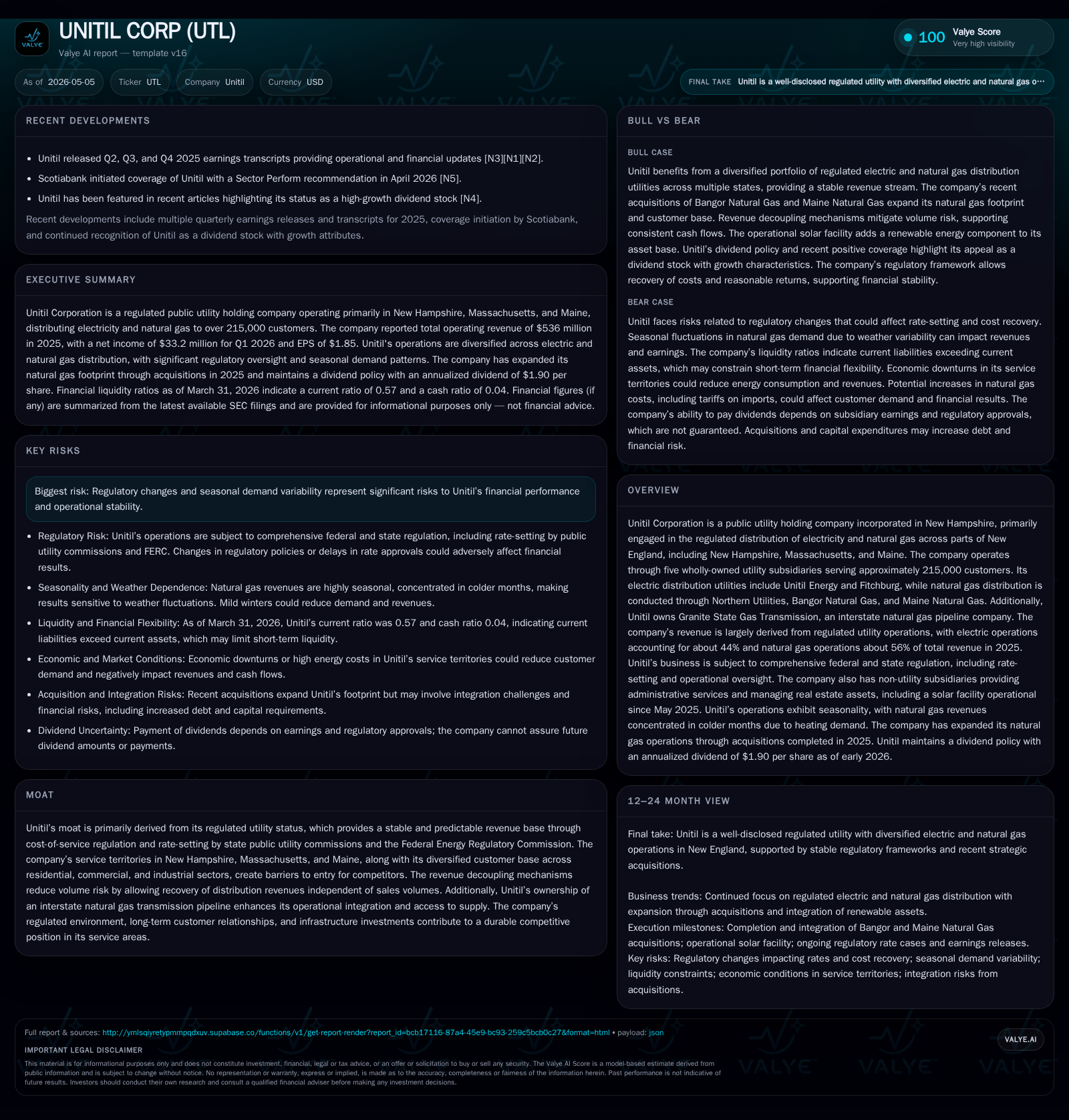
Unitil Corporation reported steady operational performance in its latest quarter ending March 2026, supported by its regulated electric and natural gas distribution businesses serving over 215,000 customers in New England. The company’s business model benefits from cost-of-service regulation with revenue decoupling, helping mitigate volume risk amid seasonal demand variability. Growth is driven primarily by capital expenditures in infrastructure upgrades and geographic expansion via recent acquisitions. However, regulatory uncertainties and operational risks tied to aging assets and weather sensitivity remain watchpoints. Financially, Unitil maintains significant leverage balanced by a stable rate-regulated cash flow profile.
Latest Quarterly Developments and What They Mean
Unitil Corporation’s latest quarterly report filed on May 4, 2026 [S2] highlights a continuation of stable operational performance across its regulated utility segments during Q1 2026. The company serves approximately 215,000 customers with a nearly balanced mix of electric (44%) and natural gas (56%) revenues. There was no material deviation in customer counts or service territory reported relative to prior quarters. Recent event filings dated May 1, 2026 [S3] confirm annual shareholder meeting outcomes without major strategic shifts but emphasize ongoing focus on infrastructure enhancements.
The company reinforced the narrative that its capital investment program remains a key focal point to maintain system reliability amidst regional energy demand pressures. Earnings conference call transcripts from late April/early May 2026 [N1][N2][N3] reaffirm management’s guidance to pursue grid modernization and pipeline integrity projects while navigating expected seasonal demand fluctuations.
Unitil’s Business Model: Regulated Utility Backbone
Unitil is structured as a vertically integrated regulated utility holding company anchored by local distribution subsidiaries operating under cost-of-service regulation endorsed by state Public Utility Commissions (PUCs) in New Hampshire, Massachusetts, and Maine [S1]. This rate-setting framework assures that capital invested into infrastructure plus operating costs are recoverable through customer rates with an allowed return on equity—providing predictable cash flows.
The firm's revenue streams hinge on distribution services delivering electricity and natural gas rather than commodity sales; notably all subsidiaries function as distributors with customers sourcing commodity supply independently except when default service provisions apply. Revenue decoupling mechanisms implemented in MA and NH de-link revenues from volumetric consumption patterns mitigating volatility caused by weather-driven demand swings or energy efficiency trends [S25].
Strategically important is Unitil's ownership of Granite State Gas Transmission, an interstate gas pipeline offering enhanced supply chain integration for its downstream distributors Northern Utilities and others. This asset provides a degree of operational control over upstream capacity vital for serving customer needs reliably.
Operational Footprint and Product Mix in New England
Unitil serves five wholly-owned utilities:
- Electric Distribution: Unitil Energy Systems (NH) covering the seacoast including Concord; Fitchburg Gas & Electric (MA).
- Natural Gas Distribution: Northern Utilities (NH & southern/central ME), Bangor Natural Gas (central ME), Maine Natural Gas (southern/central ME).
- Gas Pipeline Transmission: Granite State spans ~85 miles between NH & ME providing critical interconnections [S1,S15,S16].
These subsidiaries collectively cater to a diverse customer base including residential households, commercial enterprises across health care, education, manufacturing sectors, and industrial accounts typical of the New England region's economic profile. Customer counts total roughly 110k electric and 105k natural gas meters combined with favorable dispersion reducing concentration risk [S16,S22].
The product mix exhibits roughly equal economic weight between electricity distribution revenues (44%) and natural gas (56%), balancing exposure between the two fuels where gas volumes display pronounced winter seasonality while electric usage remains more stable but still subject to summer peak variability due to cooling load [Valye Report Excerpt; S25].
Industry Structure: Regulation and Competitive Dynamics
Operating as a cost-of-service regulated utility places Unitil firmly within a traditionally stable industry structure characterized by stringent state-level oversight via PUCs alongside Federal Energy Regulatory Commission jurisdiction over interstate pipelines such as Granite State. Rate cases periodically establish allowed revenue requirements based on prudently incurred costs plus authorized returns on invested capital — mechanisms that limit competitive threats through territorial exclusivity granted by regulators [S1,S8,S23].
Barriers to entry are substantial given the sunk investment in distribution networks buried under state law monopoly franchises covering specific geographical corridors. Competitors cannot economically replicate these entrenched infrastructures or circumvent established rate agreements readily.
Environmental mandates shaping the region’s decarbonization policies catalyze evolving investment priorities emphasizing grid hardening and clean energy integration while preserving safety standards around aged pipelines [S8]. Supply constraints in electric transmission or natural gas interstate capacity may pose operational challenges necessitating strategic infrastructure development.
Growth Drivers: Infrastructure Investment and Revenue Decoupling
Unitil’s principal growth vectors rest upon:
- Capital Expenditures: Significant ongoing investments target modernization of distribution grids—upgrading aging electrical transformers, automated controls—and reinforcing pipeline integrity aligned with regulatory safety mandates.
- Acquisitions: Recent accretive purchases of Bangor Natural Gas (Jan 2025) and Maine Natural Gas (closed Oct 2025) expanded natural gas footprint adding ~15k customers combined extending both geographic reach and volumetric base [S10,S29].
- Revenue Decoupling: This regulatory mechanism underpins margin stability by enabling full recovery of allowed distribution revenues independent of fluctuating sales volumes due to weather or conservation behaviors—mitigating traditional cyclical risks typical for utilities reliant on volumetric throughput [S25].
Rate case filings are anticipated at regular intervals ensuring economic alignment between invested capital growth translating into higher regulatory rate bases compensated through retail tariffs. Such filings provide discrete milestones for measuring growth trajectory impact on future earnings sustainability.
Risks and Constraints: Regulatory and Operational Challenges
Despite structural advantages, Unitil faces several notable risk factors:
- Regulatory Risk: Variability in administrative decisions regarding allowed returns or disallowed expenses may compress earnings; protracted rate case timings can strain cash flows.
- Operational Hazards: Distribution systems entail inherent dangers including leaks or failures potentially causing outages or accidents implicating safety liabilities [S8]. Aging infrastructure demands increased maintenance expenditures.
- Demand Volatility: Seasonal weather extremes drive sharp swings especially in natural gas volumes affecting short-term financial performance despite decoupling cushions.
- Liquidity Stress: Q1 2026 financials reveal a low current ratio of 0.57 with $236.9 million current assets against $415.9 million current liabilities highlighting tight near-term liquidity; pervasive leverage at $673 million total debt underscores reliance on financing markets for capex funding managing refinancing risk carefully imperative [F1].
- Cybersecurity & Technology Risks: Increasing dependence on complex information systems introduces exposure to disruptions from cyber-attacks or software failures potentially impacting operations.
Near-Term Milestones and Guidance to Watch
Investor focus should monitor:
- Upcoming regulatory rate cases particularly with MA Department of Public Utilities (MDPU) and NH Public Utilities Commission (NHPUC); successful settlements or approvals will materially influence near-term revenue trajectories.
- Quarterly billing volume trends across electric/gas segments reflecting potential abnormal weather impacts or macroeconomic shifts influencing consumption patterns.
- Progress updates on pipeline expansions or grid enhancement projects slated within the next fiscal periods tracking execution against budget/timelines announced in prior earnings calls [N1–N3,S3].
- Customer growth metrics signaling incremental demand lift or attrition trends indicative of regional economic vitality or competition.
- Dividend policy statements from management providing insights into cash flow adequacy amid leverage levels following the recent annual shareholder meeting outcome affirmations [S26].
Current Financial Snapshot: Leverage and Liquidity Metrics
Latest financial snapshot
| Metric | Value | Period |
|---|---|---|
| Cash & equivalents | $17mm | |
| 2026-03-31 | ||
| Total debt | $673mm | |
| 2026-03-31 | ||
| Net debt | $656mm | |
| 2026-03-31 | ||
| Current assets | $237mm | |
| 2026-03-31 | ||
| Current liabilities | $416mm | |
| 2026-03-31 | ||
| Current ratio | 0.57x | |
| 2026-03-31 |
Source: SEC companyfacts cache [F1].
| Metric | Value |
|---|---|
| Cash & Equivalents | $16.9 million |
| Total Debt | $673.1 million |
| Net Debt | $656.2 million |
| Current Assets | $236.9 million |
| Current Liabilities | $415.9 million |
| Current Ratio | 0.57 |
As of March 31, 2026, Unitil's balance sheet reveals substantial long-term debt typical for capital-intensive utilities investing heavily in regulated infrastructure portfolios. The modest cash balance relative to liabilities points to dependency on revolving credit facilities or bond markets for short-term liquidity needs. Nonetheless, consistent regulatory cost recovery frameworks underpin stable cash flow generation capacity aiding debt servicing ability [F1,S2].
This leverage level requires vigilant capital management particularly if accelerated capex programs intensify borrowing requirements amid potential interest rate environment uncertainties affecting new debt issuance costs.
This analysis is based solely on available SEC filings through May 4, 2026 ([S1]-[S29]), recent earnings transcripts ([N1]-[N3]), news sources ([N4]-[N6]), and companyfacts financial data ([F1]). No investment recommendations are provided.
Disclaimer: This is research-only, informational analysis and not investment advice. It may include AI-generated interpretation and general industry context. Always verify important details using primary sources.

Comments