
Cheesecake Factory Navigates Inflation and Capital Commitments in Q1 2026
Q1 2026 results highlight resilience amid inflationary pressures and ongoing capital allocation strategies.
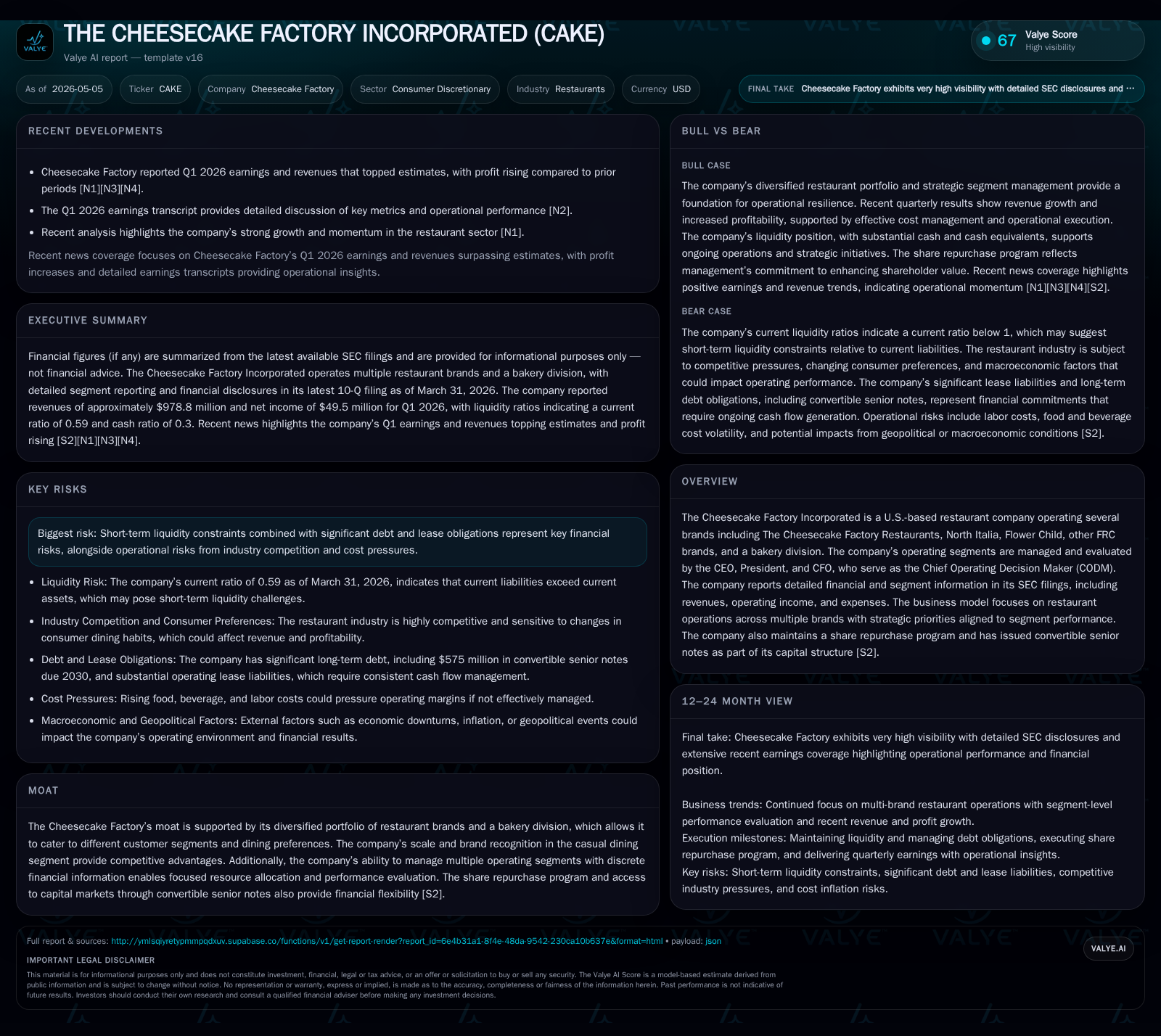
The Cheesecake Factory reported its latest quarterly results for Q1 2026, emphasizing operational resilience despite cost pressures from commodity and wage inflation. The company maintains compliance with its revolving credit financial covenants and has expanded its share repurchase authorization. Key challenges include ongoing tax disputes and legal contingencies, while growth is supported by brand portfolio diversification and targeted capital investments. Liquidity remains adequate with significant cash reserves offsetting debt obligations.
Recent Operating Update: Q1 2026 Highlights
The Cheesecake Factory’s most recent quarterly filing dated May 4, 2026 ([S2]) provides key insights into the company's operating condition as it advances through the first quarter of fiscal year 2026. Notably, the company is navigating an ongoing Internal Revenue Service examination pertaining to tax years 2015 through 2020. The IRS has proposed disallowing certain depreciation and domestic production activity deductions, along with associated penalties. Management has formally contested most of these findings, escalating the matter to the IRS Appeals Division without any material reserve recorded currently. While this matter poses some risk uncertainty, its impact on the immediate liquidity or earnings does not yet appear material.
Under the revolving credit facility—providing committed access to up to $400 million—the company must maintain a maximum net adjusted leverage ratio (net debt to EBITDAR) of 4.25x and a minimum EBITDAR coverage ratio of interest plus rent at 1.90x quarterly. As of March 31, 2026, Cheesecake Factory was in compliance with these covenants ([S2]). This disciplined approach supports ongoing access to working capital amid elevated but moderating inflation pressures.
On April 23, 2026 ([S3]), the Board declared a quarterly cash dividend of $0.30 per share payable in late May—a slight increase evidencing commitment to returning capital notwithstanding cautious earnings visibility.
Additionally, share repurchases remain integral to capital allocation strategy with the Board increasing buyback authorization from prior levels to a total of 66 million shares as of February 2026. Buybacks executed to date exceed 60 million shares for roughly $2 billion invested through March end, reflecting a purposeful offset of dilution from equity compensation as well as an effort to boost per-share metrics ([S7]).
Business Model: Multi-Brand Restaurant Operations with Strategic Financial Flexibility
Cheesecake Factory operates primarily through a multi-brand restaurant group structure including its flagship Cheesecake Factory Restaurants, North Italia fast-casual outlets, Flower Child health-focused concepts, additional Fox Restaurant Concepts (FRC) brands, and an affiliated bakery division supplying cakes and desserts across outlets and retail channels ([S1],[S2]). Revenue is generated mainly via dine-in services accompanied by off-premise sales such as catering and delivery.
Customers range broadly across demographic segments seeking casual yet differentiated dining experiences featuring menu variety—from broad American fare & signature cheesecakes to regionally inspired cuisines through portfolio brands. This segmentation affords diversified revenue streams that can mitigate narrow market downturns.
Revenue mechanics depend heavily on foot traffic volumes, average check sizes influenced by menu pricing changes (notably adjusting for ingredient cost inflation), mix shifts between dine-in vs. off-premise orders, promotions efficacy, and consumer sentiment linked to economic conditions ([S1]). Margins are sensitive to labor expenses—which have risen steeply due to wage inflation—as well as food commodity costs impacted by broader supply-chain dynamics.
Capital efficiency is aided by active share repurchase programs reducing share count over time and convertible senior notes issuance—currently $575 million outstanding due in 2030 bearing low fixed coupon rates near 2% per annum—providing low-cost funding albeit with structural obligations ([S12]). Share repurchase timing considers operating cash flow forecasts alongside debt service capacity governed by loan covenants limiting distributions based on leverage levels ([S7],[S2]).
This approach supports long-term EPS accretion without compromising investment in restaurant openings or renovations required for brand vitality.
Industry Structure and Competitive Position
The casual dining sector in which Cheesecake Factory participates is characterized by intense competition both from traditional sit-down chains (such as Brinker International’s Chili's & Maggiano's) and rapidly growing fast-casual players that appeal via convenience or niche cuisine focuses. Pricing pressure from discount-driven consumer behavior amid inflationary periods challenges margin preservation.
Cheesecake Factory’s moat rests on premium brand recognition—especially for dessert offerings—and geographic reach across approximately 240 units nationwide combined with sister brands reaching complementary customer bases ([S1],[S2]). Moreover, operational oversight centralized under key executive roles facilitates coherent strategic resource allocation per segment rather than siloed approaches, allowing nimble response to market trends.
However, rising labour costs combined with fixed lease commitments impede rapid margin expansion absent effective price realization or operational efficiencies ([S22]). Capacity constraints within existing real estate portfolios limit accelerated systemwide expansion speed—a factor common across established chain operators.
Notably the bakery segment supplies proprietary products that reinforce brand authenticity while diversifying revenue sources beyond direct foodservice sales.
Growth Drivers
- Menu Innovation & Brand Extension: Continued rollout of new food items tailored toward health-conscious consumers alongside plant-based options under Flower Child could capture evolving preferences.
- Digital & Off-Premise Sales Expansion: Scaling out digital ordering platforms and third-party delivery partnerships may partially offset slower dine-in growth volatility.
- Operational Efficiencies: Leveraging technology for labor scheduling optimization plus supply chain re-engineering promises modest margin uplift despite cost headwinds.
- Selective Unit Growth: Opening strategically located new stores particularly for fast-casual banners such as North Italia where demand elasticity is higher versus core Cheesecake Factory venues constrained by size or lease terms.
- Capital Deployment Discipline: Maintaining balance between share buybacks and reinvestment enables EPS growth aligned with sustainable leverage profiles.
Risks / Watchpoints / Growth Constraints
- Tax & Legal Contingencies: The unsettled IRS audit spanning multiple tax years introduces execution uncertainty potentially affecting free cash flow if penalties materialize beyond current estimates ([S2],[S14]).
- Debt Covenants: Revolving credit restrictions cap debt levels relative to EBITDA-based metrics restraining aggressive leverage buildup; dividend payments or repurchases can be curtailed if ratios deteriorate ([S2]).
- Inflation Persistence: Wage inflation well above historical averages continues pressuring cost structures especially given tight labor markets; supply-side commodity price shocks could intermittently surface.
- Consumer Behavior Shifts: Post-pandemic trends toward convenience-oriented dining may reduce traditional casual dining visits; competitive encroachment by fast-casual disruptors demands continuous adaptation.
- Lease Obligations: Heavy fixed rental expenses limit operational flexibility during downturns or changing site economics affecting profitability reliability.
What To Watch Next
- Track resolution progress on IRS appeals process for tax deduction disallowances which bears on contingent liabilities exposure.
- Monitor quarterly EBITDAR performance relative to interest plus rent expense sustaining covenant compliance thresholds.
- Evaluate same-store sales growth trends across individual restaurant brands reflecting consumer acceptance amidst macroeconomic shifts (data releases forthcoming).
- Assess subsequent share repurchase volumes given Board-authorized limits versus available cash flows.
- Follow announcements about new unit openings or renovations especially for North Italia or Flower Child as execution indicators for portfolio growth strategies.
- Observe commodity price indices alongside wage rate trends disclosed in subsequent earnings calls or SEC updates.
Financial Profile Summary (March Q1 2026)
Latest financial snapshot
| Metric | Value | Period |
|---|---|---|
| Cash & equivalents | $235mm | |
| 2026-03-31 | ||
| Total debt | $631mm | |
| 2026-03-31 | ||
| Net debt | $396mm | |
| 2026-03-31 | ||
| Current assets | $465mm | |
| 2026-03-31 | ||
| Current liabilities | $781mm | |
| 2026-03-31 | ||
| Current ratio | 0.59x | |
| 2026-03-31 |
Source: SEC companyfacts cache [F1].
This snapshot reflects liquidity buffers supported by substantial cash balances amidst sizable debt obligations predominantly comprised of unsecured convertible notes coupled with revolving credit availability ([F1],[S2]).
Disclaimer
This report is intended solely for informational purposes providing an analysis based on publicly available data as of early May 2026 without offering investment advice or recommendations.
Disclaimer: This is research-only, informational analysis and not investment advice. It may include AI-generated interpretation and general industry context. Always verify important details using primary sources.

Comments