
Firefly Aerospace Advances Production and Launch Capabilities Leveraging Robust Liquidity in Competitive Space Market
Latest quarterly disclosures highlight Firefly Aerospace's operational scaling, executive consolidations, and financial resilience amid industry competition.
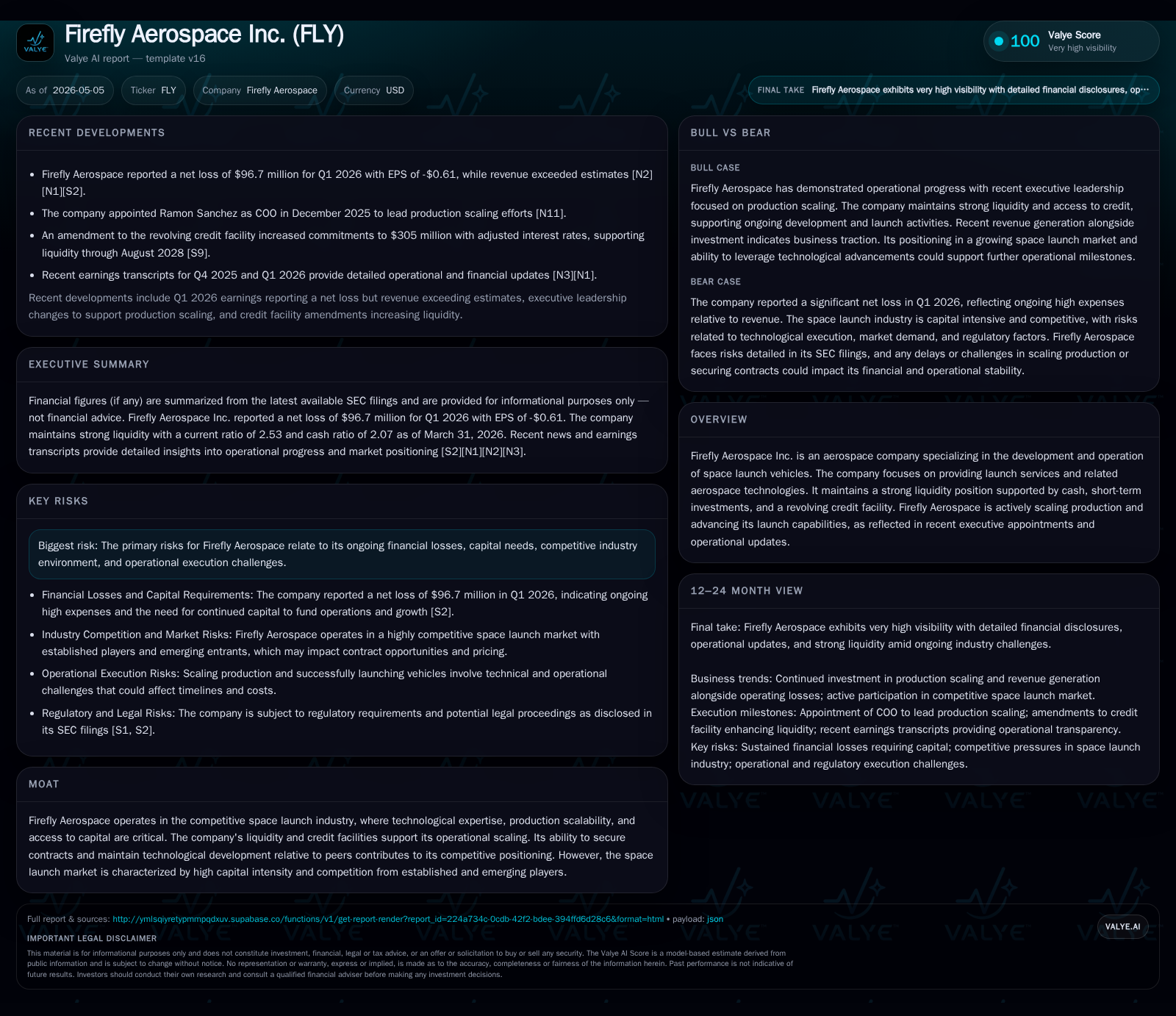
Firefly Aerospace Inc. reported ongoing progress in scaling its space launch vehicle production and operational capabilities in its latest quarter ending March 31, 2026. The company strengthened its management framework through renewed executive contracts, while maintaining a strong liquidity position supported by $326 million in cash and manageable debt. Operating within an intensely capital-intensive and competitive aerospace sector, Firefly continues expanding its launch service offerings and technological development. Key growth drivers include contract acquisitions, production scalability, and credit facility enhancements, with risks centered on execution challenges and competitive pressures.
Recent Operating Update
In its Q1 2026 Form 10-Q filed May 4, 2026 [S2], Firefly Aerospace provided detailed updates on its continuing efforts to scale production facilities and refine launch capabilities. The quarter closed with a robust cash balance of $326 million against a relatively low total debt of $27 million as of March 31, 2026 [F1], supporting a strong current ratio of 2.53. This liquidity foundation enables ongoing investment into rocket manufacturing and technology development.
Around mid-April 2026, the company formalized confirmatory employment agreements with its CEO Jason Kim, CFO Darren Ma, and COO Ramon Sanchez [S26], ensuring executive leadership continuity amidst its growth phase. These agreements include base salaries ranging from $420K to $500K with substantial bonus potentials tied to performance metrics.
Additionally, Firefly amended its senior secured revolving credit facility increasing commitments by $45 million to an aggregate $305 million [S16]. Interest rates on this facility were adjusted upwards slightly but remain aligned with market conditions. Covenants were also modified to remove minimum free cash flow requirements while mandating a minimum liquidity threshold of approximately $381 million monthly.
Business Model
Firefly Aerospace operates primarily in the design, development, manufacturing, and provision of launch services for space vehicles. Revenue is generated principally through contracts awarded by commercial satellite operators, government agencies (including NASA), and defense customers seeking reliable orbital access for satellites or cargo.
The company’s revenue mechanics hinge on volume of launched missions driven by backlog orders and contracts signed; pricing depends on launch vehicle configuration complexity and mission parameters. Margins are influenced by production efficiency gains over time as capacity utilization improves alongside technological maturation. The dynamics also incorporate multi-year arrangements common in aerospace contracting.
Scalability is strategic: expanding factory throughput reduces unit fixed costs while accelerating launch cadence enhances revenue velocity without proportionate overhead increases. Maintaining proprietary engine technologies and certification processes establishes barriers to entry reinforcing differentiation.
Customer behavior reveals increasing demand for flexible small-to-medium launchers catering to proliferating satellite constellations. Firefly positions itself to capture this niche through the Alpha rocket family series along with plans for heavier-lift models targeting broader market segments.
Industry Structure and Competitive Position
The commercial space launch industry is intensely competitive with high barriers stemming from complex engineering requirements plus capital intensity exceeding hundreds of millions annually. Major incumbents like SpaceX dominate scale economics; however, emerging companies such as Rocket Lab and Blue Origin also contest market share focusing on specific payload classes or innovation areas.
Firefly Aerospace’s competitive edge lies in its agile production strategies combined with strategic credit facilities that fund rapid expansion without excessive leverage risk [S16]. Its integration of end-to-end aerospace capabilities—covering propulsion development acquired through SciTec Innovations in late 2025 [S8]—bolsters vertical integration reducing supply chain dependencies.
Strategically, Firefly targets small-to-medium payload markets where flexibility commands premium pricing versus larger vehicles optimized for bulk launches. Successful contract captures hinge on demonstrated mission reliability and regulatory compliance within a constrained geopolitical environment impacting export controls.
Growth Drivers
- Increasing Launch Frequency: Scaling factory output improves ability to fulfill automated launches fulfilling backlog demand steadily enhancing revenue recognition profiles.
- Expanded Product Portfolio: Development efforts directed to evolve next-generation rockets capable of higher payload capacities or reusable stages signal potential margin improvements.
- Contract Wins: Securing government missions or commercial constellation services via competitive bidding sustains top-line growth momentum.
- Credit Facility Enhancements: Larger revolving credit provides financial flexibility to invest aggressively in CAPEX required to handle increasing manufacturing volumes without liquidity stress.
- Technological Innovation: Advancements in engine technology via acquired SciTec innovations offer potential cost advantages delivered through improved thrust efficiency or reusability parameters.
These drivers link directly with measurable KPIs: booked backlogs pending launch orders; number of successful launches per period; R&D completion milestones; cash burn relative to operating leverage; credit covenant compliance metrics.
Risks / Watchpoints / Growth Constraints
- Execution Risk: Delays or failures in vehicle development/testing phases can materially impact revenue timing while eroding customer trust.
- Financial Burn Rate: Despite strong cash reserves [F1], the capital-intensive nature requires vigilant management of operating losses till breakeven can be achieved.
- Competitive Pressure: Pricing wars or superior technological breakthroughs by rivals could erode Firefly’s market share in target payload segments.
- Regulatory Environment: Export controls around propulsion tech or geopolitical tensions could restrict certain contract opportunities or raise compliance costs.
- Supply Chain Dependencies: Component shortages remain elevated industry-wide post-pandemic supply shocks posing periodic interruptions until vertical integration matures fully.
What To Watch Next
Investors and stakeholders should monitor several key developments:
- Updates on backlog figures announced during quarterly earnings calls or event presentations detailing new awards versus fulfillment status [N1][N2].
- Successful execution milestones achieved on test flights or certification steps validating new rocket types under development [S2][S3].
- Quarterly liquidity covenant adherence especially reflecting amended minimum liquidity requirements ($381M monthly) under the credit agreement [S16].
- Progress in integrating acquired SciTec propulsion technologies into flight hardware delivering improved performance metrics [S8].
- Any changes disclosed regarding risk factors or operational setbacks particularly in subsequent SEC filings [S24].
- General aerospace industry trends surrounding satellite constellation expansions that could buoy long-term rocket demand curves [N13][N14].
Financial Profile (Brief Latest Context)
Latest financial snapshot
| Metric | Value | Period |
|---|---|---|
| Cash & equivalents | $326mm | |
| 2026-03-31 | ||
| Total debt | $27mm | |
| 2026-03-31 | ||
| Net debt | $-299mm | |
| 2026-03-31 | ||
| Current assets | $674mm | |
| 2026-03-31 | ||
| Current liabilities | $266mm | |
| 2026-03-31 | ||
| Current ratio | 2.53x | |
| 2026-03-31 |
Source: SEC companyfacts cache [F1].
As of Q1 2026:
- Cash & equivalents: $326 million [F1]
- Total debt outstanding: $27 million [F1]
- Current assets: $674 million; Current liabilities: $266 million resulting in a current ratio of 2.53 [F1]
- Reported net losses remain sizable as investments into R&D and operational scale ramp up (Operating loss approx. -$260 million annualized based on latest year-end figures) [F1]
- Revolving credit facility extended/expanded to $305 million total commitments with adjusted interest terms reflecting market conditions [S16]
This financial stance supports continued investment capacity without immediate refinancing pressure; however profitability will rely heavily upon achieving higher launch frequencies combined with operational efficiencies developed over the medium-term horizon.
This analysis synthesizes currently available public insights from Firefly Aerospace's SEC filings up to May 2026 alongside recent news transcripts capturing operational progress without conjecture beyond disclosed facts. It aims to present an industry-informed perspective anchored firmly on documented developments rather than speculative projections.
Disclaimer: This is research-only, informational analysis and not investment advice. It may include AI-generated interpretation and general industry context. Always verify important details using primary sources.

Comments