
Southern First Bancshares Elevates ClientFIRST Banking in Growing Southeast Metro Markets
Southern First Bancshares leverages its relationship banking and regional footprint to support growth amid evolving economic and regulatory challenges.
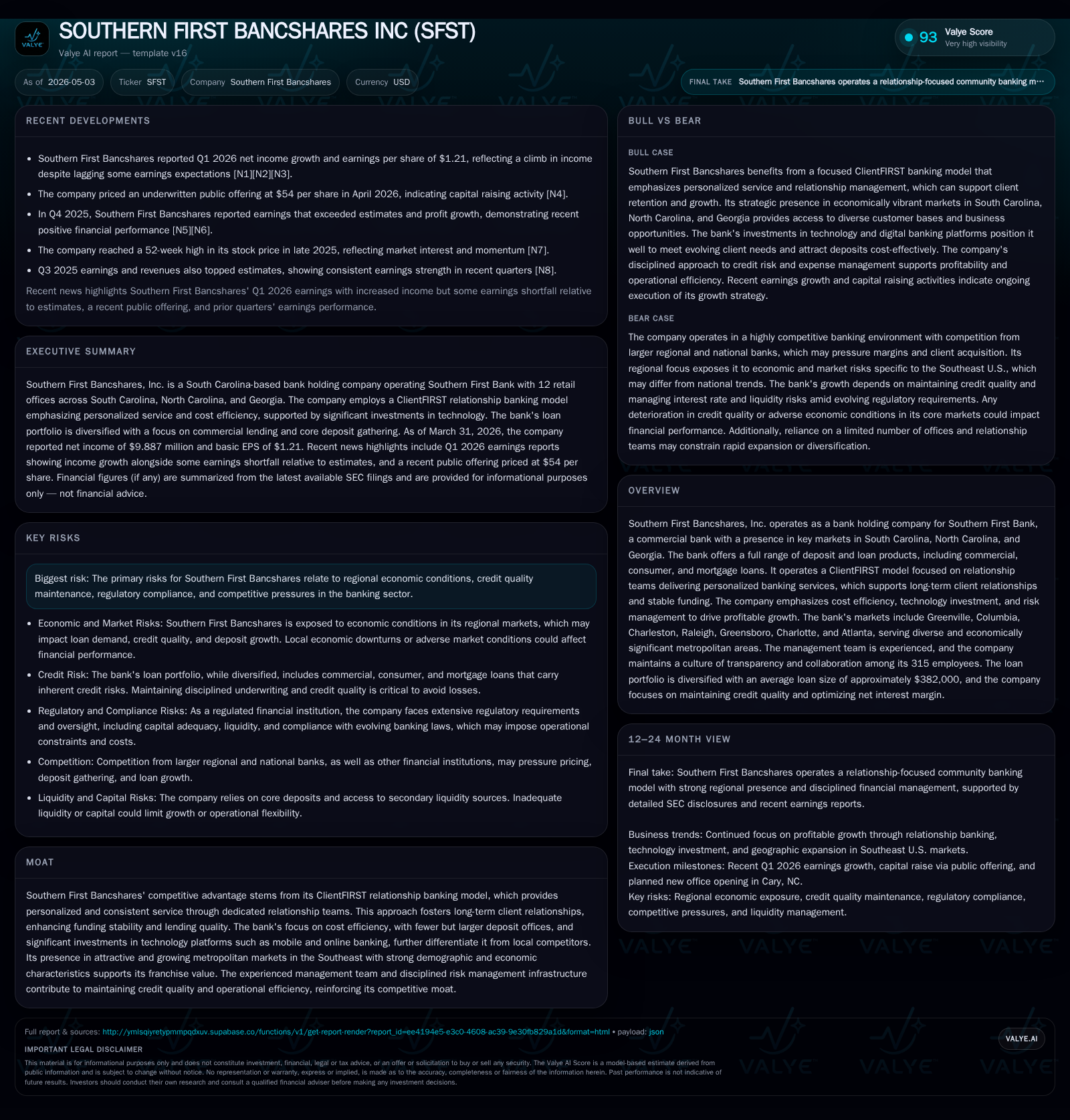
Southern First Bancshares reported first-quarter 2026 results highlighting steady loan growth and ongoing investments in technology and market expansion. Anchored by its ClientFIRST relationship banking model, the company maintains high deposit concentration per office, emphasizing personalized service and credit discipline. Operating primarily across economically vibrant Southeast metropolitan areas, Southern First balances growth initiatives including a new Cary, NC office with a disciplined risk management framework that mitigates regional real estate concentration risk. Key upcoming milestones include monitoring loan performance trends and execution of strategic branch openings.
Recent Quarterly Update Illuminates Key Operational Shifts
Southern First Bancshares’ most recent quarterly report (10-Q filed May 1, 2026) reveals sustained operational discipline amidst macroeconomic uncertainties impacting its Southeast markets [S2]. The first quarter showed a balanced loan portfolio without significant deterioration in asset quality metrics or credit charge-offs. Deposit composition continues to tilt toward retail transaction accounts rather than wholesale time deposits, reflecting efforts to maintain low-cost funding sources. Additionally, the recent April 21 event filing detailed Q1 earnings results accompanied by an investor slide deck which emphasize solid core deposit growth and effective expense management despite some pressures on net interest margins due to shifting rate environments [S3]. This near-term operational update is critical because it reflects management’s commitment to preserving the ClientFIRST model while navigating the complexities of a real estate–concentrated lending book under scrutiny from evolving regulatory perspectives.
The ClientFIRST Model: Southern First’s Core Business Advantage
At the heart of Southern First Bancshares’ strategy lies the ClientFIRST banking model, which structures client engagement around dedicated relationship teams delivering consistent, personalized service [S1]. These teams manage all aspects of a client’s banking needs—from commercial loans to deposit products—creating high switching costs that support deposit stability and lending quality. The bank operates comparatively fewer but larger branches—averaging approximately $263.7 million in deposits per office—which achieves notable cost efficiency compared with peers servicing similar demographics [S1]. This approach fosters deep local market knowledge leveraged by experienced bankers who focus on client retention rather than rapid geographic expansion. By emphasizing larger average loan sizes (~$382,000) per relationship over growing office count, Southern First creates scalable value while mitigating typical small community bank inefficiencies.
Product Suite and Relationship Management Driving Revenue Quality
Southern First offers a comprehensive array of financial products targeting commercial, consumer, and mortgage segments. Approximately 83% of loans are collateralized by real estate—a structural exposure that underpins both repayment security and regulatory scrutiny [S1]. Besides traditional commercial real estate financing (owner-occupied and investor properties), the bank extends carefully underwritten consumer loans comprising about 1.1% of the portfolio as of end-2025 [S4]. Fee income streams derive from deposit transaction fees, ATM charges, wire transfers, and other ancillary services enabled by robust digital platforms [S5][S15]. Notably, the 2023 establishment of a Dream Mortgage Center enriches mortgage lending capabilities with enhanced borrower education programs designed for long-term customer acquisition and retention. This diversified revenue mix paired with strong customer relationships contributes to outcome resilience.
Competitive Positioning in Southeast Regional Banking
Southern First’s footprint encompasses major Southeastern metro markets: Greenville, Columbia, Charleston (SC), Raleigh, Greensboro, Charlotte (NC), and Atlanta (GA). These areas benefit from favorable demographic trends and economic dynamism relative to national averages but also pose localized cyclical risks tied to industries such as manufacturing and commercial real estate development [S1][S2]. The firm’s competitive strength derives from its ability to provide localized personalized banking alternatives to large out-of-state competitors consolidating community banks within these metros. Integration of technology platforms combined with focused relationship teams differentiates Southern First's delivery experience and underpins higher average account balances per branch compared to peers. Despite geographic concentration risks inherent at regional banks versus nationally diversified institutions, Southern First manages these via disciplined underwriting processes backed by rigorous credit risk governance [S16][S18].
Growth Catalysts: Market Expansion and Technology Investment
The company’s near-term growth trajectory is underpinned by concrete initiatives: opening a retail branch in Cary, North Carolina scheduled for late 2026 aims to capture rising suburban demand in an affluent metro area with expanding residential development [S1][S3]. Concurrently, ongoing investment in digital banking—including mobile deposit channels which accounted for 15% of deposits during 2025—and the Dream Mortgage Center enhance both customer acquisition funnels and cross-sell potential within existing markets [S15]. Talent acquisition remains crucial given the ClientFIRST model’s reliance on skilled bankers rather than pure geographic proliferation. These targeted expansions suggest capacity for incremental volume gains without disproportionate overhead increases reflecting prudent capital deployment strategy.
Risk Profile: Economic Sensitivity and Credit Quality Controls
Significant risk factors center on regional macroeconomic volatility influencing client cash flows especially in commercial real estate-dependent loans making up over three-quarters of assets collateralized by property value [S1][S16]. Given FDIC guidance tightening oversight on CRE exposure levels nationally—a threshold linked to loans exceeding multiples of risk-weighted capital—Southern First must vigilantly monitor portfolio concentrations to avoid regulatory-imposed lending curbs that could throttle growth or require accelerated risk mitigation actions [S18]. Repayment of commercial business loans relying primarily on borrower cash flows rather than collateral liquidation underscores vulnerability should local economic cycles worsen abruptly. Additionally, persistent inflationary pressures may strain borrower liquidity impacting delinquencies or increasing provision expenses [S2]. Regulatory changes remain fluid; however, current capital adequacy tests affirm solid buffers supporting ongoing operations under stress scenarios [S12][F1]. Cybersecurity threats pose another layered risk given increasing reliance on digital platforms integral to customer service delivery.
Monitoring Metrics: Guidance and Milestones Ahead
Investors should closely observe quarterly loan origination trends segmented by commercial versus consumer categories to gauge sustainable asset growth. Monitoring shifts in deposit mix between low-cost retail accounts versus wholesale certificates of deposit will reveal funding cost pressures or efficiencies achieved. Execution timelines for the new Cary office opening represent tangible milestones tied directly to local market penetration ambitions. Credit charge-off ratios and nonperforming asset levels will serve as leading indicators of portfolio health amid uncertain inflation-adjusted regional economic activity. Regulatory announcements around capital requirements post-Basel III adjustments or CRE lending limits may affect strategic planning horizons. Management’s commentary accompanying future quarterly reports or investor presentations will provide further directional clarity on balancing growth with prudence.
Overview of Current Financial Health
According to latest disclosures complemented by companyfacts data through fiscal year-end December 31, 2025, Southern First maintains net income levels indicative of stable profitability supported by controlled expense ratios and diversified revenue streams (net income approximately $30.4 million) [F1]. The balance sheet shows a healthy cushion above regulatory-mandated capital thresholds positioning the bank as well-capitalized under FDIC metrics [S12]. Liquidity metrics remain sound though specific recent quarter-end cash equivalents were last publicly reported as $5.8 million as of end-2022; subsequent filings imply ongoing adequacy amidst growth funding demands without material shortfall concerns [F1][S2]. The company authorized up to $5 million share repurchases signaling confidence in free cash flow stability absent urgent capital needs [S7]. Overall financial solidity supports continued ClientFIRST program investment alongside measured geographic expansion.
This analysis synthesizes publicly filed SEC documents predominantly from Southern First Bancshares’ Q1 2026 Form 10-Q alongside annual filings dated February 24, 2026. It integrates contextual insights into Southeast regional banking dynamics relevant for stakeholders seeking a nuanced understanding beyond headline financials. No forward-looking investment recommendations are made herein.
Disclaimer: This is research-only, informational analysis and not investment advice. It may include AI-generated interpretation and general industry context. Always verify important details using primary sources.

Comments