
Apple Reports Strong Q2 Momentum Backed by iPhone Sales and Ecosystem Expansion
Apple's Q2 fiscal 2026 results highlight robust demand for flagship hardware and accelerating services growth amid a pivotal leadership transition.
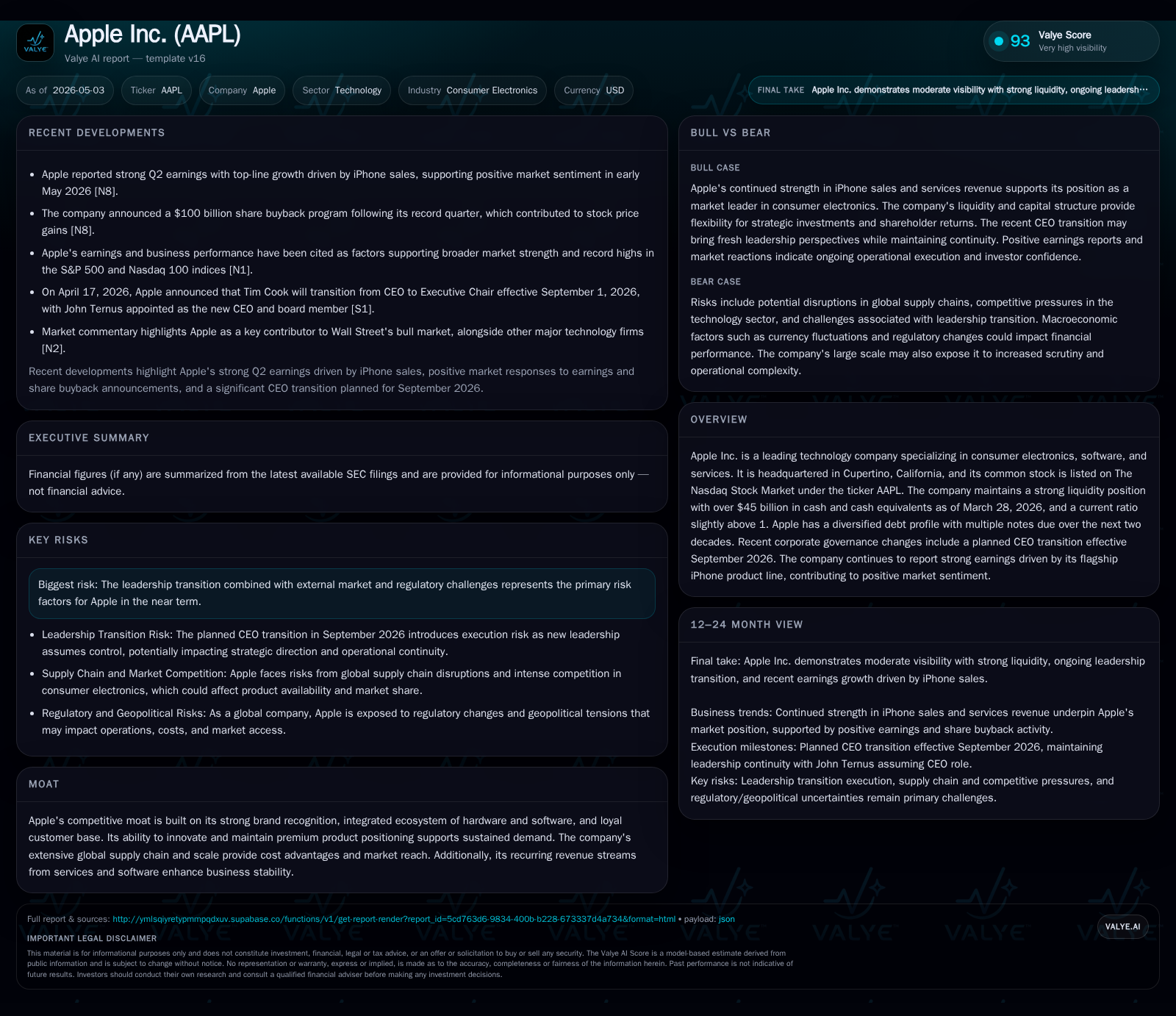
In its latest quarterly filing, Apple reported record sales driven predominantly by iPhone unit growth and expanding revenue from its services segment. This momentum underscores the strength of Apple’s integrated ecosystem and premium product positioning as key competitive advantages. Meanwhile, a significant corporate governance transition is underway with John Ternus set to succeed Tim Cook as CEO in September 2026, marking an inflection point for strategic continuity. Industry dynamics remain favorable but ongoing regulatory scrutiny and macroeconomic factors warrant close monitoring.
Q2 2026 Operating Highlights: Breaking Down the Latest Results
Apple's fiscal Q2 2026 disclosures [S2][S3] articulate a period of record operational performance anchored by the sustained strength of its flagship iPhone lineup. The quarter ending March 28, 2026, saw a notable uptick in iPhone unit volumes combined with improved average selling prices (ASPs), contributing materially to overall revenue expansion. Market commentary confirms this beat was the strongest among major technology peers this earnings season [N2][N6]. Services revenue again showed robust growth trends, reflecting increased engagement across the App Store ecosystem, paid subscriptions, and cloud services.
This quarter’s financial momentum catalyzed positive market reactions with share price appreciation noted immediately post-results [N10]. Commentary within filings indicates broad-based geographic penetration gains accompanied by early traction in adjacent device categories such as wearables. These outcomes reflect executional excellence against a backdrop of cautious macroeconomic environments.
Business Model Excellence: Ecosystem Synergies and Product Leadership
Apple’s business model centers on a triad of integrated pillars: premium hardware products like iPhones, Macs, and wearables; proprietary operating systems with tailored applications; and an expanding suite of subscription-based services including digital content delivery and cloud offerings [S1]. This tightly knit ecosystem generates substantial ecosystem lock-in through seamless interoperability, high switching costs, and a unified user experience.
Revenue is principally generated via direct consumer purchases of hardware at premium price points enabled by enduring brand loyalty. Simultaneously, the services segment reinforces recurring revenue streams that benefit from high customer lifetime value and scalable economics due to minimal incremental costs per user. This hybrid monetization approach diversifies Apple's income sources while enhancing margin stability.
Product quality remains a cornerstone with frequent iterative innovation cycles ensuring that each new generation sustains competitive relevance. The combination of hardware-software co-design enhances feature differentiation difficult for competitors to replicate fully, thus supporting sustainable pricing power.
Competitive Positioning in Consumer Electronics and Services
Within the consumer electronics industry landscape, Apple's moat is underpinned by its global scale in supply chain management and researcher-intensive innovation capabilities. Its ability to procure components efficiently and orchestrate complex manufacturing logistics sustains cost advantages amidst supply headwinds impacting peers.
The premium smartphone market exhibits somewhat inelastic demand profiles linked tightly to brand differentiation; Apple capitalizes on this dynamic through controlled product launches and selective channel distribution strategies. However, regulatory environments—especially scrutiny on App Store commissions in multiple jurisdictions—and US-China trade relations introduce risks affecting cost structures or potential forced business model adjustments [S4].
Industry innovation cadence favors players investing heavily in augmented reality features, AI integration in user interfaces, and health-monitoring technologies—a natural extension for Apple given its wearables portfolio synergy.
Growth Catalysts: Innovation, Services Expansion, and Market Reach
Looking forward, Apple’s growth vectors crystallize around continuous product innovation — including augmented reality wearables rumored to be entering pilot production — alongside expansion of high-margin services such as Apple Music, iCloud storage subscriptions, Apple TV+, and financial offerings integrated via Apple Pay [S2]. These initiatives are fueled by the ever-growing installed base locked into Apple’s ecosystem.
Emerging markets represent another strategic frontier where rising middle-class adoption can offset saturation in developed regions; however, premium pricing strategies require careful calibration to maximize penetration without diluting brand aspirations. Enhanced bundled offerings could increase wallet share per active user.
Capitalizing on connectivity proliferation also permits Apple to innovate with cloud computing-backed features improving user engagement metrics—critical drivers for recurring revenue acceleration.
Potential Constraints: Leadership Transition and Regulatory Pressures
Noteworthy near-term uncertainty accompanies the impending leadership transition effective September 1, 2026 [S14], as longtime CEO Tim Cook will step into an Executive Chair role. His successor John Ternus brings extensive engineering leadership but has yet to prove stewardship at this executive tier. Maintaining strategic momentum without disruption represents a key governance challenge.
Concurrently, persistent regulatory pressures focusing on antitrust concerns around App Store fees impose potential threat vectors that could reshape service economics or licensing models [S4]. Geopolitical tensions impacting component sourcing or tariffs add complexity to supply chain reliability amid continuing inflationary dynamics.
The durability of demand amid global macroeconomic fluctuations also demands vigilance—premium product cycles typically face variability during economic slowdowns.
Looking Ahead: Key Milestones and Indicators for Near-Term Monitoring
Market participants should track several cues over upcoming quarters including:
- Management commentary on Q3 guidance relative to current macro trends [S2]
- Active installed base trends across devices providing early signals for upgrade cycle vigor
- Service segment subscription growth rates serving as proxies for ecosystem monetization health
- Supply chain updates revealing resilience or emerging bottlenecks impacting product availability
- Execution progress on new product categories such as AR/VR devices or expanded financial technologies
- Governance developments relating to CEO transition effectiveness impacting strategic clarity [S14] Collectively these indicators will clarify whether recent operational excellence translates into sustainable long-term growth trajectories.
This analysis synthesizes information contained primarily within Apple's latest quarterly 10-Q filing dated May 1, 2026 [S2], recent event filings [S3][S14], annual report context [S1], supplemented by credible secondary sources [N2][N6] without offering investment recommendations or forecasts. The assessment focuses on operational dynamics underpinning business fundamentals rather than detailed financial metrics per policy constraints.
Disclaimer: This is research-only, informational analysis and not investment advice. It may include AI-generated interpretation and general industry context. Always verify important details using primary sources.

Comments