
SouthState Bank’s Multi-State Branch Network and Diversified Services Drive Sustainable Growth
Strong first-quarter results and the integration of a major acquisition underpin SouthState Bank's expanding regional franchise.
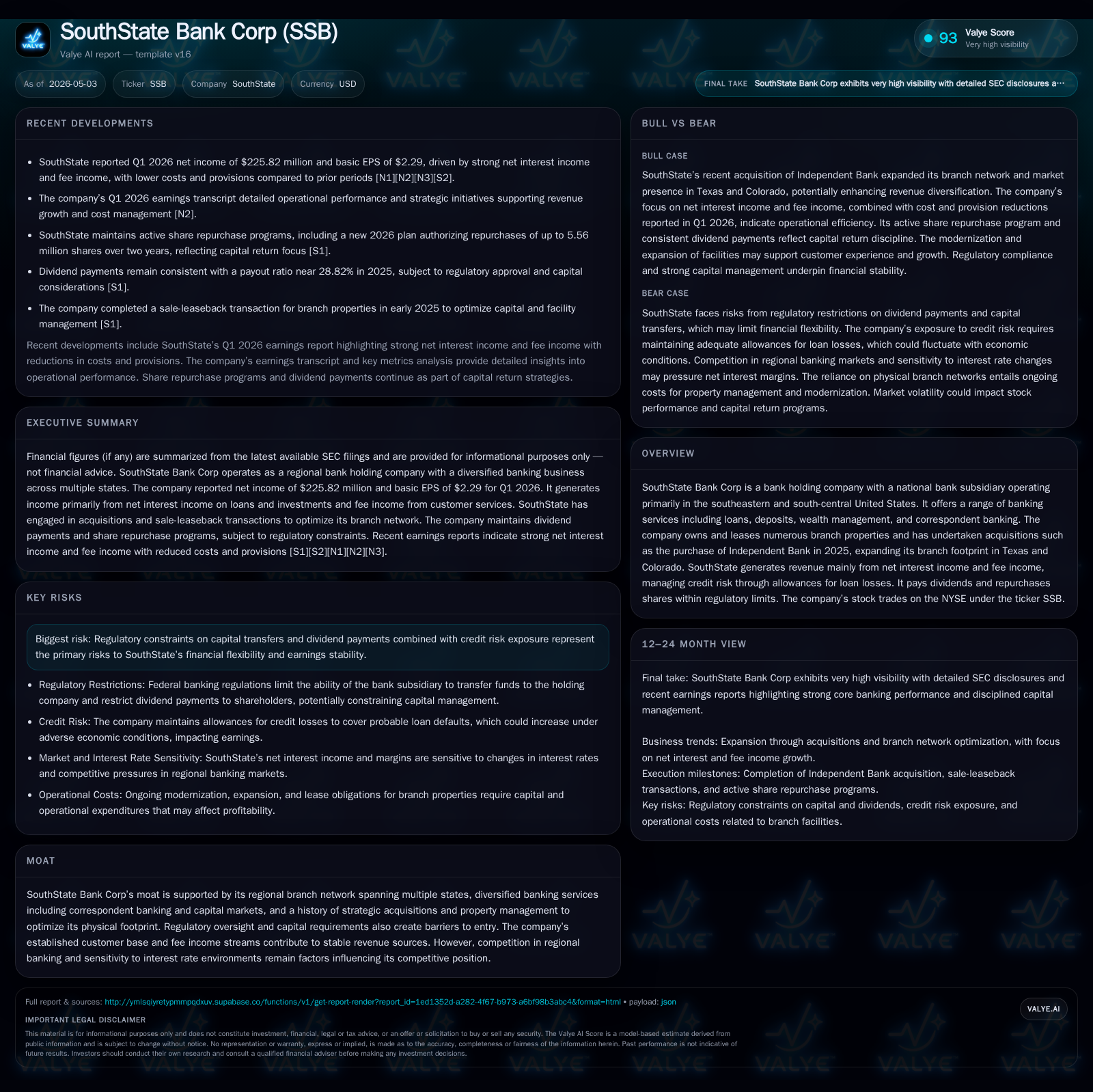
SouthState Bank Corp reported robust first-quarter 2026 results characterized by increased net interest income, rising fee income, and controlled expenses following the full integration of the Independent Bank acquisition. The company’s business model leverages a diversified suite of banking services and a broad multi-state branch network that supports stable revenue streams from loans, deposits, and fee-based products. Its competitive position is bolstered by strategic acquisitions, an optimized physical footprint through sale-leaseback transactions, and prudential asset-liability management. Looking ahead, growth will be fueled by continued organic loan origination, deposit expansion, and fee income diversification, while risks center on credit exposure, interest rate sensitivity, and regulatory capital constraints.
Latest Quarterly Update: Key Operating Metrics and Strategic Moves
SouthState Bank Corp’s first-quarter 2026 10-Q filing [S2] highlights key operating improvements affirming its strong growth trajectory post its transformative acquisition of Independent Bank in early 2025. Net interest income grew materially supported by both organic loan growth and the incremental assets acquired through Independent. Fee income also increased buoyed by wealth management and correspondent banking activities alongside disciplined expense management leading to reduced costs and provisions compared to prior periods [N1].
Signaling shareholder confidence, the Board declared a $0.60 per share quarterly dividend payable in mid-May 2026 [S3]. The smooth operational integration of Independent’s 92 branches across Texas and Colorado has enhanced SouthState’s scale in high-growth markets without diluting service quality or profitability [S1][N1]. This quarter cements the bank’s ability to leverage M&A for accretive growth while maintaining prudent expense discipline.
Business Model Overview: Branch Network, Product Mix, and Revenue Drivers
SouthState operates as a bank holding company providing traditional retail and commercial banking services with a footprint covering Florida, South Carolina, Georgia, North Carolina, Alabama, Virginia, Tennessee—expanded recently into Texas and Colorado via acquisition [S1]. It generates revenues predominantly through net interest income derived from a diversified loan portfolio mixing acquired performing/non-performing loans with organically originated loans. Additionally, non-interest revenue arises from fee-based services such as wealth management offerings, correspondent banking relationships servicing community banks nationally, mortgage lending operations including SBA loans, and capital markets activities [S1].
Critically, over 108 branch properties are owned while nearly 300 are leased—SouthState employs sale-leaseback agreements to convert owned branch real estate into liquidity enhancing triple net leases with specialized real estate capital partners like Blue Owl [S1]. This approach optimizes capital usage without sacrificing physical customer access or operational control.
Customer relationships drive deposit funding which is granular—over 1.4 million accounts with roughly $55 billion total deposits as at December 2025—and balances include a sizable proportion of low-cost noninterest-bearing accounts (circa 24%) plus carefully managed brokered deposits capped below policy limits [S1][S5]. Revenue therefore is influenced by volume growth in loans/deposits alongside pricing on deposits (notably brokered versus local out-of-market deposits) and fees collected from diversified financial services.
Competitive Landscape: Regional Banking Dynamics and Differentiators
Within the regional bank competitive set spanning Southeastern to Southwestern U.S., SouthState stands out due to its sizeable multi-state branch network enhanced by acquisitions—most notably Independent—which provide critical scale advantages in key markets such as Texas. Regulatory oversight imposes significant barriers—including risk-based capital requirements and operational controls—that limit new entrants or disruptors from replicating fully integrated regional franchises easily [S1].
The bank’s correspondent banking division adds differentiation by enabling fee-based revenues beyond typical retail/commercial banking while its capital markets group complements lending activities providing bond sales/trading capabilities concentrated geographically but integrated nationally [S1]. These factors contribute to a moat characterized by diversified earnings streams coupled with physical distribution breadth.
Interest rate environments remain an ongoing source of margin pressure or opportunity depending on asset-liability positioning—a known cyclical element that SouthState manages actively through ALCO’s policies governing loan-to-deposit ratios under 100%, brokered deposits under 15%, and liquid asset buffers above minimums [S6][S7]. Pragmatically balancing stable core deposits against lower-cost brokered deposits enables sustained net interest margin amidst rate fluctuations.
Growth Catalysts: Acquisitions, Deposit Expansion, and Fee Income
Organic loan book growth is supported not only by market demand but also by the migration of acquired loans into the non-acquired portfolio post-maturity or renewal—in Q4 2025 alone organic additions accounted for significant increases after factoring out acquisition-related volumes [S5]. Meanwhile deposits have expanded both via acquisition—Independent brought $15.2 billion in total deposits—and organically through relationship banking strategies emphasizing bundled financial services to commercial borrowers who maintain deposit balances [S5].
Fee income has shown resilience growing from wealth management initiatives coupled with rising correspondent banking activity including SBA loan purchases from third parties demonstrating proactive diversification beyond conventional lending/borrowing spreads. Strategically timed sale-leasebacks of branch properties unlocked approximately $456 million in cash improving balance sheet flexibility allowing reinvestment into higher-returning assets or shareholder distributions without impairing branch presence [S1][N1]. This dynamic mix supports sustained margin enhancement opportunities.
Risk Factors and Operational Constraints
Credit risk persists as principal given sizeable acquired non-performing or purchased credit deteriorated loan tranches although mitigated through conservative allowances for loan losses adjusted quarterly based on macroeconomic conditions [S2][S5]. Interest rate risk remains material; repricing mismatches in assets versus liabilities expose earnings volatility though ALCO-led hedging plus disciplined deposit pricing help manage this risk.
Regulatory capital constraints impact SouthState’s flexibility regarding dividend payments and share repurchases—though current ratios well exceed minimums they can compress temporarily after large acquisitions or adverse credit events requiring cautious capital allocation decisions [S12][S17]. Competition for deposits especially at attractive rates from larger national banks or aggressive local lenders could pressure funding costs.
Liquidity risk is contained via layered funding sources outlined including $5.7 billion available capacity at Federal Home Loan Bank lines plus ample pledged securities supporting short-term borrowings if needed; policy metrics indicate solvency well within prescribed limits at December 31, 2025 [S4][S7][S8].
Next Steps: Milestones and Indicators to Monitor
Stakeholders should watch subsequent quarterly earnings releases for evidence of sustained revenue momentum driven by continued organic loan growth mixed with acquisition loan roll-forwards into performing status. Deposit trends—growth composition between core local accounts versus brokered deposits—will indicate funding stability under evolving rate environments.
Portfolio quality metrics such as NPL ratios or allowance coverage will signal credit cycle impacts versus benign economic conditions. Further progress integrating Independent’s systems/processes will determine cost efficiency gains.
Overall profitability is supported by improved net interest margins owing to favorable deposit pricing shifts balancing out maturities in investment securities portfolio alongside controlled operating expenses minimizing provision charges this quarter [N1].
It is intended solely for informational purposes without offering investment advice or recommendations. Readers should perform further due diligence where appropriate.
Disclaimer: This is research-only, informational analysis and not investment advice. It may include AI-generated interpretation and general industry context. Always verify important details using primary sources.

Comments