
BMP AI Technologies Sharpen Focus on Enterprise AI Platform Amid Structural Challenges
Following a strategic pivot and asset acquisition, BMP AI Technologies centers operations on a compliant, document-grounded enterprise AI platform to address regulated industries.
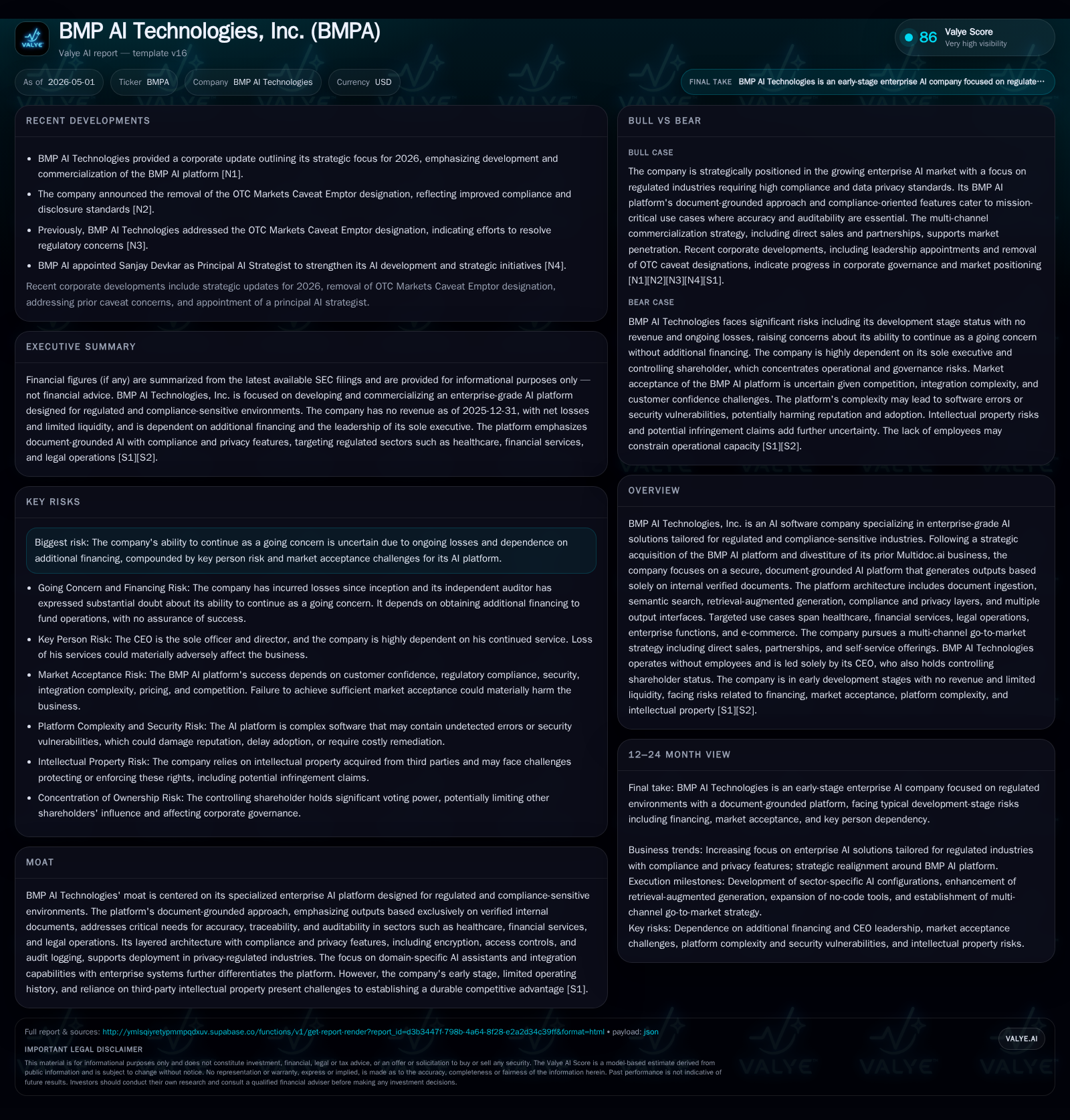
BMP AI Technologies restructured in 2025 by divesting its Multidoc.ai business and acquiring the BMP AI platform, redirecting its focus exclusively to enterprise-grade AI solutions designed for compliance-sensitive sectors. Their document-grounded AI platform emphasizes accuracy, traceability, and privacy for clients in healthcare, finance, and legal fields. Despite these strategic moves, the company faces significant operational risks including lack of revenue generation, ongoing losses, key person dependency, and capital constraints. Its competitive moat lies in compliance-oriented features and domain-specific application potential, but growth hinges on successful commercialization amid sector-specific regulatory hurdles.
Recent Operating Update
BMP AI Technologies’ most recent quarterly filing dated November 14, 2025 [S2] confirms ongoing operational status as a development-stage entity focusing entirely on its newly acquired BMP AI platform, following the prior divestiture of the Multidoc.ai business completed earlier that year [S1]. There were no material changes in risk factors during the latest quarter [S2], underscoring persistent execution risks.
No revenue has been reported through the latest annual period ending December 31, 2025 [F1], while operating losses more than tripled year-over-year to -$241K at operating income level and -$264K net loss [F1]. The balance sheet reveals zero cash reserves alongside approximately $232K total debt at year-end 2025 [F1], signaling liquidity constraints without near-term financing disclosed.
Leadership remains concentrated with Mr. Vighnesh Dobale as sole executive officer and director since May 20, 2025 [S1], highlighting significant key person risk given his control over company strategy and operations.
Business Model
BMP AI Technologies generates value by developing and commercializing an enterprise-grade artificial intelligence platform built explicitly for regulated industries requiring strict data confidentiality and compliance. The core offering—BMP AI platform—is engineered to deliver responses grounded exclusively on a client’s internal verified documents rather than general-purpose public data training sets. This document-grounded approach aims at supporting mission-critical use cases demanding transparency, traceability, accuracy, and auditability.
Revenue generation would theoretically arise from integrating this platform into customer workflows across multiple verticals via direct sales, strategic partnerships with system integrators or software vendors, as well as scalable self-service models targeting smaller organizations [S4]. However, there is no reported revenue as of the latest filings [F1], illustrating that monetization depends heavily on achieving product-market fit in niche compliance-sensitive sectors.
Customer payments in such deployments would typically cover fees related to platform licensing/subscription, deployment customization (including sector-specific configurations), usage volume (document ingestion/query processing), support contracts for compliance tooling updates, and possibly professional services for integration into existing IT ecosystems.
Margins appear pressured given the absence of scalability at this early stage combined with anticipated elevated R&D spend on no-code workflow tools expansion and SDK development for partner enablement [S9]. Cash conversion cycles remain constrained by low collection activity due to lack of revenues.
Industry Structure and Competitive Position
The enterprise AI market serves a broad spectrum of industries but segments focused on regulated sectors (healthcare, financial services, legal) have distinct requirements around data privacy laws such as HIPAA or GDPR-like regulations. Competition in these segments stems from major cloud providers offering generalist AI platforms with emerging compliance modules plus smaller niche vendors specializing in secure document management or vertical workflow automation.
BMPAI’s competitive differentiation pivots on its architecture layering document ingestion with semantic vector embeddings enabling retrieval-augmented generation (RAG), prioritized by a compliance & privacy framework including encryption, access controls, audit logs, and human-in-the-loop workflows [S8]. This specificity ideally equips it to integrate as a trusted assistant within sensitive operational environments demanding end-to-end explainability alongside regulatory adherence.
However, BMPA’s limited operating history post-acquisition and the early state of commercial rollout place it at a disadvantage relative to incumbents or better capitalized startups scaling enterprise footholds. Moreover, reliance upon intellectual property acquired from third parties introduces uncertainty around defensibility against infringement claims [S16].
Growth Drivers
Growth prospects rest primarily on accelerated market adoption driven by:
- Regulatory stringency: Heightened data protection regulations heighten demand for AI solutions capable of rigorous audit trails and controlled data access.
- Sector-specific customization: Expansion of vertical-tailored versions aiming at healthcare protocol guidance, financial onboarding flows or legal contract analysis increases relevancy [S8][S9].
- Workflow automation trends: Broader enterprise digital transformation fosters integration of intelligent assistants into HR support or IT helpdesks boosting cross-functional penetration.
- Platform extensibility: Development of SDKs and partner tools enhance ecosystem reach and facilitate integration into third-party software stacks [S4].
- Self-service offerings: Targeting small/mid-market businesses could unlock scalable SaaS adoption beyond complex direct sales cycles.
Risks / Watchpoints / Growth Constraints
Critical risks constraining BMPA’s growth trajectory include:
- Going concern uncertainty: Continuing losses combined with lack of liquidity creates financing dependency risks; failure to secure funds could curtail operations imminently [S1][F1].
- Key person dependency: Operations hinge entirely on CEO Dobale whose loss would materially disrupt execution; no life insurance coverage exists [S1].
- Limited operating history: Reorganized business model only recently focused on BMP AI platform lacks proven track record tying technology to revenue growth [S1].
- Intellectual property exposure: Reliance on third-party IP assets may trigger costly infringement disputes impairing product availability or requiring redesigns [S16].
- Market acceptance barriers: Enterprise buyers in regulated fields demand high confidence levels; skepticism towards nascent AI platforms could delay adoption [S20].
- Competitive intensity: Larger cloud providers or specialized startups can leverage scale or innovation velocity making market penetration difficult.
- Dilution risk: Large authorized share count enables future equity issuances potentially diluting current holders’ stakes [S12].
- Geographic complexities: CEO residency outside US raises enforcement challenges for shareholders affecting governance perceptions [S20].
What to Watch Next
Investors and analysts should monitor several milestones:
- Evidence of initial commercial traction such as first enterprise contracts or signees adopting sector-specific configurations.
- Progress updates on roadmap items including advanced retrieval-augmented capabilities refinements and low-code/no-code workflow expansions announced for R&D priority [S4][S9].
- Strategic partnerships development facilitating channel diversification beyond direct sales approaches.
- Financing events signaling improved liquidity or funding adequacy to sustain product development pace.
- Intellectual property status updates clarifying rights assertions and mitigating litigation risk.
- Regulatory developments relevant to AI use cases particularly concerning compliance mandates impacting product design criteria.
Without explicit company guidance disclosures so far, these indicators are key proxies for execution momentum.
Financial Profile Summary (Supporting Context)
Historical performance (annual)
Capital returns and efficiency (annual)
BMPA’s financial snapshot confirms a typical early-stage tech company struggling past reorganizations: zero revenue recorded through FY2025 while incurring growing losses ($241K operating loss vs $77K prior year) [F1]. Net income deteriorated sharply (–$264K vs prior positive due mainly to restructure effects) exacerbating negative equity which stood at –$758K by end-2025 [F1]. Operating cash flow margin remains deeply negative (–$254K) highlighting ongoing burn funded presumably by debt accumulation ($232K total debt) without external capital injection disclosed recently [F1]. Current assets reported at zero vs current liabilities $762K yield a zero current ratio reflecting near-term liquidity mismatch without secured financing line evident [F1]. These metrics parallel standard development-stage characteristics yet underline pressing capital needs to transition toward scalable enterprise sales stages.
This analysis synthesizes publicly available SEC filings complemented by structured financial data while omitting investment recommendations. It highlights BMPA’s strategic refocus towards a specialized enterprise AI platform poised for regulated markets but stresses substantial execution risks inherent to nascent commercialization efforts under tight financial constraints.
Disclaimer: This is research-only, informational analysis and not investment advice. It may include AI-generated interpretation and general industry context. Always verify important details using primary sources.

Comments