
Progressive Corp Tops Q1 Expectations with Solid Underwriting and Investment Performance
Progressive’s Q1 2026 results reflect disciplined underwriting and robust investment income amid persistent market volatility.
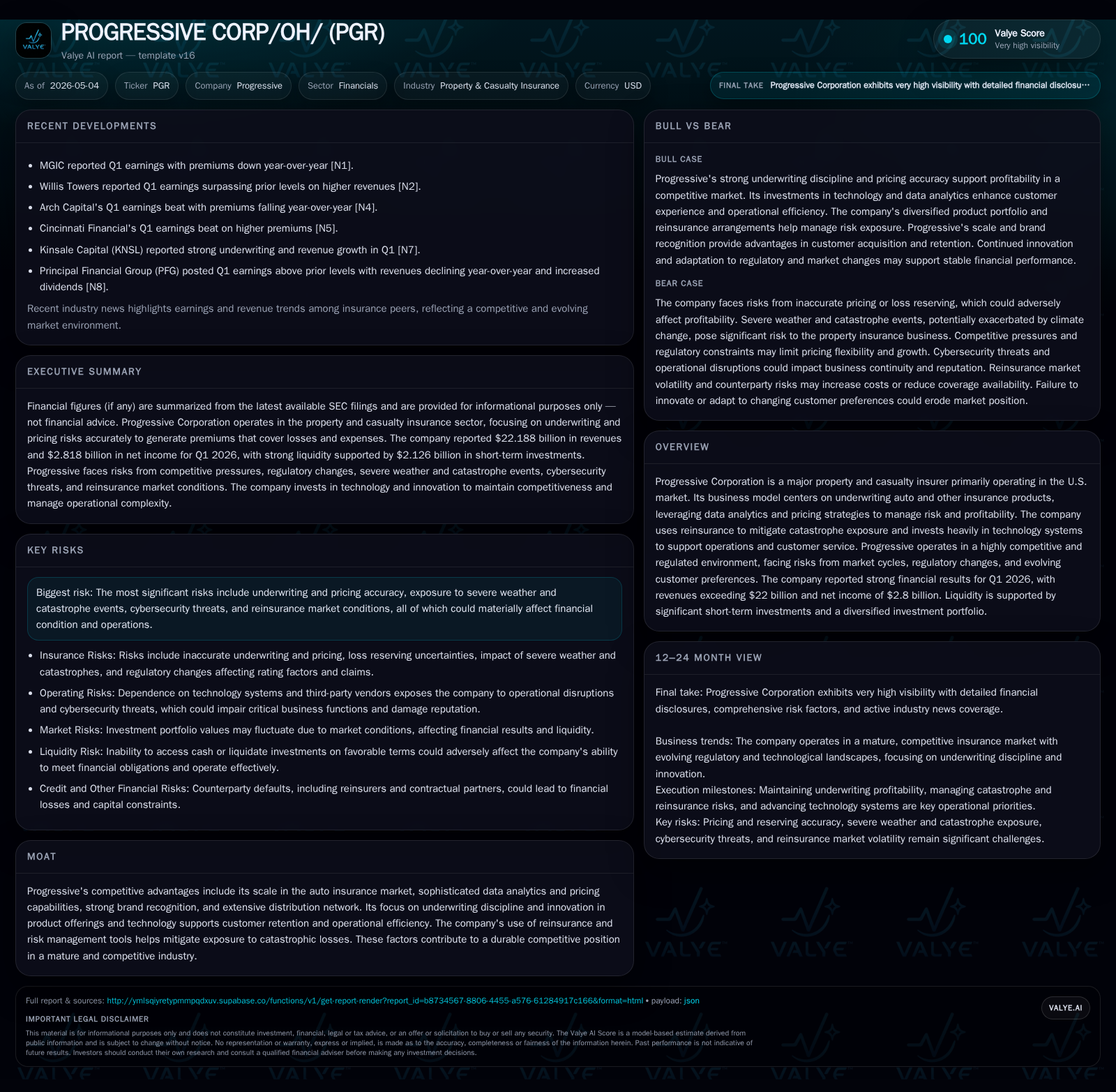
In its latest quarterly filing dated May 4, 2026, Progressive Corporation reported net premiums earned of $20.97 billion, investment income of $917 million, and net income of approximately $2.8 billion, underscoring strong execution in underwriting and asset management. Despite increased unrealized losses in its fixed-income portfolio driven by interest rate pressures, the company’s disciplined risk management and data-driven pricing strategy maintain a resilient financial profile. As a major U.S. property and casualty insurer specializing in auto insurance, Progressive leverages advanced analytics and reinsurance to sustain competitive advantages in a highly regulated, mature industry.
Latest Quarter Overview: Navigating Market Volatility
Progressive's most recent quarterly results for Q1 2026 reveal continued strength in underwriting operations alongside notable investment portfolio performance despite headwinds. The company reported net premiums earned of approximately $20.97 billion, a clear indication that demand for their core auto insurance products remains solid amid persistently unpredictable macroeconomic conditions [S2]. Investment income grew to around $917 million, driven largely by returns on fixed maturities; however, the company also recorded net holding period losses on equity securities at about $189 million. More significantly, unrealized losses climbed within the fixed-income portfolio — notably a $488 million gross unrealized loss primarily concentrated in U.S. government debt securities — a reflection of broader interest rate pressures affecting bond valuations rather than an intrinsic deterioration in credit quality [S2].
This constellation of data underscores Progressive’s dual challenge: managing underwriting profitability while navigating investment yield compression caused by elevated rates. Yet the firm demonstrated resilience through measured underwriting discipline and ongoing enhancements to pricing models leveraging granular data analytics.
Business Model and Product Suite: Data-Driven Insurance Innovation
At its core, Progressive Corporation operates as a leading property and casualty insurer with a dominant focus on personal auto insurance within the United States [S1]. The company primarily generates revenues from premiums paid by policyholders seeking coverage against vehicle accidents and related liabilities. Premium revenue mechanics hinge on writing new policies, retaining existing customers, applying nuanced risk tiering enabled by proprietary data sets, and adjusting rates dynamically according to loss trends and market conditions.
Progressive’s strategic strength resides in its advanced analytical capability which enables precise risk segmentation far beyond traditional models. This drives accurate price setting that balances competitiveness with margin preservation — a critical moat given the commoditized nature of auto insurance products. Moreover, the company’s expansive distribution network includes direct-to-consumer channels alongside independent agencies, enabling broad market access.
Beyond underwriting discipline, innovation extends into product design offering tailored coverages and digital service platforms. These investments foster higher customer retention through ease of claims processing and policy adjustments.
Reinsurance arrangements constitute another pillar of risk management by transferring portions of catastrophic hazard exposures to third parties. This buffering effect allows progressive to limit earnings volatility linked to large-scale weather or disaster events while maintaining underwriting capacity [S1].
Competitive Positioning within Property & Casualty Industry
Within the intensely competitive P&C landscape, Progressive stands out due to its scale in personal auto lines combined with superior analytical infrastructure. Proprietary datasets accumulated over decades provide unique advantage over smaller competitors less equipped to capitalize on sophisticated modeling techniques.
While regulatory regimes impose pricing oversight that can limit rate maneuvering flexibility at state levels, Progressive’s rigor in data utilization facilitates differentiated pricing power within allowable frameworks. Brand equity generated by multi-channel marketing efforts complements these technical competencies.
Industry barriers to entry are heightened by both the technological investment required for modern underwriting and customer servicing platforms as well as the capital demands of robust reinsurance contracts necessary for catastrophe risk mitigation.
Growth Catalysts: Technology Investments and Pricing Accuracy
Driving near-term growth prospects is Progressive’s continual upgrade of technology platforms aimed at streamlining claims adjudication processes and enhancing user experience via mobile applications. These improvements translate into operational cost savings while elevating policyholder satisfaction – reinforcing retention in a low-switch-cost environment.
On the revenue side, iterative refinement of predictive modeling enhances pricing accuracy allowing segmentation down to micro-risk strata not feasible by peers with less sophisticated datasets. Better matching premiums to expected loss costs preserves margin integrity while enabling targeted market share expansion among selected demographics.
Reinsurance optimization—through treaty negotiations calibrated against emerging climate risk scenarios—also supports earnings stability which can in turn free capital for selective growth initiatives.
Early indicators from Q1 results signal scalable benefits accruing from these areas: stable premium growth combined with disciplined loss experience suggest sustainable margin improvement potential even amid evolving external challenges [S2].
Risks and Constraints: Catastrophe Exposure and Market Cycles
Principal risks facing Progressive include accuracy in underwriting assessments; any miscalculation can materially impact loss reserves or profitability given inherent uncertainty in insured event frequency or severity [S1]. Catastrophic weather phenomena remain an episodic but potentially devastating source of claims volatility—which even best-in-class reinsurance programs cannot fully immunize.
Cybersecurity threats pose operational risks by targeting sensitive customer information or disrupting digital service platforms that underpin customer engagement strategies.
Regulatory changes affecting allowable premium rates or mandated coverage features represent further constraints that could impinge on pricing flexibility or increase claim costs unexpectedly.
Upcoming Milestones and Market Signals to Monitor
Investors should attentively monitor forthcoming quarterly filings for continued trends in loss ratios which reflect underwriting effectiveness amidst ongoing inflationary pressures on claims costs [S2]. Details from reinsurance treaty renewals will also be informative regarding shifting market terms or coverage scope affecting future catastrophe risk management.
Progress reports on advanced digital platform rollouts will shed light on operational scalability influences driving efficiency gains. Additionally, regulatory developments—particularly within key states comprising large fractions of Progressive’s book—may alter permissible price movement dynamics impacting future revenue trajectories [S3].
Brief Financial Profile: Balance Sheet Strength and Earnings Snapshot
From a capital structure standpoint, Progressive reported total revenues exceeding $22 billion for Q1 2026 when combining underwriting premiums and investment income streams [S2]. Net income approached $2.8 billion during this period indicating solid earnings generation capacity under current operating parameters.
The balance sheet remains well-capitalized with total debt near $7 billion as per the latest full-year disclosure at December 31, 2025; liquidity is bolstered by substantial allocations to short-term investments which provide ready cash deployment flexibility [F1][S2].
This analysis synthesizes the latest publicly filed disclosures alongside contextual understanding of progressive industry dynamics shaping Progressive Corporation’s operational profile as of early 2026. It does not constitute investment advice but aims to present an informed assessment grounded strictly in verified regulatory filings and industry knowledge.
Disclaimer: This is research-only, informational analysis and not investment advice. It may include AI-generated interpretation and general industry context. Always verify important details using primary sources.

Comments