
Organon Faces Integration and Patent Challenges While Pursuing Growth in Women’s Health and Biosimilars
Recent quarterly results highlight ongoing top-line pressure amid an impending merger with Sun Pharma and patent cliffs, balanced by diversification across contraception, fertility, and biosimilars.
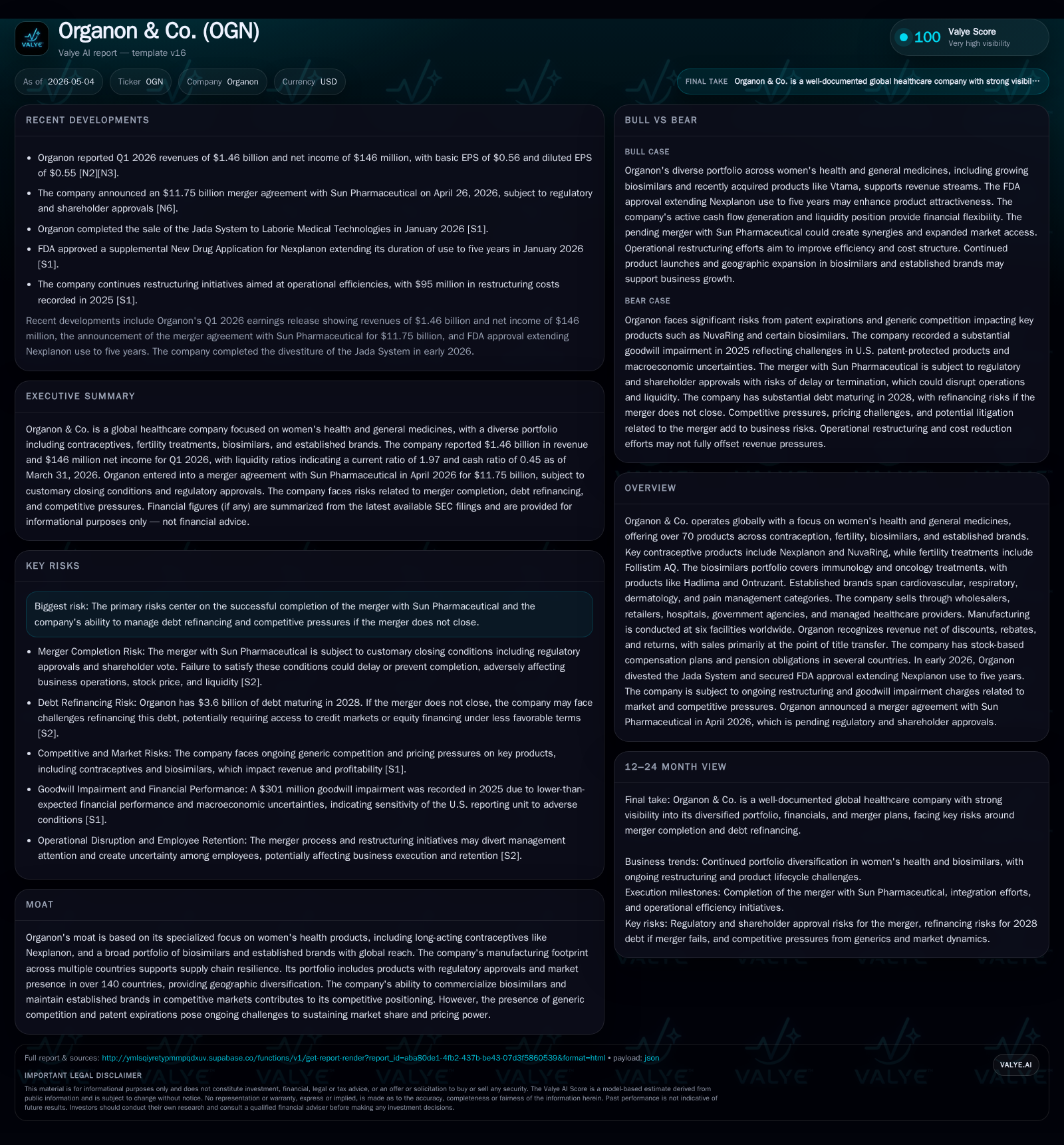
Organon & Co.’s latest quarterly filing reveals a complex near-term outlook dominated by its pending merger with Sun Pharmaceutical Industries and intensifying generic competition, notably for Nexplanon. The company’s business model centers on women’s health products, biosimilars, and established medicines, distributed globally through multiple channels. Key growth drivers like the FDA-approved extension of Nexplanon’s use to five years and expanding biosimilar sales contend with risks from patent expirations and ongoing regulatory investigations. Organon’s financial structure reflects substantial leverage which underscores the importance of successful integration or refinancing strategies post-merger.
Recent Operating Update: Q1 2026 Highlights
Organon & Co.’s first-quarter 2026 SEC filing ([S2]) and earnings release ([S3]) indicate a nuanced operating environment shaped by ongoing product lifecycle dynamics and strategic developments. While specific revenue figures for Q1 are not separately disclosed, the context provided confirms continued net revenue pressures driven by generic competition on key contraceptives such as NuvaRing and impending patent expirations of Nexplanon rod patents scheduled between 2027-2030 ([S1], [S6]). However, a notable positive development was the FDA approval in January 2026 extending Nexplanon's label duration from three to five years, potentially lengthening product lifecycle value if exclusivity is maintained.
Parallel to operational execution, Organon revealed on April 26, 2026, it entered into an Agreement and Plan of Merger with Sun Pharmaceutical Industries Ltd., whereby Sun Pharma will acquire Organon in an all-cash transaction ([S2]). The agreement outlines multiple customary closing conditions including regulatory approvals under U.S. antitrust laws (HSR Act) and foreign direct investment scrutiny. The transaction carries execution risk given the dependency on external approvals and shareholder consents ([S2]). Failure to close could materially impair Organon's business outlook and stock price ([S2]).
Business Model
Organon's fundamental revenue engine centers on pharmaceutical products focused predominantly on women's health—including contraception (Nexplanon implant, NuvaRing vaginal ring), fertility treatments (Follistim AQ), biosimilars primarily targeting immunology and oncology segments (e.g., Hadlima), alongside established branded medicines addressing cardiovascular, respiratory, dermatology, and pain management therapies ([S1]). The firm markets over 70 products globally through wholesalers, retailers, hospitals, managed care providers, and government agencies. Revenue recognition is typically at transfer of title net of customer discounts and inducements.
The business's competitive edge stems largely from its specialized women’s health franchise anchored by long-acting contraceptives such as Nexplanon—a significant cash-flow contributor benefiting from recent label expansions—and its globally diversified biosimilars portfolio that leverages market demand for cost-effective biologic alternatives. Manufacturing operations distributed across six facilities worldwide enhance supply chain flexibility but bring complexity exposure in quality control and operational costs ([S1]).
However, the company grapples with inherent industry challenges: extensive generic competition compressing pricing power on products like NuvaRing; patent cliffs looming for flagship items; legal disputes over intellectual property that pose risks of shortened exclusivity or impairment charges; stringent regulatory requirements affecting new product development timelines; plus increasingly complex global compliance mandates ([S4], [S5], [S6]).
Furthermore, Organon's revenue is partially affected by one-off events such as the cessation of certain U.S. wholesaler sales practices that reduced full-year 2025 sales by $15 million ([S1]), highlighting execution intricacies within distribution channels.
Industry Structure and Competitive Position
Organon operates within the global pharmaceuticals sector characterized by high regulation, intense competition from generics and biosimilars, patent-driven product lifecycles, pricing pressures influenced by managed care organizations, government policies on drug reimbursement, and evolving healthcare delivery models.
Its niche focus on women’s health provides differentiation but also concentrates exposure risks related to patent expirations (notably Nexplanon rod patents due to expire between 2027-2030 per litigation timeline [S6], [S11]) and increased consumer access to lower-cost alternatives. The biosimilars segment functions as both a growth avenue and a battleground due to competitive pressures among multiple producers vying to capture share from originator biologics.
Large multinational pharmaceutical firms compete on innovation pipelines while generics players aggressively target off-patent products eroding market exclusivity for branded drugs. Organon's emphasis on diversified geographic reach across over 140 countries tempers localized competitive risks but introduces variability linked to region-specific regulatory frameworks ([S1]). The recent merger agreement with Sun Pharma could fortify scale advantages but poses integration risk.
Growth Drivers
Label Extension for Nexplanon
The January 2026 FDA approval extending contraceptive Nexplanon's effective duration to five years significantly enhances lifetime unit demand economics—an important commercial lever given near-term threats of patent expiration ([S1]). Prolonged label indications typically support improved prescribing confidence among clinicians which can drive market share.
Expanding Biosimilar Portfolio
Hadlima's rapid uptake (+60% sales growth y/y) evidences growing traction in therapeutic areas like immunology where cost containment incentives favor biosimilars ([S1]). Ongoing efforts to increase penetration in new geographies underpin structural topline expansion.
Fertility Segment Momentum
Sales of Follistim AQ grew moderately (+11% y/y), primarily supported by U.S. demand despite declines in China due to challenging market dynamics precluding sustained volume expansion ([S1]). Fertility treatment demand is expected to benefit structurally from demographic trends supporting longer-term growth.
Global Distribution Network & Manufacturing Capabilities
Diverse channels including wholesalers, healthcare providers, government programs combined with multi-site manufacturing yield resilience amid supply chain disruptions while allowing customized go-to-market approaches per local market characteristics ( [S1]).
Strategic Merger Potential
The pending transaction with Sun Pharma promises synergy capture through scale economies in R&D, production optimization, and combined commercial capacity contingent upon favorable regulatory clearance ([S2]).
Risks & Watchpoints
Merger Completion Uncertainty & Execution Risks
Closing depends heavily on regulatory review outcomes including antitrust approvals subject to broad governmental discretion ([S2]). Delays or failure could leave Organon exposed to standalone operational challenges with elevated leverage constraints.
Patent Expirations & Generic Encroachment
Key products face imminent patent cliff pressure notably Nexplanon rod patents in 2027-2030 ([S6], [S11]) threatening revenue base stability absent successful lifecycle management or product replacement programs.
Legal & Regulatory Investigations Impacting Operations
Ongoing audits related to prior Nexplanon sales practices have triggered SEC inquiries leading to resource diversion potential and possible sanctions or reputational harm ([S5], [S8], [S11]). Patent infringement litigations add uncertainty over exclusivity periods.
Leverage & Refinancing Constraints without Merger Support
Market Access & Pricing Pressures Globally
Regulatory reforms targeting drug pricing across major markets coupled with payer demands for increased rebates place downward pressure on margins especially in commoditized categories where brand loyalty is weak or generic penetration accelerates ([S4], [S13]).
What To Watch Next
- Progress on obtaining required shareholder approvals for the Sun Pharma merger including any competing offers or regulatory objections.
- Regulatory milestones particularly HSR Act waiting period expiration and non-U.S antitrust clearance timelines impacting transaction certainty.
- Quarterly updates on performance of key women’s health products post-label change adoption—metrics such as prescriptions filled or volume growth rates for Nexplanon.
- Market share trajectory of biosimilars like Hadlima alongside launch success rates for pipeline assets.
- Legal developments related to outstanding patent suits or SEC investigations that may influence future exclusivity or compliance costs.
- Capital markets signals about refinancing conditions ahead of significant debt maturities starting mid-to-late 2028 if merger does not consummate.
- Adjustments in dividend policy or cost rationalization initiatives reflecting liquidity preservation measures amid earnings variability.
Financial Profile Snapshot (Q1 2026)
Latest financial snapshot
| Metric | Value | Period |
|---|---|---|
| Cash & equivalents | $1116mm | |
| 2026-03-31 | ||
| Total debt | $8.6bn | |
| 2026-03-31 | ||
| Net debt | $7.5bn | |
| 2026-03-31 | ||
| Current assets | $4.9bn | |
| 2026-03-31 | ||
| Current liabilities | $2.5bn | |
| 2026-03-31 | ||
| Current ratio | 1.97x | |
| 2026-03-31 |
Source: SEC companyfacts cache [F1].
(Figures sourced from [F1])
This balance sheet highlights significant leverage requiring disciplined liquidity management especially given the absence of fully assured merger completion as flagged in management disclosures ([S9]).
Conclusion
Organon occupies a specialized niche anchored around women's health pharmaceutical solutions complemented by an expanding biosimilar presence that counters some margin volatility inherent in commoditized markets. Recent operational data signals ongoing cyclicality induced partly by generic erosion while regulatory approvals like extended Nexplanon use inject potential longevity into cash flows.
Nonetheless, elevated leverage coupled with pending transformative corporate actions present material uncertainty requiring close monitoring of integration progress or alternative capital strategies if the merger falters. Legal and regulatory headwinds introduce additional execution complexity underscoring that sustained value creation depends equally on managing external stakeholder conditions alongside internal commercialization discipline.
This analysis is intended for informational purposes reflecting facts disclosed through SEC filings and public releases as of May 4, 2026. It does not constitute investment advice or recommendations.
Disclaimer: This is research-only, informational analysis and not investment advice. It may include AI-generated interpretation and general industry context. Always verify important details using primary sources.

Comments