
Berkshire Hathaway’s Latest Quarterly Snapshot Illuminates Capital Strength and Diversified Moat
Berkshire Hathaway's proactive debt issuance and robust liquidity underpin its expansive insurance and investment ecosystem.
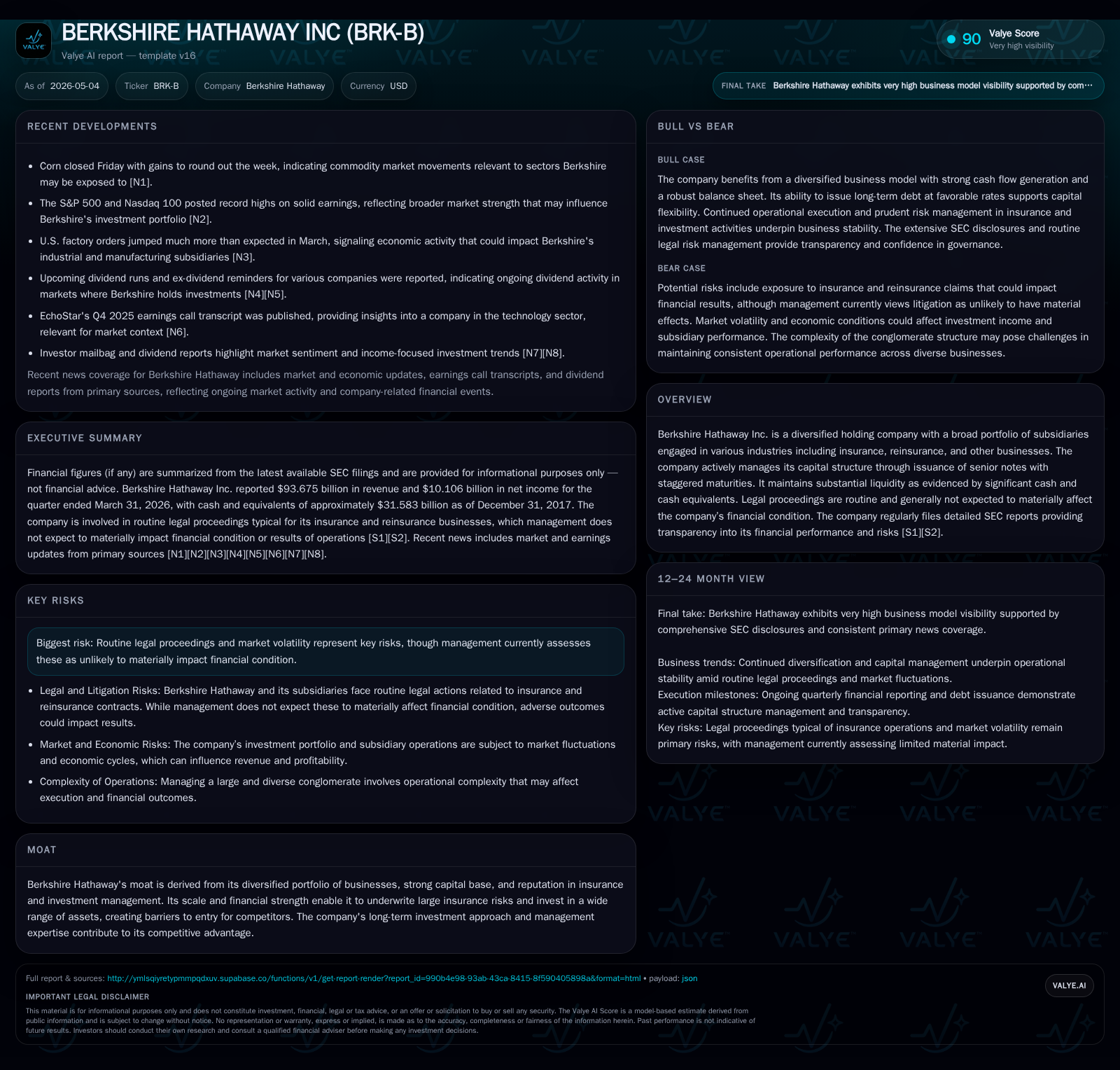
In its Q1 2026 10-Q filing, Berkshire Hathaway issued new senior notes with attractive coupons, signaling strategic capital management amid favorable market conditions. The company maintains substantial liquidity, supporting its underwriting and investment activities. Berkshire’s broad portfolio leverages scale and reputation to sustain competitive advantages across insurance, manufacturing, retail, and utilities. Growth is driven by disciplined underwriting float deployment, investment portfolio growth, and opportunistic acquisitions, while risks center on market volatility, legal proceedings, and operational complexity.
Recent Quarterly Operating Highlights: Capital Management and Liquidity
Berkshire Hathaway’s Q1 2026 10-Q filing dated May 4 outlines a deliberate approach to balancing long-term debt issuance with operational liquidity needs [S2]. Notably, on April 16, the company issued multiple tranches of senior notes including ¥22.3 billion in 2.739% Senior Notes due 2033 and ¥27.3 billion in 3.084% Senior Notes due 2036 as disclosed in the recent 8-K [S3]. These relatively low-coupon senior notes indicate Berkshire’s ability to access credit markets favorably despite a large maturity ladder extending through mid-century.
This fresh debt capital enhances flexibility without undermining the company’s historic conservatism. Combined with cash equivalence levels noted historically near $31.5 billion as per earlier Companyfacts data [F1], Berkshire is well positioned to fund ongoing underwriting operations and seize opportunistic investments.
Berkshire Hathaway’s Business Model: Diversified Portfolio Anchored by Insurance
The company operates principally as a diversified holding entity that generates profits through two primary axes: insurance/reinsurance underwriting operations that produce significant "float" (premium funds held before claims payout) and a broad range of subsidiaries spanning manufacturing, retailing, utilities, and freight transportation [S1].
Insurance segments benefit from Berkshire’s substantial capital base that underwrites sizeable and complex risks at economics few competitors can match. This underwriting float provides steady, low-cost capital which management invests patiently into diverse asset classes generating compounded returns.
Simultaneously, operating subsidiaries yield steady cash flows anchored by durable competitive positions in their respective sectors. This diversification mitigates exposure to any single industry cycle enhancing earnings stability—an attractive feature for long-term value creation.
Competitive Position and Industry Dynamics: Scale, Reputation, and Moat
Berkshire’s scale enables it to commit large amounts of capital across the risk spectrum from property-casualty insurance to specialty reinsurance—a niche where trustworthiness and conservative reserving policies command price premiums [S1]. Barriers arise not only from regulatory capital requirements but also from the company’s demonstrated financial strength which assures counterparties of claim-paying ability even under extreme losses.
The company’s moat deepens via its renowned management pedigree distinguished by disciplined capital deployment principles emphasizing intrinsic value over short-term market trends. The integrated nature of its portfolio affords synergies unavailable to smaller entities reliant on narrower product lines or geographic footprints.
Moreover, regulatory oversight underscores complexity in its industry landscape—especially within insurance pricing controls and compliance regimes—favoring established incumbents who have cultivated proven systems over decades.
Growth Drivers: Investment Strategy, Insurance Underwriting, and Opportunistic Acquisitions
Growth fundamentally arises from increasing the underwriting float—achievable either through premium rate adjustments aligned with prevailing loss projections or expanding policy volumes in selective segments—and deploying that float profitably into equities or fixed-income instruments producing incremental investment income year-over-year [S1][S2].
Berkshire also pursues bolt-on acquisitions leveraging its conservative balance sheet alongside cautious valuation discipline characteristic of noted management. This acquisition channel supplements organic growth derived from subsidiary operations.
Although new lines might confront practical scale or regulatory limits given Berkshire’s size, overall growth is nonetheless fueled by compounding underwriting profits combined with astute portfolio reinvestment ensuring long-duration earnings accretion.
Risks and Limitations: Market Volatility, Legal Exposure, and Operating Complexity
Legal proceedings remain routine for an insurance conglomerate this size but are generally assessed as unlikely to inflict material financial strain given consistent disclosure of legal exposures without significant contingencies impacting consolidated outcomes [S1][S6][S7].
Investment portfolio valuations naturally fluctuate with market cycles introducing earnings volatility especially during periods of macroeconomic disruption. Similarly, insurance underwriting faces cyclical shifts tied to catastrophic event frequency or pricing environment changes leading to margin compression potential.
Managing an extensive roster of distinct businesses while preserving operational cohesion presents complexity risks around integration efficiencies or regulatory compliance across jurisdictions requiring ongoing attention.
Upcoming Catalysts and Investor Watchpoints
Attention should focus on forthcoming quarterly reports outlining underwriting profitability trends which signal whether premium pricing aligns adequately with emerging insured risk profiles [S2]. Additionally, tracking any announcements on further debt refinancings or capital allocation intentions will illuminate management’s response to evolving cost-of-capital dynamics seen through fixed-income issuance patterns [S3].
Potential acquisition updates would also provide insight into tactical adjustments within Berkshire’s diversified strategy addressing growth via inorganic means alongside organic performance.
Brief Financial Profile: Liquidity, Debt Maturities, and Capital Structure
While the latest filings do not disclose explicit current leverage ratios or aggregate debt levels directly within these excerpts, inferred from multiple recently issued senior notes maturing between 2027 through 2059 it is evident that Berkshire employs a staggered maturity strategy reducing refinancing risk concentration [S3].
Historically strong cash equivalents positioning supports claim-paying capability central to its insurance franchise integrity [F1]. This combination of steady liquidity buffers paired with a measured approach to incremental long-duration borrowing aligns well with sustaining operational agility amid diverse business pressures.
Disclaimer: This analysis is based solely on publicly available SEC filings dated up to May 4, 2026. It aims to provide an objective assessment without constituting investment advice or recommendations regarding Berkshire Hathaway Inc.'s securities.
Disclaimer: This is research-only, informational analysis and not investment advice. It may include AI-generated interpretation and general industry context. Always verify important details using primary sources.

Comments