
Atmus Filtration Technologies Navigates Tariff Pressures and Customer Concentration in Q1 2026
Q1 results highlight resilience amid tariff impacts, with key OEM relationships anchoring Atmus' growth and risk profile.
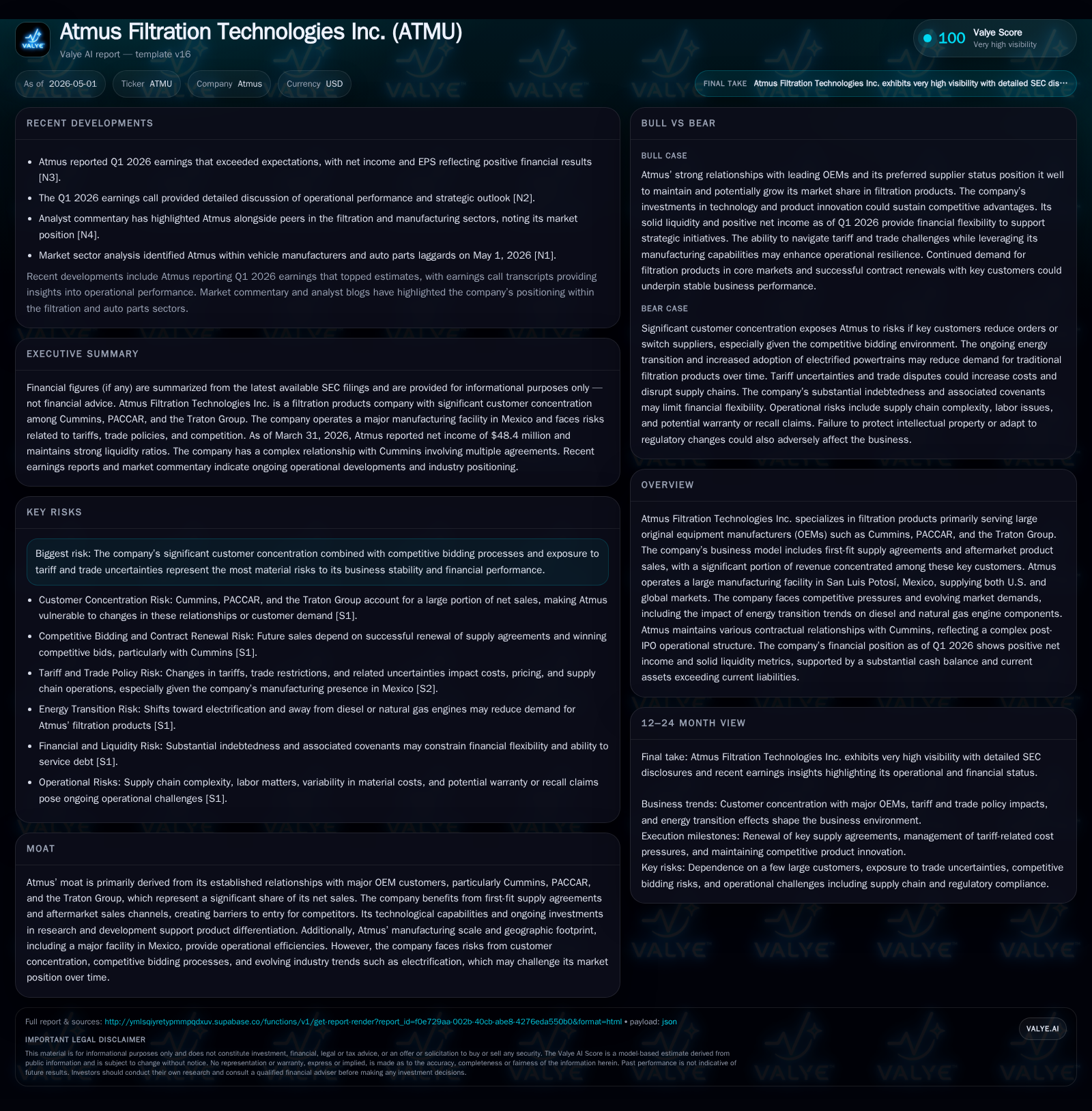
Atmus Filtration Technologies Inc. reported solid Q1 2026 financial performance supported by strong demand from its major OEM customers, notably Cummins, PACCAR, and the Traton Group. The company faces ongoing risks related to tariff uncertainty impacting costs and pricing dynamics, alongside significant customer concentration. Operationally anchored by a large manufacturing footprint in Mexico, Atmus leverages first-fit supply contracts and aftermarket sales as its core revenue drivers. Going forward, navigating evolving trade policies and industry trends such as electrification will be critical to sustaining its competitive position.
Recent Operating Update
Atmus Filtration Technologies Inc.’s latest quarterly filing (10-Q dated May 1, 2026) provides crucial insights into near-term operating dynamics that frame the company’s trajectory.[S2] The Management Discussion highlights firm sequential demand from large original equipment manufacturers (OEMs), including Cummins, PACCAR, and the Traton Group. Despite headwinds from recent increases in tariffs levied on imports from key manufacturing regions such as Mexico — where the bulk of Atmus’ production occurs — the company managed to partially pass through cost increases via targeted price adjustments.[S2][S10] The U.S. Supreme Court's February 2026 ruling that tariffs imposed under the International Emergency Economic Powers Act exceeded statutory authority introduces further complexity due to uncertain refund timelines and potential future regulatory changes._[S2][S10]
This filing underscores the interplay between macro trade policy volatility and Atmus’s operational exposure. Notably, the company depends heavily on its San Luis Potosí facility in Mexico to supply both U.S. domestic and international markets. While benefits from geographic proximity under trade agreements like USMCA support cost competitiveness currently, evolving tariff regimes remain a material risk._[S2][S13]
Business Model
Atmus operates primarily as a filtration technology supplier specialized in diesel engine filtration products for heavy-duty vehicles and industrial applications.[S1] Central to its business model is a two-pronged revenue approach: first-fit supply agreements with leading OEMs secure stable volume commitments; simultaneously, aftermarket sales provide complementary revenue streams often characterized by higher margin profiles.[S1][N1] This structure offers some diversification within a concentrated customer base but inherently links Atmus’s financial results to the purchasing patterns of a few top-tier manufacturers.
The company’s supply agreements include long-term contracts with Cummins—its largest single customer contributing roughly 18.8% of net sales in 2025—as well as similarly substantial engagements with PACCAR and the Traton Group._[S12] These relationships embed switching costs for customers via proprietary designs and qualification standards that create barriers for competitors.
Atmus’s moat derives largely from these entrenched contracts combined with scale manufacturing efficiencies at its Mexican facility.
That said, competitive bidding processes remain intense for new program wins—a dynamic where pricing power can erode if alternative technologies or suppliers emerge rapidly. The shift toward electric powertrains reduces medium-term demand growth for Atmus’s core diesel filtration products; nonetheless, emerging hybrid configurations sustain some near- to mid-term replacement demand in the aftermarket segment._
Growth Drivers
Growth catalysts for Atmus hinge on several fronts:
- Strategic Acquisitions: The company added an industrial filtration business in early 2026 to expand beyond vehicle filters into adjacent markets with attractive unit economics [S27].
- Global Expansion: Joint ventures in India and China underpin access to high-growth commercial vehicle markets where emission regulations are tightening [S27].
- Aftermarket Penetration: Increasing aftermarket sales diversify revenue streams away from cyclical OEM production cycles.
- Innovative Product Development: Investments targeting enhanced filter durability and efficiency address tightening environmental regulations [N1].
- Tariff Adaptation Strategies: Supply chain realignments including possible production shifts mitigate ongoing tariff exposures while preserving cost competitiveness [S2].
These elements collectively aim to offset structural headwinds tied to engine electrification while exploiting pockets of regulatory-driven filtration demand globally.
Risks and Watchpoints
Key risks highlighted include:
- Customer Concentration: Over half of revenues derive from three OEMs—any contract non-renewal or volume cut could materially impact results [S1][S12].
- Tariff Uncertainty: Fluctuating trade policies have introduced raw material cost volatility influencing margins [S10].
- Regulatory Compliance Costs: Adherence to evolving emissions regulations raises R&D expenditures with uncertain recoverability [S25].
- Supply Chain Complexity: Sourcing disruptions or labor disputes could constrain manufacturing output [S8].
- Technology Transition Risk: Electrification accelerates obsolescence risk for traditional diesel filtration products .
Given these factors, monitoring contract renewal negotiations with Cummins and other OEMs will be especially critical alongside developments in international trade disputes affecting Mexico-sourced goods.
What to Watch Next
Investors should track the following milestones closely:
- Renewal status updates on first-fit supply agreements expiring in upcoming quarters [N1].
- Tariff refund progress following the Supreme Court ruling's implementation timeline [S2];
- Quarterly bookings or backlog disclosures signaling aftermarket demand strength;
- Integration success of industrial filtration acquisition indicated by margin or synergies realization;
- R&D pipeline announcements addressing filtration needs for hybrid or alternative fuel engines;
- Cost pass-through effectiveness amid commodity inflation pressures.
These indicators will collectively signal whether Atmus can sustainably navigate near-term external shocks while repositioning itself strategically within a shifting automotive landscape.
Financial Snapshot (Q1 2026)
Latest financial snapshot
| Metric | Value | Period |
|---|---|---|
| Cash & equivalents | $210mm | |
| 2026-03-31 | ||
| Total debt | $1000mm | |
| 2026-03-31 | ||
| Net debt | $790mm | |
| 2026-03-31 | ||
| Current assets | $911mm | |
| 2026-03-31 | ||
| Current liabilities | $361mm | |
| 2026-03-31 | ||
| Current ratio | 2.53x | |
| 2026-03-31 |
Source: SEC companyfacts cache [F1].
Atmus maintains a liquidity position supported by over $209 million in cash against $1 billion in total debt as of March 31, 2026.[F1] The current ratio of 2.53x indicates sufficient short-term asset coverage against liabilities amid tariff-related inventory cost pressures.[F1] While leverage remains elevated, it is consistent with capital-intensive manufacturing peers reliant on secured credit facilities.[F1]
This analysis synthesizes recent SEC disclosures along with operational context without providing investment advice or price guidance. It aims to present a grounded view of Atmus Filtration Technologies Inc.’s positioning within its industry amid unfolding tariff challenges and technology transitions.
Disclaimer: This is research-only, informational analysis and not investment advice. It may include AI-generated interpretation and general industry context. Always verify important details using primary sources.

Comments