
Tower Semiconductor Advances SiGe Defense Applications While Expanding Specialty Analog Manufacturing Capacity
Tower Semiconductor solidifies its niche with high-performance SiGe solutions for U.S. defense and commits $920M to specialty fab expansion.
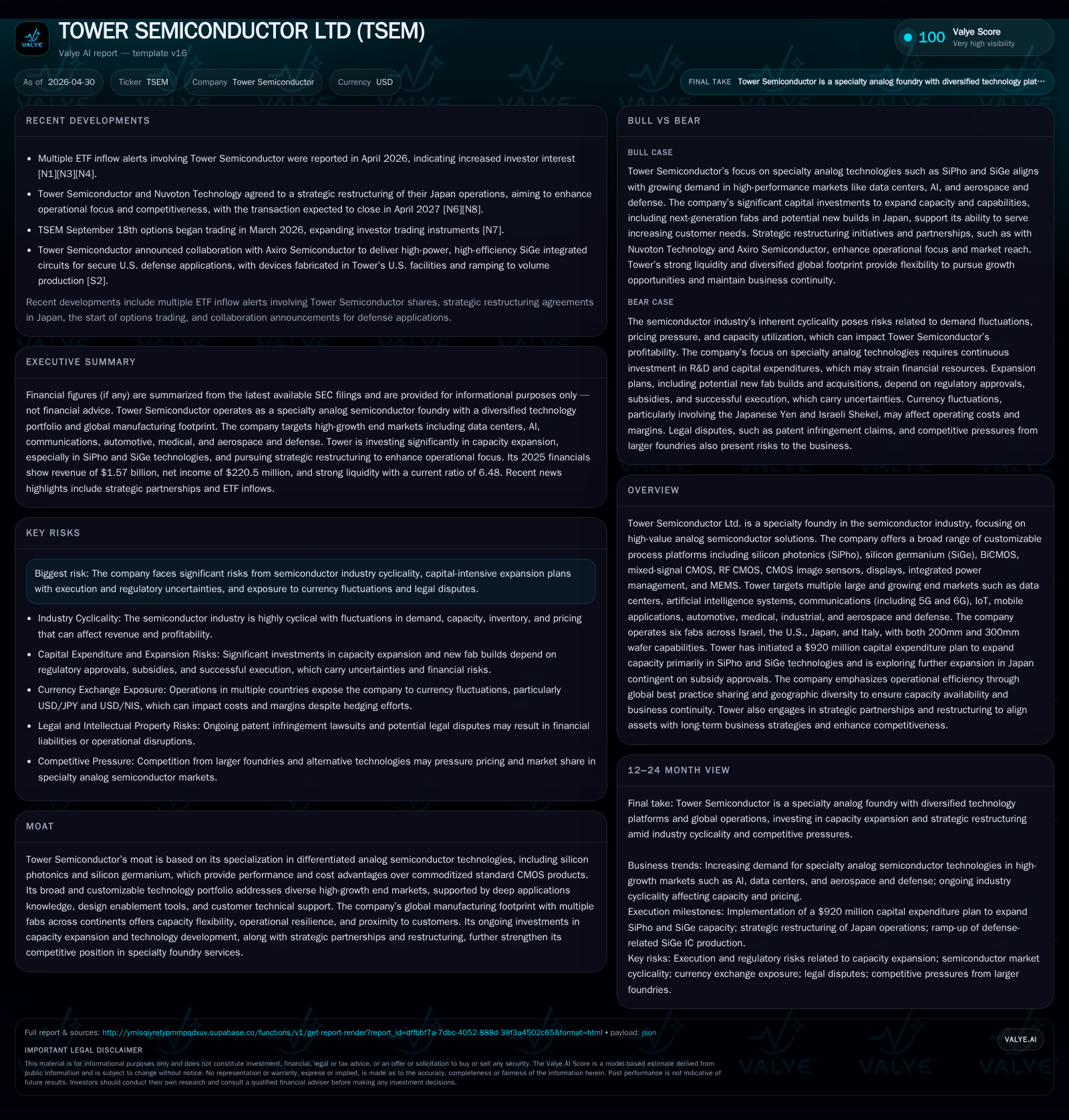
In April 2026, Tower Semiconductor announced volume production of Axiro’s high-efficiency silicon germanium (SiGe) radar beamforming ICs fabricated at its U.S. fabs, underscoring its strategic role in secure defense supply chains. The company operates six global fabs offering 200mm and 300mm wafer capabilities, focusing on differentiated analog semiconductor platforms like SiPho and SiGe that command premium pricing. Amid industry pressures toward smaller nodes and larger wafers, Tower’s specialty focus helps mitigate pricing erosion seen in commoditized CMOS fabs. Its $920 million capital expenditure plan targets capacity expansion primarily in SiPho and SiGe technologies, enhancing its ability to serve fast-growing markets including data centers, AI systems, communications, automotive, and aerospace-defense. Risks include cyclical semiconductor demand, capital intensity of expansions, regulatory uncertainties in Japan, and ongoing patent litigation.
Recent Operating Update
Tower Semiconductor’s latest SEC filing dated April 27, 2026 highlights a pivotal development: the ramp to volume production of Axiro Semiconductor's Ku and X-band radar beamforming integrated circuits (BFICs) using Tower's advanced Silicon Germanium (SiGe) technology footprint fabricated in Tower's U.S. facilities [S2]. This collaboration underscores Tower's established position as a trusted foundry partner serving the U.S. aerospace and defense sector. These BFICs achieve differentiated advantages such as enhanced gain, linearity, output power, efficiency, and fast switching critical for next-gen radar applications required by domestic defense primes. Axiro exclusively chose Tower's U.S.-based manufacturing to reinforce supply chain security amid rising demand for domestically sourced mission-critical components [S2].
This news is strategically significant as it solidifies Tower's role not just as a specialty foundry but as a contributor to sovereign supply chains in sensitive sectors—a trend gaining momentum globally due to geopolitical considerations.
Alongside this partnership progression is the scheduled first quarter earnings release forthcoming May 13, 2026 [S3], wherein management will presumably update financial results alongside outlook amid these operating dynamics.
Business Model
Tower Semiconductor operates as a specialty analog semiconductor foundry providing customizable process technologies spanning silicon photonics (SiPho), silicon germanium (SiGe), BiCMOS, mixed-signal CMOS, RF CMOS, CMOS image sensors, displays, integrated power management (BCD), and MEMS technologies [S1][S21]. Unlike commodity digital foundries chasing ever-smaller geometries primarily for logic devices, Tower targets diversified high-growth analog market segments requiring complex mixed-signal integration combined with high performance or low power characteristics.
Revenue mechanics rely on wafer fabrication contracts where customers pay primarily based on wafer volumes processed under long-term or project-specific agreements. Key drivers include wafer volume shipments complemented by price per wafer influenced by process complexity and mix.
Tower differentiates itself by offering specialized processes that allow customers to build differentiated products for data centers (especially optical interconnects through SiPho), AI accelerator systems requiring custom analog interfaces, communications infrastructure (5G/6G RF front-ends), automotive sensors and power management circuitry, medical instrumentation, and aerospace/defense components.
Support services including design enablement tools and close application engineering deepen customer engagement creating switching costs uncommon among commodity foundries. Tower also extends multi-fab sourcing options across six facilities spanning Israel (one fab), U.S. (two fabs), Japan (two fabs via TPSCo joint venture), and Italy (shared 300mm fab with STMicroelectronics) ensuring operational resilience contrasted against single-location peers [S1].
Margins benefit from technology-driven product differentiation improving pricing power relative to standard CMOS manufacturing commoditization trends seen elsewhere in the industry.
Industry Structure and Competitive Position
The global semiconductor foundry industry bifurcates into large digital pure-play players offering cutting-edge sub-5nm logic nodes mainly for CPUs/GPUs/APUs versus specialty foundries targeting analog/mixed-signal niches excluded from the economics scale race towards tiny geometries.
Tower occupies an important niche specializing in mature process geometries optimized for analog device quality rather than transistor density alone: contemporary nodes range from 0.18μm down to 0.13μm on 200mm wafers; and from 65nm down to 45nm on their newer 300mm lines tailored especially for SiPho modules which do not require ever-smaller lithography due to the nature of optical components involved [S21].
Key competitors within this specialty analog foundry arena include companies like GLOBALFOUNDRIES’ analog offerings post-divestitures from main digital business; TSMC’s specialty services albeit facing less analog-focused scope; other pure-play analog fabs; plus IDM captive fabs migrating select capacity externally.
Tower benefits competitively from its breadth of platform technologies (SiGe, BiCMOS variants, RF CMOS), global geographically diversified manufacturing footprint allowing operational risk mitigation vs regional disruptions or trade issues; plus deep customer technical partnerships enabling tailored solutions addressing complex mixed-signal problems.
Growth Drivers
Specialty Analog Demand Tailwinds
The proliferation of connected devices requiring enhanced sensing (automotive lidar/radar), optical data transmission (data center interconnects leveraging SiPho), wireless infrastructure upgrade cycles (5G/6G transceivers relying on RF-SOI/SiGe amplifiers), AI computation enhancements demanding customized analog front ends—all constitute growing end-market pull for Tower’s platforms.
Capital Expansion Focused on High-Growth Techs
The company has embarked on an ambitious $920 million capex program targeting expansion of its silicon photonics and silicon germanium process capacities across strategic fabs—particularly Fabs 2,3 (Israel/Japan) and their newest Agrate Italy facility offering high-volume matured 300mm capacity [S19][S1].
Notably during early 2026 they secured committed capacity reservation contracts extending through at least 2028 backed by prepayments incentivizing upfront funding security while allowing customers preferential access amid tight industry fab utilizations—a noteworthy demand validation signifier [S19].
Geographic Restructuring Aligned with Focused Execution
Strategic moves such as the planned restructuring deal granting Tower full control over the TPSCo Japanese 12-inch fab reflect efforts to optimize operational focus while maintaining collaborative production allocations with minority stakeholders [N1][N2][S22]. Taken together this aids growth by simplifying governance while allowing sharper local investment decisions aligned with long-term strategy.
Risks / Watchpoints / Growth Constraints
Cyclicality & Capital Intensity
As per longstanding semiconductor industry patterns cited in filings including the annual report note tower faces inherent demand cyclicality leading to fluctuations in utilization rates that can compress margins during downturn phases [S21]. Large capital expenditures expose the firm to execution risk: delays or cost overruns particularly tied to complex cleanroom builds and advanced equipment procurement could strain financial resources or limit timely capacity availability [S4][S5].
Regulatory & Subsidy Dependencies in Japan Expansion
Japanese capacity additions depend partly on government subsidies requiring approval after formal application processes—introducing uncertainty around timing/funding levels which could affect scale or pace of expansion plans there [S19]. Furthermore local regulatory hurdles related to property acquisition or environmental controls may slow deployment.
Patent Litigation Exposure
GlobalFoundries recently initiated patent infringement lawsuits against Tower seeking relief via U.S. ITC and federal courts presenting downside legal expense risks alongside potential injunctions threatening product lines or customer contracts if claims succeed materially [S6][S20].
What To Watch Next
- First quarter 2026 earnings release on May 13 will provide updated financial results and second quarter guidance possibly giving clearer metrics on ramp progress particularly related to Axiro BFIC production volumes/sales impact [S3].
- METI subsidy approval outcomes concerning Japanese expansion plans remain key milestones underpinning future capacity trajectory assumptions [S19].
- Progress updates on Japanese restructuring transaction closing targeted April 2027 will signal clarity on operational control shifts there with impact on future strategic investments [N1][N2][S22].
- Developments in ongoing patent litigation proceedings could materially influence strategic legal risk exposures with potential outcomes impacting licensing costs or design freedom.
- Monitoring wafer shipment volumes across specialized platforms such as SiPho & SiGe alongside order backlog indicators will serve as proxies for sustained demand momentum.
Financial Profile Snapshot
Latest financial snapshot
| Metric | Value | Period |
|---|---|---|
| Cash & equivalents | $235mm | |
| 2025-12-31 | ||
| Current assets | $1710mm | |
| 2025-12-31 | ||
| Current liabilities | $264mm | |
| 2025-12-31 | ||
| Current ratio | 6.48x | |
| 2025-12-31 |
Source: SEC companyfacts cache [F1].
On the balance sheet front as of December end-2025 cash & equivalents stood at ~$235 million well in excess of total debt estimated ~$179 million as of mid-2023 indicating net cash position supportive of near-term liquidity needs amid ongoing capex programs. The current ratio exceeds 6x indicating strong short-term asset coverage relative to liabilities enhancing financial flexibility for planned investments [F1].
Overall financial resilience combined with robust cash generation ($395m operating cash flows) allows execution confidence around $920 million capacity expansion plan largely funded internally though potential capital markets access remains available if needed under favorable conditions discussed in disclosures [F1].[F1]
This report is intended solely for informational purposes reflecting recent operating developments and business context derived from publicly available SEC filings and news sources without providing investment advice or recommendations.
Disclaimer: This is research-only, informational analysis and not investment advice. It may include AI-generated interpretation and general industry context. Always verify important details using primary sources.

Comments