
TH International's Operational Reset and Growth Challenges in China’s Coffee Market
TH International pursues store network rationalization amid liquidity strains while seeking growth through menu innovation and strategic financing.
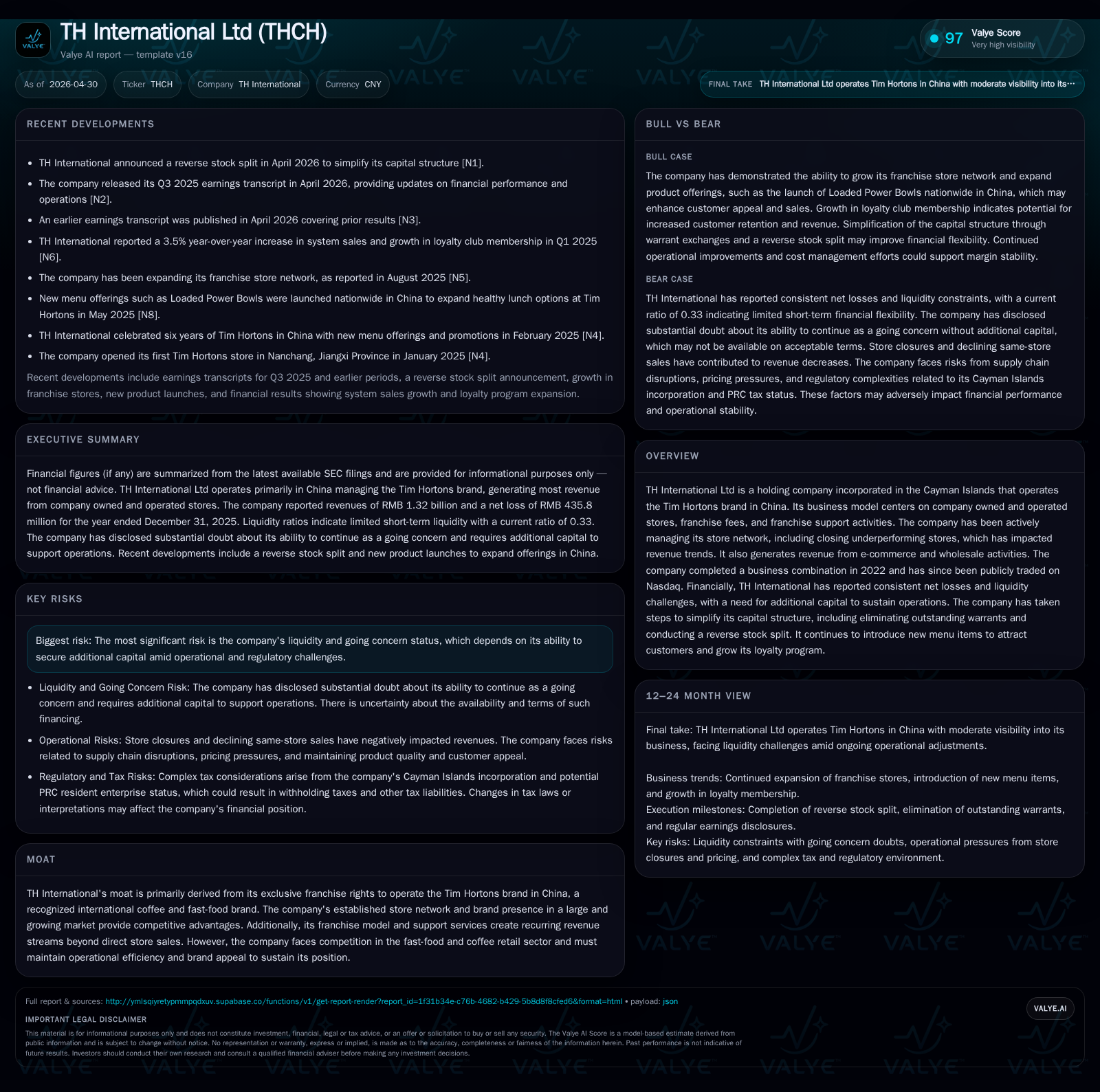
The latest quarterly filing from April 2026 reveals TH International's ongoing efforts to improve operational efficiency through store closures and network right-sizing. Despite the Tim Hortons brand's established presence in China, the company faces persistent liquidity challenges, margin pressure from rising input costs, and intense competition. Growth initiatives focus on new product launches and expanding digital channels, though capital constraints remain a key risk. Key near-term developments include monitoring equity financing progress under existing agreements and sales performance metrics.
Latest Quarterly Operating Update: Key Developments and Implications
TH International’s April 15, 2026 Form 6-K provides the freshest insight into its operational posture amid challenging market dynamics in China’s coffee retail segment [S2]. The company continues its active store network rationalization strategy by closing underperforming outlets to restore profitability and streamline operations. This tactical pruning reflects management’s acknowledgment of the need for improving unit economics as competitive intensity and cost pressures persist.
Moreover, the filing underscores ongoing efforts to enhance operating efficiency across company-owned stores amid sluggish revenue trends influenced by these closures. While exact retail footfall or same-store sales figures are not detailed in this report, the emphasis on store right-sizing suggests prioritization of sustainable long-term contribution margins over sheer footprint expansion.
This operational reset is critical as it sets an immediate context for evaluating TH International's near-term performance and financial viability given persistent headwinds.
Business Model Overview: Revenue Streams and Customer Value Proposition
TH International Ltd operates exclusively within Mainland China under exclusive franchise rights for the Tim Hortons brand—a well-recognized Canadian coffee and fast-food franchise with growing consumer awareness in the region [S1]. The business model earns revenues predominantly from three pillars:
- Company-operated store sales capturing direct consumer transactions.
- Franchise fees including royalty streams generated from franchised locations supported by TH International.
- E-commerce and wholesale distribution of branded products enhancing reach beyond physical stores.
This multi-channel approach supports diversified revenue streams although company-owned stores remain vital for brand experience control.
The firm has been actively introducing new food and beverage menu items aiming to boost traffic frequency and basket size—efforts visible from recent earnings transcripts highlighting innovation as a customer retention lever [N2]. Strategic franchise support activities contribute recurring income associated with network development and operations assistance.
The licensing arrangement creates a moat grounded in brand exclusivity within one of Asia's largest coffee markets. However, the model leans heavily on maintaining product quality standards aligned with Tim Hortons’ global appeal to differentiate against local players. The balance between operating owned outlets versus scaled franchising further impacts margin profiles.
Industry Context: Competitive Positioning and Market Dynamics
China’s coffee shop market is intensifying as international chains like Starbucks coexist alongside emerging domestic brands that aggressively expand via localized offerings. TH International faces stiff competition in both urban cores and emerging tier cities.
Geopolitical tensions impacting global commodity prices have translated into increased costs for wheat, dairy, oils, and energy inputs crucial for fast-food operations [S1]. Supply chain disruptions exacerbate raw material sourcing difficulties leading to inventory risks given perishable ingredients demand. The firm's ability to leverage bulk purchasing agreements for regional ingredients partially mitigates inflation effects but does not fully offset margin compression.
Pricing power remains constrained by consumers’ sensitivity amplified in economically uncertain environments coupled with internal discretionary promotional discounting actions evident in recent periods to sustain volume [S1]. The cost-price squeeze alongside operational costs associated with staff wages and real estate occupancy forms a structural profitability challenge.
Nevertheless, THCH benefits from scale economies relative to smaller competitors but must continuously navigate rationalizing less productive locations while protecting overall brand perception.
Growth Drivers: Expansion Levers and Innovation Efforts
TH International’s path to growth rests on several pillars:
- Network Optimization: Streamlining store count aims at curbing losses from marginal stores thus improving aggregate unit economics—a prerequisite towards return to profitability noted in the latest quarterly disclosures [S2].
- Menu Innovation: Regular introduction of new products intends to stimulate additional customer visits and compete on novelty and taste adaptations suitable for the Chinese palate as per earnings commentary [N2].
- Digital Channels & E-Commerce: Enhancing online order capabilities aligns with Chinese consumer digital habits enabling incremental sales beyond physical locations.
- Capital Access: On June 28, 2024, strategic transactions secured convertible note financings totalling US$40 million alongside amendments enhancing franchise agreements which provide vital equity-linked capital injection capacity necessary for funding growth initiatives [S1]. Furthermore, a committed equity facility via a Purchase Agreement allows THIL to raise up to $100 million via VWAP purchases subject to conditions—offering a conditional financing runway at market prices favorable relative to convertible debt servicing burdens [S4].
These factors combined underpin cautious optimism about stabilization followed by growth but depend heavily on execution amid tight liquidity conditions.
Risks and Constraints: Liquidity, Market Competition, and Regulatory Challenges
The dominant risk factor confronting TH International is its liquidity position exemplified by a strained current ratio of approximately 0.33 substantially below standard operating thresholds despite holding CNY 121.8 million cash equivalents at year-end 2025 [F1]. This imbalance highlights high current liabilities relative to short-term assets signaling near-term financial stress requiring external capital inflows.
Management openly concedes substantial doubt regarding going concern status given ongoing net losses (> CNY 434 million annually) combined with negative cash flow from operations [F1], notwithstanding mitigative plans involving cost reduction, bank facilities renewal, shareholder support, and potential further debt/equity issuance [S5].
Operational margin erosion driven by raw material inflation alongside competitive pricing pressure threatens profitability sustainability. Regulatory complexities inherent in PRC foreign exchange controls limit fluid repatriation of funds from subsidiaries which constrains parent liquidity deployment flexibility [S26]. Restrictions on dividend flows further complicate internal capital allocation.
Finally, significant dilution risks loom due to outstanding convertible notes mandating conversion contingencies which could depress share value if executed under distressed conditions [S8]. Coupled with unresolved material weaknesses in internal financial controls potentially impairing reporting reliability adds layers of corporate governance risk impacting investor confidence [S23].
Key Upcoming Milestones to Monitor
Investors should closely watch:
- Upcoming quarterly earnings releases for signs of stabilization or improvement in same-store sales trends or adjusted corporate EBITDA margins indicative of operational efficiency gains [N1], [S24].
- Activity under equity financing mechanisms, notably any VWAP Purchase execution under the ordinary shares Purchase Agreement reflecting tangible liquidity infusion progress potentially alleviating going concern pressure [N3], [S4].
- New product pipeline deployments gauged by marketing campaigns or widening digital sales penetration signaling successful consumer appeal boosts.
- Progress on mitigating internal control weaknesses, as advancing compliance enhancements may restore reporting credibility over time enhancing overall corporate governance profiles [S23].
- Regulatory developments influencing cross-border fund flows impacting dividend policies or debt servicing capabilities within Chinese jurisdictional frameworks.
These elements offer directional insights into balance sheet resilience and top-line momentum ahead.
Current Financial Profile and Liquidity Snapshot
At fiscal year-end December 31, 2025, TH International reported cash and equivalents of CNY 121.8 million and total debt of approximately CNY 16.1 million, resulting in a net cash position of about CNY 105.7 million [F1]. However, the company’s current liabilities stood at over CNY 1.0 billion against current assets of approximately CNY 326.6 million, yielding a current ratio of 0.33, which indicates a stressed liquidity profile [F1].
This imbalance between short-term liabilities and assets underscores significant near-term liquidity challenges requiring effective capital management and potential external financing to maintain operational continuity.
Total debt remains modest relative to cash reserves, suggesting limited outright leverage but highlighting the importance of managing working capital and refinancing risks prudently [F1].
Overall, the company’s cash burn from operations remains material, necessitating replenishment through equity sales, bank facilities, or other financing sources subject to market and regulatory conditions.
Disclaimer: This analysis is based solely on publicly available regulatory filings and news releases up to April 2026. It does not constitute investment advice or recommendations. All financial figures are sourced directly from cited SEC filings or authoritative company data without extrapolation beyond disclosed information.
Disclaimer: This is research-only, informational analysis and not investment advice. It may include AI-generated interpretation and general industry context. Always verify important details using primary sources.

Comments