
Steakholder Foods Faces Twine Insolvency Yet Pursues Expansion in Plant-Based Seafood Tech
Recent quarter highlights operational challenges from Twine acquisition insolvency amid geopolitical volatility and ongoing product development.
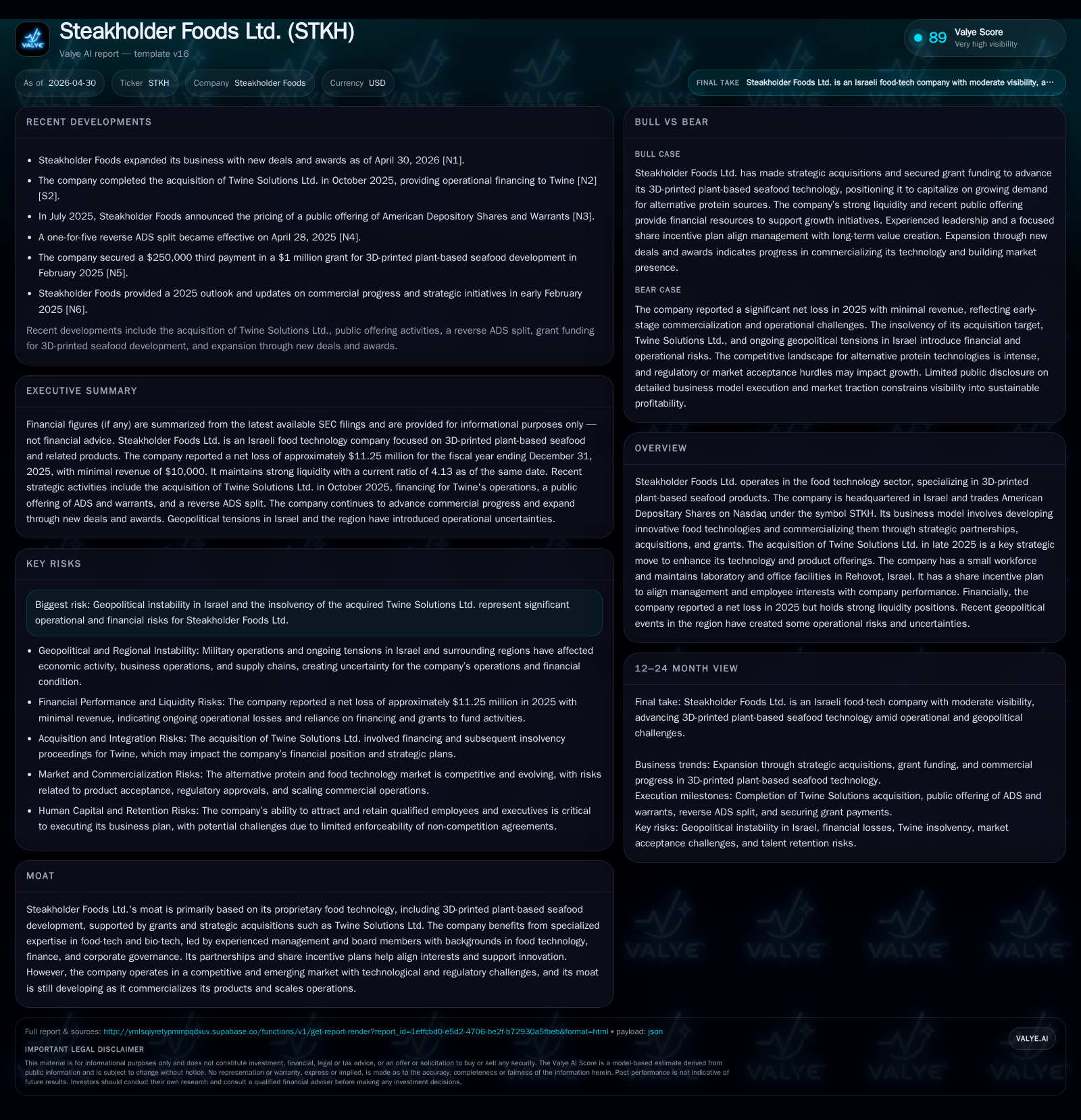
Steakholder Foods Ltd. (STKH), an innovator in 3D-printed plant-based seafood, disclosed in its Q4 2025 filing the insolvency of its recently acquired subsidiary Twine Solutions Ltd., raising execution risks. Despite the setback, the company continues to expand its technology offerings through strategic partnerships and investment in new office space. Geopolitical tensions in Israel further complicate near-term operations but also underscore the importance of resilient supply chains. Steakholder’s proprietary food-tech platform and collaborations provide a foundation for growth, though commercialization remains nascent with limited current revenues and a net loss reflecting ongoing R&D investment.
Recent Operating Update
Steakholder Foods Ltd.'s latest quarterly (6-K dated February 3, 2026) disclosure centers on significant developments surrounding its acquisition of Twine Solutions Ltd., a strategic move intended to enhance Steakholder's 3D-printed plant-based seafood technology portfolio. However, Twine Solutions became insolvent by December 2025 and subsequently initiated formal insolvency proceedings early in February 2026 [S2],[S3]. This unexpected development introduces operational and financial uncertainties that complicate integration plans and may affect future technology deployment timelines.
Alongside this adversity, the company has undertaken active steps to support its expanding operations — notably approving the subletting of additional office and meeting space from Kaiser Kaufman law firm in Ramat Gan at an annual rate of about $33,000 to accommodate growth [S7]. Also, an amendment to the royalties and materials supply agreement with Wyler Farm was executed where Steakholder agreed to purchase previously supplied raw materials for approximately $34,000 USD [S9]. These moves indicate ongoing efforts to stabilize supply chain inputs crucial for their manufacturing processes.
Geopolitical risk has intensified since late February due to "Operation Roaring Lion," involving military actions between Israeli/U.S. forces and Iran, with collateral strikes hitting Israel including rocket fire from Hezbollah in Lebanon. Although a temporary ceasefire was secured in April 2026, the situation remains unstable with potential disruptions to business activity and supply chains [S9]. The company acknowledges this uncertainty as a key external risk factor presently affecting economic conditions within its primary operating geography.
Business Model
Steakholder Foods operates within the emergent food technology sector focusing on advanced cellular agriculture methodologies enhanced by its proprietary 3D printing capabilities tailored towards plant-based seafood alternatives [S1],[N1]. The firm's revenue generation mechanics rely predominantly on developing next-generation biofabrication technology platforms delivered under licensing or partnership models rather than traditional consumer-packaged goods sales currently. This model emphasizes intensive upfront R&D investment deployed alongside selective acquisitions — exemplified by Twine Solutions — to build out capabilities spanning not only FoodTech but adjacent sectors such as textile applications seen with their TwineX1 system sale to Germany's Textile Research Institute [S16].
This specialization yields high barriers due to technological know-how complexities but presents a risk-return tradeoff as commercial adoption remains early stage with limited current revenue confirmed at $10,000 reported by end-2024 [F1]. The core intellectual property encapsulates unique formulations and printing methodologies targeting sustainability trends such as reducing seafood farming's ecological footprint while capturing consumer interest in alternative proteins.
Steakholder employs a share incentive plan that allocates restricted share units vesting over three years, aligning management incentives closely with corporate performance outcomes [S1]. Corporate governance includes independent board members experienced across finance and biotechnology sectors aiming to navigate both innovation challenges and capital market imperatives effectively.
Industry Structure and Competitive Position
Within the global alternative protein arena — particularly segmenting into cultured meat and plant-based seafood — Steakholder positions itself as a niche innovator leveraging biofabrication via 3D printing. This contrasts more commoditized plant-protein firms focusing on scalable extrusion products or fermentation-derived proteins.
However, competition remains stiff from both established multinational food companies accelerating product launches and startups securing venture funding for bioengineered meats. Regulatory landscapes are evolving as authorities formulate frameworks addressing safety, labeling, and sustainability claims around novel foods. Technological hurdles include scale-up capabilities ensuring cost efficiencies, taste/texture fidelity matching traditional seafood profiles, and consumer acceptance dynamics.
Steakholder's moat derives from patented food printing technology married with strategic acquisitions like Twine (despite its insolvency) supporting diversified applications. Its Israel base provides proximity to leading biotech hubs but brings exposure to geopolitical risks that few peers may face equivalently. Partnerships extending into textile innovation highlight cross-industry technology transfer potential without diluting core competencies.
Growth Drivers
Several vectors underpin potential growth trajectories:
Technology Commercialization: Success in translating lab-designed products into commercially viable offerings will drive revenue expansion beyond minimal historical levels [F1],[S1]. Progress depends on regulatory approvals, pilot-scale production ramp-up, and customer acceptance.
Strategic Partnerships: Collaborations like those with BlueSoundWaves collective improve market reach and resource access aiding go-to-market strategies [S1]. Additional partnerships could accelerate distribution channels or co-development ventures.
Product Line Extensions: Leveraging acquired assets such as Twine’s dyeing technologies for textiles demonstrates ability to explore adjacencies creating diversified revenue streams [S16],[N1].
Market Trends: Increasing consumer demand for sustainable food options globally aligns well with Steakholder’s value proposition.
Facility Expansion: New office/meeting spaces facilitate staffing growth enhancing operational capacity necessary for development milestones [S7].
Risks / Watchpoints / Growth Constraints
Challenges demanding vigilance include:
Twine Insolvency Impact: The bankruptcy of Twine Solutions clouds asset integration benefits originally anticipated from the acquisition; financial exposure includes roughly $1 million intercompany loans extended pre-insolvency [S7],[S2]. Remedies depend on court proceedings outcomes.
Regional Instability: Continued Middle East hostilities risk disrupting raw material supply chains, labor availability (reserve mobilizations), and general business activities locally impacting cost structures or timelines [S9].
Commercialization Uncertainty: Transitioning innovative technologies from prototype phase to scalable production remains inherently risky with uncertain timelines impacting cash flow forecasts.
Competitive Pressure & Regulation: Rapid innovation cycles within alternative proteins invite competitive headwinds while evolving regulations may introduce compliance costs or delays.
Liquidity Constraints: The company’s balance sheet shows a current ratio of 4.13x as of December 31, 2025, indicating strong short-term liquidity [F1]. However, sustained losses necessitate prudent capital management [S1].
What To Watch Next
Key upcoming indicators include:
- Resolution progress on Twine’s insolvency proceedings shaping long-term asset utilization [S2],[S3].
- Updates on new product commercialization status or pilot program launches indicating pathway toward revenue scale.
- Additional strategic partnership announcements signaling ecosystem expansion or diversification.
- Operational impact assessments of evolving geopolitical events influencing supply chain stability.
- Quarterly results reflecting burn rate management relative to liquidity reserves.
Financial Profile (Latest Snapshot)
Latest financial snapshot
| Metric | Value | Period |
|---|---|---|
| Cash & equivalents | $3.1mm | |
| 2025-12-31 | ||
| Current assets | $3.7mm | |
| 2025-12-31 | ||
| Current liabilities | $894,000 | |
| 2025-12-31 | ||
| Current ratio | 4.13x | |
| 2025-12-31 |
Source: SEC companyfacts cache [F1].
The company reported negligible revenue as it continues to invest heavily in research & development along with corporate infrastructure expansion. Operating losses reflect expected start-up costs typical within emerging biotechnology ventures.
Disclaimer: This analysis reflects publicly available information as of April 30, 2026; it does not constitute investment advice or recommendations.
Disclaimer: This is research-only, informational analysis and not investment advice. It may include AI-generated interpretation and general industry context. Always verify important details using primary sources.

Comments