
Wingstop’s Q1 2026 Highlights Asset-Light Franchise Expansion and Digital Sales Growth
Wingstop’s latest quarterly filing underscores continued system-wide sales growth, robust digital penetration, and strategic global expansion plans.
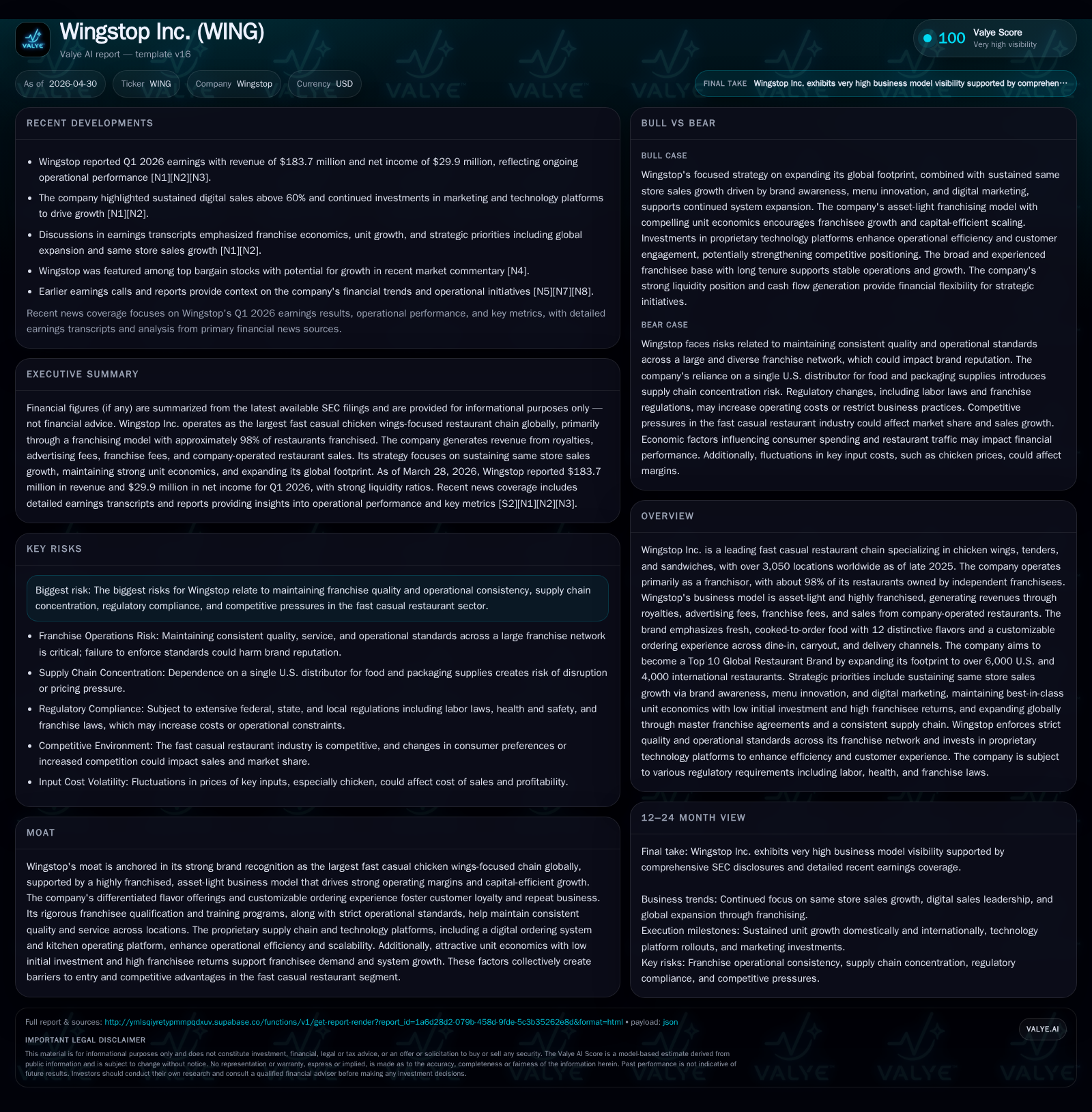
Wingstop Inc. reported solid operating momentum in its first quarter of fiscal 2026, leveraging its highly franchised, asset-light model to drive system-wide sales growth despite pressures on domestic same-store sales. Its emphasis on digital ordering now exceeds 70% of sales, reflecting strong customer adoption of off-premise channels. The company aims to nearly triple its restaurant footprint globally over the coming years, with a focus on maintaining quality and operational consistency through franchisee oversight and technology investments. While competitive dynamics in fast casual chicken wings and supply chain concentration remain watchpoints, Wingstop’s differentiated flavor offerings and scalable platform position it well for capital-efficient growth.
Recent Operating Update: Q1 2026 Financial Results
Wingstop's most recent quarterly filing (10-Q filed April 29, 2026 [S2]) highlights ongoing growth within its fast casual chicken wing segment anchored by a franchising-heavy model. As of the quarter ended March 28, 2026, Wingstop operated 3,056 restaurants worldwide — a roughly 19.2% increase from the prior year — reinforcing aggressive unit expansion primarily through franchise partners.
The company reported its system-wide sales continuing an upward trajectory due to new restaurant openings even as domestic same-store sales declined slightly by approximately 3.3%. Notably, digital sales maintained a dominant share, exceeding 70% of all system-wide sales, indicating strong customer adoption of off-premise ordering channels like delivery and carryout [S2][S3]. Company-owned restaurants showed positive same-store sales growth (+2.6%), reflecting effective operational management in these controlled units.
The business remains capital efficient due to its asset-light franchise structure where roughly 98% of locations are franchisee-owned; revenues primarily derive from royalties, advertising contributions, fees, and company-operated store sales [S1]. The company also declared a quarterly dividend of $0.30 per share payable June 5, 2026 [S7], sustaining consistent shareholder returns.
Business Model
Wingstop operates predominantly as a franchisor within the fast casual dining sector focused on chicken wings, tenders, sandwiches, and complementary sides with an emphasis on fresh-made-to-order food in twelve proprietary flavors [S1]. Revenue streams flow from:
- Royalties: Percentage fees based on franchisees' gross sales.
- Advertising Fees: Contributions to national marketing efforts supporting brand awareness.
- Franchise Fees: Initial fees charged upon new store openings.
- Company-Owned Store Sales: Income from directly operated units.
This highly franchised structure drives favorable unit economics with minimal capital expenditure requirements on Wingstop’s part while enabling rapid footprint growth domestically and internationally [S1]. The brand's focus on flavor differentiation — including layering bold taste profiles without shortcuts like heat lamps or microwaves — helps foster customer loyalty across multiple day parts and occasions.
Operationally, Wingstop invests heavily in proprietary digital platforms for ordering and kitchen operations that streamline processes and support scalability among its franchise network [S1]. Maintaining rigorous franchise standards — including training and operational protocols — ensures service consistency critical for sustaining brand reputation given ongoing expansion.
Industry Structure and Competitive Position
Within the rapidly growing fast casual wing sector, Wingstop stands out as the largest dedicated brand globally with a keen focus on scalable franchising. Its asset-light model contrasts with more capital-intensive peers that emphasize company ownership or larger menu breadths.
Competition ranges from other specialty wing concepts to broader fast casual pizza or sandwich brands encroaching into similar day-part occasions. Wingstop’s moat is founded on:
- Strong brand recognition deeply tied to chicken wing expertise.
- A limited but highly curated menu that simplifies operations.
- Digital convenience that supports off-premise dining trends.
- Attractive franchise unit economics fueling demand within prospective operators.
- Proprietary supply chain relationships ensuring flavor consistency.
The company’s stringent enforcement of franchise agreements mitigates risks associated with inconsistent service or food quality [S1]. Nonetheless, supply chain concentration—common within poultry sourcing—and regulatory compliance present ongoing challenges in maintaining smooth operations.
Growth Drivers
Wingstop’s path toward becoming a Top 10 Global Restaurant Brand rests on three pillars:
- System Expansion: The company targets more than doubling its current footprint to over 6,000 domestic locations and expanding internationally beyond 4,000 restaurants by leveraging its proven franchising model [S1].
- Same Store Sales Growth: Sustained through menu innovation (introducing limited-time flavors), brand marketing enhancing consumer engagement, and enhancing digital loyalty programs [S1].
- Digital Penetration: Off-premise ordering via mobile app and third-party delivery channels exceeding 70% enables margin optimization and matches evolving consumer preferences [S1][S2].
Supporting these is investment in back-end technology infrastructure facilitating order accuracy and throughput efficiency—critical at scale—as well as focused franchisee recruitment prioritizing operators capable of delivering consistent guest experiences.
Risks and Watchpoints
Key risks revolve around:
- Franchise Quality Control: As nearly all units are franchised, maintaining operational standards outside direct control is essential to avoid damaging the brand reputation through subpar food or service [S1].
- Supply Chain Dependencies: Concentrated sourcing could expose Wingstop to input cost inflation or disruptions affecting pricing or availability [S1].
- Competitive Intensity: Fast casual dining remains fiercely contested; emerging players or established chains innovating wings could pressure market share or margins.
- Regulatory Compliance: Navigating food safety regulations across multiple jurisdictions demands vigilant oversight to preclude fines or reputational harm [S1].
Investors should closely monitor same-store sales trends domestically as signs of consumer spending softness or market saturation could indicate cyclical headwinds versus structural shifts.
What to Watch Next
Upcoming milestones include:
- Quarterly updates highlighting same store sales trajectory domestically vs internationally.
- Progress against unit opening targets especially in key international markets as management pursues global footprint expansion.
- Digital engagement metrics such as app downloads/use frequency signaling strength of customer loyalty programs.
- Operational execution indicators like average order times reflecting technology investments’ payoff.
- Any commentary on supply chain status amid current inflationary pressures impacting poultry prices.
- Dividend announcements maintaining steady payouts signaling cash flow health [S7].
Financial Profile (Latest Quarter Context)
Latest financial snapshot
| Metric | Value | Period |
|---|---|---|
| Cash & equivalents | $129mm | |
| 2026-03-28 | ||
| Total debt | $1221mm | |
| 2025-12-27 | ||
| Net debt | $1092mm | |
| 2025-12-27 | ||
| Current assets | $217mm | |
| 2026-03-28 | ||
| Current liabilities | $97mm | |
| 2026-03-28 | ||
| Current ratio | 2.24x | |
| 2026-03-28 |
Source: SEC companyfacts cache [F1].
As of March 28, 2026, Wingstop reported cash and equivalents totaling $128.8 million against total debt approximately $1.22 billion as of end-2025 [F1], implying net debt around $1.09 billion consistent with prior levels. The current ratio stood at a healthy 2.24x indicating sufficient short-term liquidity [F1].
Disclaimer: This analysis is intended solely for informational purposes outlining Wingstop Inc.’s business context based on publicly available SEC filings as of April 29, 2026. It does not offer investment advice or recommendations regarding the company's securities.
Disclaimer: This is research-only, informational analysis and not investment advice. It may include AI-generated interpretation and general industry context. Always verify important details using primary sources.

Comments