
Universal Display Amplifies OLED Lead with Patent Expansion and Liquidity Strength
The latest quarterly filing reveals Universal Display’s reinforced moat through strategic patent acquisitions and a strong liquidity position amid ongoing litigation.
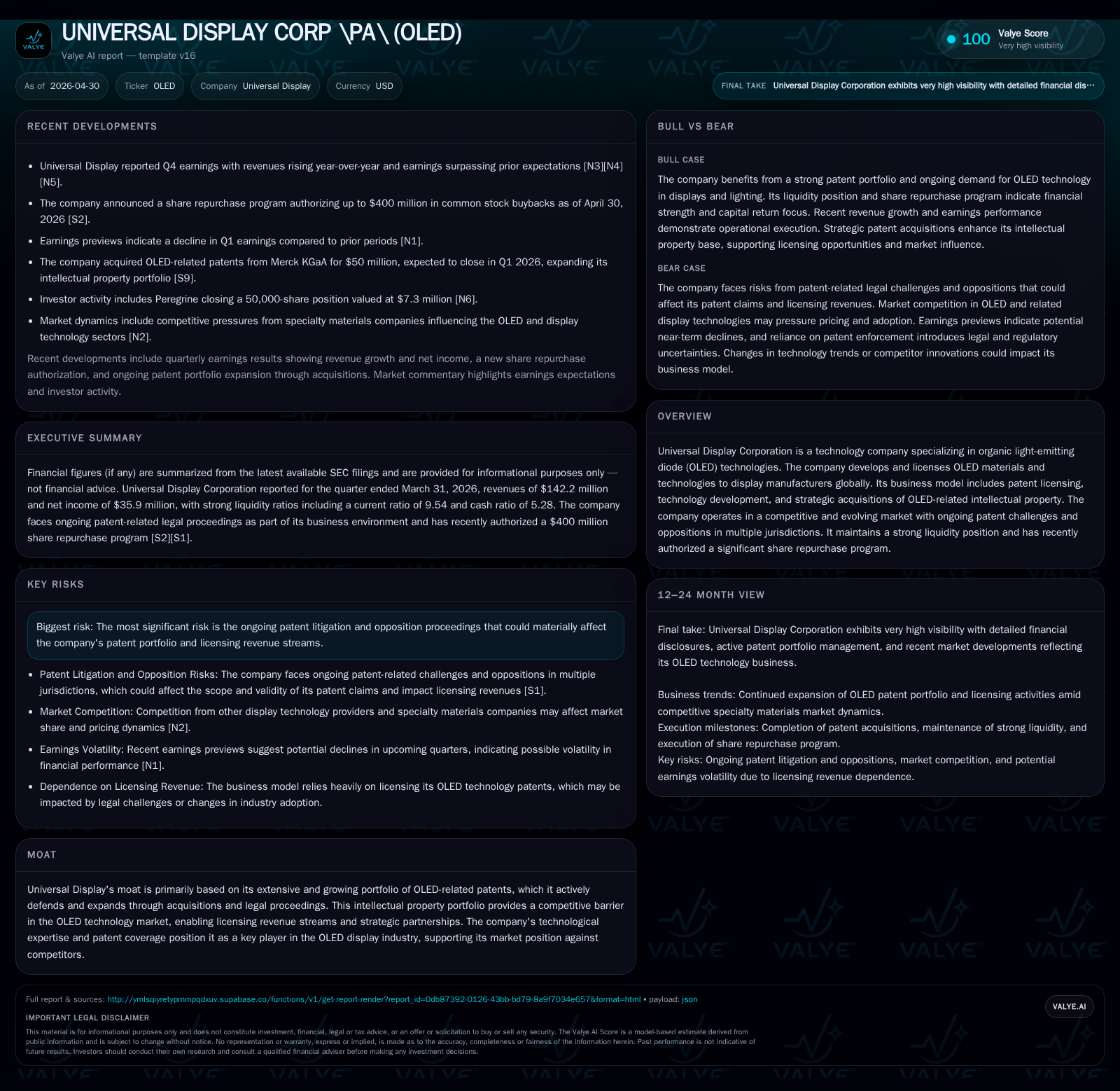
Universal Display Corporation’s Q1 2026 report underscores a solid operating performance supported by continued licensing revenue growth and an expanded patent portfolio. The company authorized an additional $400 million share repurchase program, reflecting confidence in its cash position and capital allocation flexibility. Despite ongoing patent litigation risks, Universal Display’s expansive intellectual property rights and technology leadership maintain a competitive barrier that supports durable licensing income and market positioning.
Latest Quarterly Update Highlights
Universal Display Corporation’s 10-Q filing for Q1 ended March 31, 2026, details steady operational footing amid an evolving industry landscape [S2]. Licensing revenues remain the backbone of the business model with contributions from an ever-growing OLED patent portfolio. The company announced an authorization for up to $400 million in additional share repurchases as disclosed in a contemporaneous 8-K [S3], underscoring management’s confidence in financial flexibility. This move is consistent with their strategy to return capital while maintaining reserves for ongoing patent defense and acquisitions.
Furthermore, Universal Display reported completing or progressing on strategic acquisitions of OLED-related patents—including a notable $50 million transaction with Merck KGaA finalized earlier this year [S4]—bolstering its intellectual property breadth. These operating developments highlight the firm’s dual emphasis on defending core patents against infringement challenges and extending its technological moat.
Business Model and Technology Licensing Framework
Universal Display derives revenues predominantly from royalty fees paid by device manufacturers that incorporate its patented OLED technologies into displays [S1]. This structure leverages the company’s extensive IP portfolio covering phosphorescent OLED materials essential for high-efficiency, bright displays used in smartphones, televisions, and wearable devices.
Licensing agreements typically feature tiered royalties based on device volumes and content usage, providing semi-structured revenue streams sensitive to end-device adoption rates [S1]. The investments in developing new OLED materials feed into richer product offerings that can command higher royalty content values or capture larger portions of display value chains.
Customers include major display panel producers globally who depend on Universal Display’s IP to differentiate products on energy efficiency, lifetime, and color quality—all key decision metrics for OEMs. This reliance engenders high switching costs since infringing on patents risks expensive litigation and supply disruptions. Moreover, the recurring nature of royalties linked to unit production creates predictable cash flows that scale with OLED market penetration.
Competitive Position and Industry Patent Dynamics
Universal Display’s competitive moat is anchored decisively in its large-scale patent portfolio comprising thousands of granted patents worldwide [S1]. This intellectual property arsenal forms a formidable barrier by effectively controlling critical aspects of OLED material chemistry and device engineering.
The company faces persistent third-party oppositions and patent challenges in multiple jurisdictions as competitors seek to narrow or invalidate claims—to complicate market entry or reduce licensing fees [S6][S17]. However, Universal Display's proactive acquisitions enhance coverage breadth while legal defenses preserve its position.
In an industry where producing next-generation displays requires navigating complex technical patents, the company’s established relationships with leading manufacturers amplify its ability to set royalty terms. This dynamic tends to favor licensors with deep portfolios over entrants lacking cross-jurisdictional patent enforcement capabilities.
Nonetheless, legal risks inject episodic uncertainty into future licensing income profiles.
Drivers Fueling Sustainable Growth
OLED continues to gain structural traction across consumer electronics categories including smartphones, premium TVs, laptops, and emerging AR/VR devices. Universal Display benefits directly from rising unit shipments embedded with its patented technology [N2].
Technological upgrades such as blue phosphorescent emitters improve device longevity and efficiency—translating into potential royalty rate escalations per display unit through enhanced content value capture [S3].
Additionally, increased average display sizes and multi-layer device architectures amplify materials content per unit, expanding total addressable royalties even at modest volume increments.
The company’s robust liquidity enables nimble investment both in R&D collaborations and opportunistic IP acquisitions which further extend growth runway. Meanwhile, the new share repurchase authorization enhances per-share capital returns amid measured operational scaling.
Risks: Litigation and Market Penetration Limits
Principal risks involve ongoing patent oppositions jeopardizing key claims that undergird licensing revenues [S17]. Jurisdictional reviews may affirm, limit or revoke certain patents affecting fee structures. Legal outcomes remain unpredictable; adverse rulings could erode exclusivity or trigger royalty renegotiations.
From an industry perspective, slower-than-expected OLED adoption shifts due to cost competition from rival display technologies (e.g., microLED) or macroeconomic consumer spending pressures could dampen volume growth.
Regulatory uncertainties around international IP enforcement regimes also add complexity for sustaining global license collections. As the portfolio ages, renewal costs rise while newer entrants attempt alternative material solutions posing substitution threats.
Vigilance over these dynamics is essential since they represent tangible constraints to scaling universal license penetration flawlessly across all targeted device categories.
Upcoming Catalysts to Monitor
Key near-term milestones include upcoming quarterly earnings releases offering updated guidance on licensing revenue progression amidst macro headwinds [S3][N2]. Progress reports on patent dispute resolutions or appeals will provide insight into intellectual property sustainability.
Further strategic asset purchases or partnerships announced through SEC filings could indicate acceleration in technology domain consolidation enhancing long-term competitive advantages.
Monitoring OEM adoption rates of premium OLED panels containing Universal Display technology will also signal traction levels underpinning royalty growth prospects.
Investor attention should focus on how these factors reconcile with broader display industry transitions impacting pricing power and licensing scalability going forward.
Financial Snapshot Underpinning Strategic Financial Health
Latest financial snapshot
| Metric | Value | Period |
|---|---|---|
| Cash & equivalents | $159mm | |
| 2026-03-31 | ||
| Current assets | $932mm | |
| 2026-03-31 | ||
| Current liabilities | $98mm | |
| 2026-03-31 | ||
| Current ratio | 9.54x | |
| 2026-03-31 |
Source: SEC companyfacts cache [F1].
As of March 31, 2026, Universal Display held $159.4 million in cash and equivalents with $932.3 million in current assets against $97.8 million in current liabilities—yielding a strong current ratio of approximately 9.54x indicating substantial short-term liquidity buffer [F1][S2].
This balance sheet strength supports aggressive share buybacks under the newly authorized $400 million program alongside continued investment in R&D and patent acquisitions.
Operating cash flows remain consistent due to recurring royalty income streams tied to expanding OLED adoption trends. Such financial health provides operational agility critical when facing episodic legal expenditures or competitive pressures requiring swift capital deployment.
This analysis presents a factual synthesis based on Universal Display Corporation’s recent SEC filings combined with sector knowledge of intellectual property-driven technology businesses. It avoids speculative statements unsupported by explicit disclosures or numeric evidence while contextualizing ongoing developments within industry structural fundamentals forming the basis of sustainable competitive advantages.
Disclaimer: This is research-only, informational analysis and not investment advice. It may include AI-generated interpretation and general industry context. Always verify important details using primary sources.

Comments