
Federal Realty Investment Trust Boosts Leasing Momentum and Refinances Debt in Q1
Q1 2026 results highlight strong leasing performance and strategic debt management enhancing Federal Realty's growth prospects.
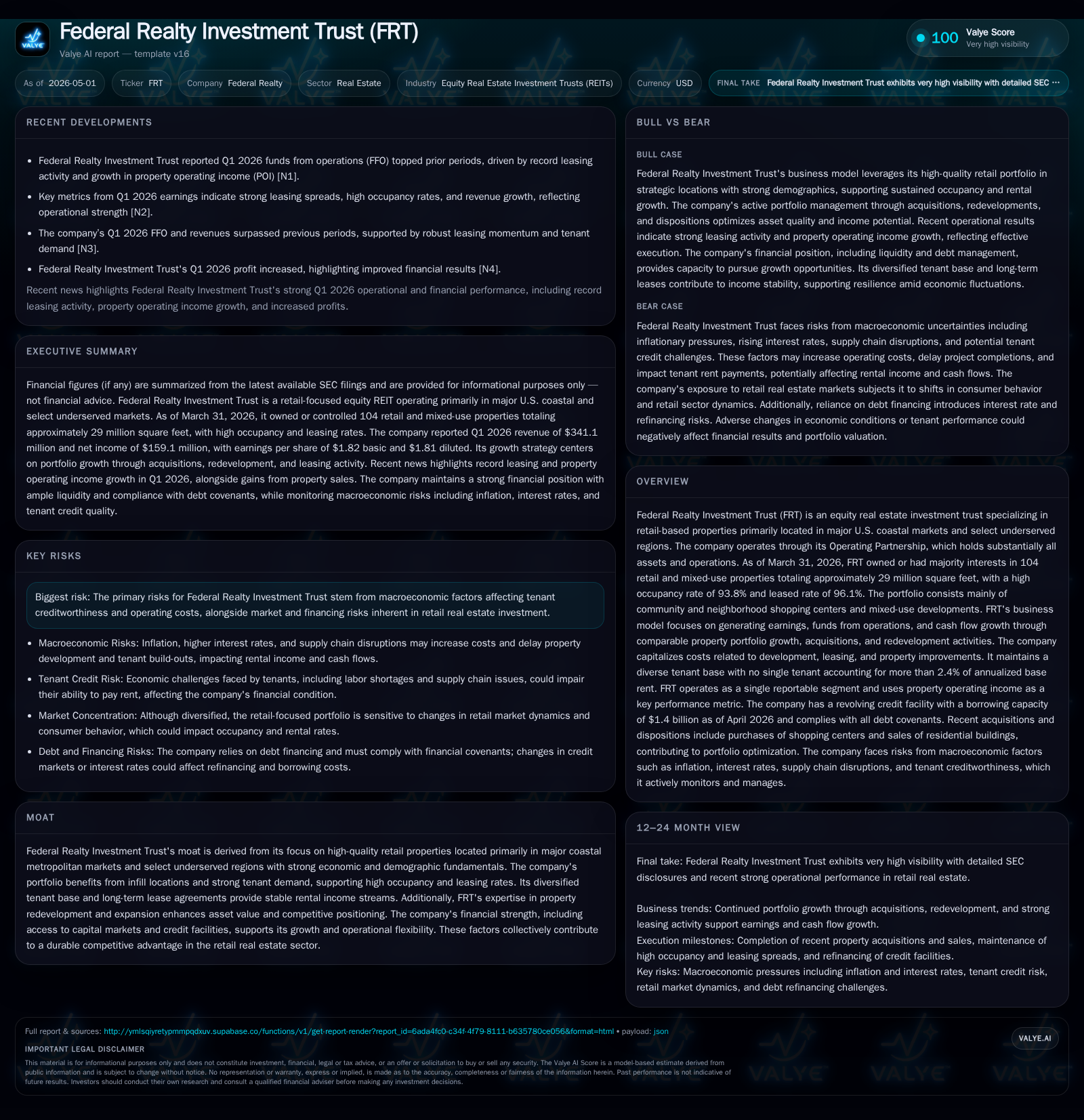
Federal Realty Investment Trust (FRT) reported robust leasing activity in Q1 2026, driving high occupancy and leased rates that underpin stable cash flow. The company also executed key debt refinancing moves, including repayment of $400 million in senior notes and drawing $250 million on an unsecured term loan, supporting capital flexibility. With a portfolio concentrated in premier coastal retail markets, FRT leverages redevelopment and acquisitions to sustain growth despite macroeconomic uncertainties. Near-term milestones will focus on leasing velocity and execution of redevelopment projects.
Recent Quarterly Developments Drive Renewed Investor Focus
Federal Realty Investment Trust’s Q1 2026 filing reveals notable operational progress combined with strategic capital moves that brighten near-term growth visibility [S2][S3][N1][N3]. Occupancy ended March at a healthy 93.8%, with leased rate even higher at 96.1%, illustrating continuing strong tenant demand in its predominantly retail portfolio. Concurrently, the company successfully repaid its $400 million 1.25% senior notes at maturity in February and drew $250 million under an unsecured term loan agreement executed late last year, balancing debt maturities with liquidity needs [S2][S9].
This combination of leasing momentum alongside measured refinancing underscores Federal Realty’s ability to sustain cash flow growth while reinforcing balance sheet flexibility amid ongoing economic uncertainties.
Business Model Overview: Retail-Centric Real Estate with Mixed-Use Focus
Federal Realty operates primarily through its Operating Partnership which holds all assets controlling a portfolio of 104 retail and mixed-use properties totaling roughly 29 million square feet as of Q1 '26 [S5][S2]. The properties are mainly community and neighborhood shopping centers, emphasizing grocery-anchored retail that serves dense urban or infill locations along U.S. coastal metro regions plus select underserved areas exhibiting favorable economic fundamentals [S1][F1].
Revenue generation stems from long-term leases with a diverse tenant base where rental income includes base rents plus capitalized tenant improvement recoveries and above/below market lease amortizations [S1]. Lease accounting uses accrual methods contingent upon tenant payment collectibility assessments—critical given sector tenant credit variations post-pandemic [S1]. Redevelopment capabilities enable Federal Realty to extend asset life cycles through property improvements that enhance competitive positioning and unlock rental premiums.
Such a model balances stable funds from operations (FFO) deriving from high occupancy with growth through property repositioning or selective acquisitions. Capitalization of development costs aligns expenses with income recognition over time.
Competitive Positioning Within Coastal and Underserved Markets
Federal Realty's emphasis on infill coastal properties creates a moat anchored by high barriers to entry due to limited developable land, strict zoning regulations, and strong demographic demand [S1][N10]. This scarcity supports pricing power evidenced by solid lease renewal spreads and occupancy persistence even as e-commerce reshapes retail footprint strategies.
The quality tenant mix spans essential services such as groceries combined with experiential retail tenants less susceptible to online substitution effects—a diversified ecosystem limiting exposure to any single tenant or industry downturn [S1]. Tenant creditworthiness assessment remains rigorous reflecting broader REIT sector trends focusing on cash flow quality post-COVID disruptions [N2].
Additionally, Federal Realty’s ability to redevelop and adapt space adds switching costs for tenants while attracting new entrants seeking premium market presence. Compared to peers more reliant on big box formats or suburban malls, FRT’s asset specialization positions it favorably for resilient demand recovery.
Growth Drivers: Leasing Performance, Redevelopment, and Acquisitions
Leasing velocity is a key growth lever validated by the increase in leased rate to above 96%, generating positive rental reversions as expiring leases roll into renewals or new agreements [S2][N3][N4]. Redevelopment initiatives represent another important driver; ongoing investment in upgrading properties fosters higher rents per square foot while extending asset useful lives—translating into increased FFO margins over time.
Acquisitions remain disciplined yet accretive. For instance, early in Q1 2026 Federal Realty acquired the fee interest in Congressional North Shopping Center for $72.3 million funded partially via operating partnership units issuance—a move aligned with strategy focused on grocery-anchored centers in affluent communities [S13]. Disposal of non-core assets during the quarter realized net gains helping recycle capital towards higher return developments.
The company’s access to capital markets backed by solid investment-grade credit ratings facilitates these transactions seamlessly [S9]. Overall, these factors collectively support sustainable NAV expansion anchored by predictable cash flows complemented by tactical property enhancements.
Risk Factors: Tenant Creditworthiness and Market Sensitivities
Federal Realty’s principal risks revolve around macroeconomic variables impacting tenants’ ability to fulfill rental obligations—rent collection probability is an accounting judgment area affecting revenue recognition directly [S1]. Economic downturns or sector-specific shocks could influence vacancy or renewal rates adversely.
Higher interest rates coupled with inflationary pressures raise operating costs potentially compressing margins absent rent escalations matching cost increases [S2]. The company maintains compliance with financial covenants under revolving credit facilities and term loans which impose leverage limits though flexibility has been enhanced through recent refinancing activities [S9].
Legal contingencies exist as is customary among REITs but do not currently threaten material adverse outcomes [S16][S23]. Continued monitoring of geopolitical instability effects on trade tariffs or consumer spending patterns forms part of management’s risk mitigation framework [S7].
Near-Term Catalysts to Monitor: Guidance and Operational Milestones
Key upcoming metrics include tracking sustained leasing velocity particularly for leases slated for renewal mid-2026 onward which will influence rental rate trends dynamically [N3]. Completion timelines for high-profile redevelopment projects will be pivotal both strategically for portfolio enhancement and quantitatively for incremental rent capture.
Management guidance updates related to Funds From Operations (FFO) projections will provide further clarity on translating operational improvements into bottom-line growth [N3]. Additionally, absorption rates of newly acquired properties onto stabilized earnings form another dimension to gauge execution.
Sector observers should also watch for potential refinements to capital allocation policy balancing dividends versus reinvestment given FRT's longstanding dividend growth record spanning nearly six decades [S1].
Latest Financial Snapshot: Liquidity and Leverage Overview
Latest financial snapshot
| Metric | Value | Period |
|---|---|---|
| Cash & equivalents | $116mm | |
| 2026-03-31 | ||
| Total debt | $5.0bn | |
| 2025-12-31 | ||
| Net debt | $4.8bn | |
| 2025-12-31 |
Source: SEC companyfacts cache [F1].
At March-end 2026, Federal Realty held $115.63 million in cash equivalents supporting ongoing liquidity requirements complemented by capacity under a revolving credit facility facilitated by recent refinancing maneuvers including the repayment of maturing senior notes [$400 million] and drawing down on a newer unsecured term loan [$250 million] executed in late 2025 [S2][S9].
The weighted-average interest rate on borrowings stood near 4.4% during the quarter evidencing reasonable financing costs amid prevailing market conditions [S9].
This analysis synthesizes publicly available SEC filings as of May 1, 2026 (primarily the Q1 Form 10-Q), corroborated with contemporaneous market commentary sources identified herein. It does not constitute investment advice or recommendations.
Disclaimer: This is research-only, informational analysis and not investment advice. It may include AI-generated interpretation and general industry context. Always verify important details using primary sources.

Comments