
GoDaddy Advances AI-Driven Platform Growth While Managing Debt and Retention Challenges
Strong Q1 2026 revenue and bookings growth led by AI-powered Applications & Commerce, offset by modest net income decline and leverage constraints.
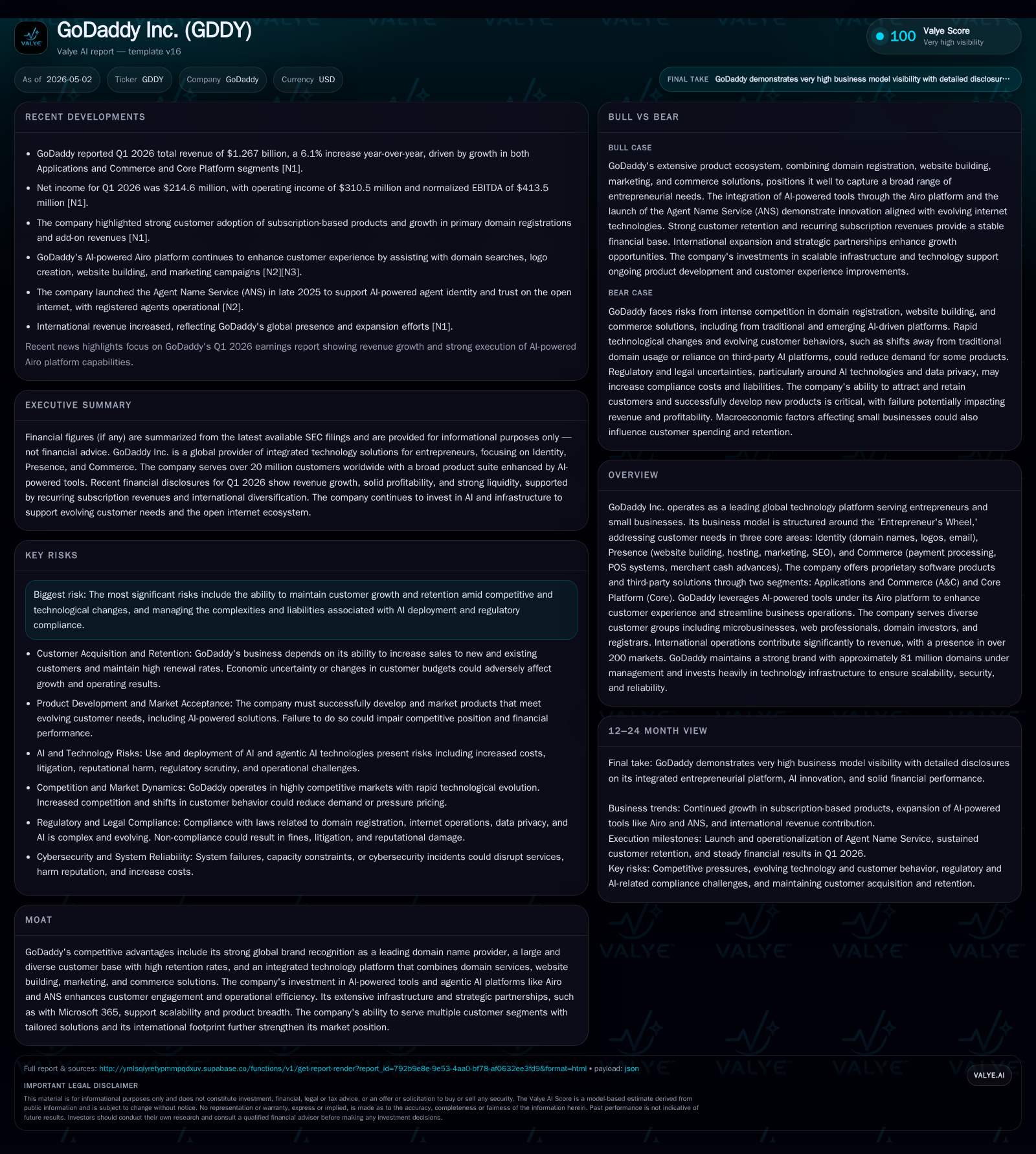
GoDaddy delivered a 6.1% revenue increase in Q1 2026 driven by its expanding AI-enabled Applications & Commerce segment, reflecting strength in proprietary software and commerce solutions. The Core Platform with domain registrations and hosting grew more modestly but remained a stable contributor. Operating income grew sharply on improved margins supported by ongoing cost optimization and cloud migration initiatives. However, net income declined slightly due to prior-year tax benefits not recurring. Customer retention remains solid, driven by integrated product bundling and AI tools like Airo. Despite strong operating cash flow, the company carries significant debt and a below-par current ratio, requiring careful capital allocation between growth investments and shareholder returns. The path to growth hinges on deeper AI integration, continued international expansion, and successful navigation of competitive pressures and regulatory risks
Recent Operating Update: Q1 2026 Performance Anchored in AI-Led Growth
GoDaddy Inc.'s Q1 2026 results released in the May 1, 2026 Form 10-Q [S2] highlight continued momentum in its transition towards integrated AI-powered services powered by its Airo platform. Total revenue rose to $1.267 billion, up 6.1% year-over-year (5.6% on constant currency basis), propelled primarily by an 11.6% jump in the Applications & Commerce (A&C) segment to $498 million from $446 million a year earlier [S17]. The Core Platform segment—which includes domain registrations, renewals, hosting, security products—grew more modestly at +2.8%, totaling $769 million [S17].
Operating income expanded significantly by 25.6% to $311 million as margin improvement was supported by ongoing cost rationalization including cloud migration initiatives reducing data center expenses [S2]. Normalized EBITDA rose a solid 13.5% to $414 million [S2]. However, net income edged down slightly to $215 million (-2.2%), impacted by a sizable one-time tax benefit ($34.6 million) recognized in the prior year quarter that did not repeat this period [S17].
International revenue continues to be an important growth vector contributing $416 million or 33% of total revenues with a healthy rise of 7% (5.5% constant currency) [S17], underscoring GoDaddy's deep global footprint across more than 200 markets [S1]. Strong bookings growth of 2.7% ($1.455 billion) signals durable demand across the portfolio but at a tempered pace compared with revenue gains [S17]. Net cash from operations also improved meaningfully (+16.5%) driven by higher collections and efficient working capital management [S2][S13].
Business Model: Integrated Technology Solutions Centered on the Entrepreneur's Wheel
GoDaddy operates under a distinct business philosophy called the "Entrepreneur's Wheel," which organizes its offering into three focal areas that address key stages of small business lifecycle: Identity (domain names, logos, email), Presence (websites, hosting, marketing platforms), and Commerce (payment processing, POS systems, merchant cash advances) [S1]. This holistic approach emphasizes cross-selling as customers onboarding for domains are encouraged toward bundled web presence solutions plus commerce capabilities—a strategy aimed at increasing lifetime value through product stickiness.
Product sales are organized into two primary segments:
- Applications & Commerce (A&C): Proprietary software-driven tools including website builders enhanced by proprietary AI (Airo platform), commerce modules such as GoDaddy Payments and POS systems along with third-party productivity products like Microsoft email licenses bundled within proprietary offerings.
- Core Platform: Traditional domain registration services including new sales and renewals alongside hosting and security solutions offered independently or bundled with software products [S1][S21].
Revenue flows from subscriptions and usage fees tied to these services with booking metrics reflecting contracted sales expected to convert into upcoming recognized revenue streams [S1]. Customer payment frequency varies by product mix; domains often carry multi-year prepayments while SaaS products operate on monthly or annual subscriptions.
Margins differ materially across segments; Core yields steady but lower margin flows dominated by domain registration fees payable to registries under contracts that dictate cost structures while A&C commands higher margins through proprietary technology leverage and SaaS pricing models enhanced by AI value-adds [S1][S17].
Industry Structure and Competitive Position
Operating within the highly competitive internet services sector serving entrepreneurs globally, GoDaddy competes against domain registrars (e.g., Namecheap), website builders (Wix, Squarespace), ecommerce platforms (Shopify), cloud service providers (Amazon Web Services), and increasingly specialized niche players in digital marketing automation.
Its moat is built on several factors:
- Brand recognition: The company boasts one of the strongest global consumer brands in the domain registration space.
- Large diversified customer base: Over 20 million customers including microbusinesses, web professionals, developers and domain investors reduce reliance on any single segment.
- Integrated platform approach: Combining domains with presence-building tools plus commerce solutions creates high switching costs compared to standalone website or payment providers.
- AI enhancements: Investment in generative agentic AI through Airo deepens personalization for customers aiding discovery of domains/logos/websites while automating operational processes thus improving retention rates.
- Strategic partnerships: Collaborations such as bundling Microsoft365 enhance solution breadth beyond proprietary software alone.
- International scale: Presence in over 200 markets provides diversification though also adds complexity around local regulations and currencies [S1][N1].
Despite advantages, competition remains fierce especially from agile SaaS-first newcomers leveraging low-cost technology stacks or from marketplaces providing commoditized domains undercutting pricing power.
Regulatory developments around domain registration policies plus evolving legislation regarding online content liability present latent risks affecting compliance burdens.
Growth Drivers
Expansion of AI-Powered Offerings
GoDaddy’s investment in its Airo agentic AI platform is central: enhancing customer journeys from ideation (domain name search) through brand identity creation (logo generation) to website launch—this improves conversion rates and allows premium pricing opportunities particularly for entrepreneurial customers valuing speed-to-market [S1][N2]. New AI features integrated into commerce products streamline inventory/order management boosting value proposition for merchants migrating online.
International Market Penetration
With international revenues growing at ~7%, GoDaddy’s strategy leverages local partnerships while customizing offerings to diverse regulatory environments enabling access to underpenetrated SMB markets worldwide [S17][S1].
Bundling & Pricing Strategies
Targeted bundling reduces buyer friction making upgrading easier for customers initially acquiring only domains or basic hosting plans [S1]. Variable pricing experiments allow GoDaddy to optimize margins without losing retention rates—a balance challenging competitors relying mainly on discount-led volume growth.
Cost Optimization & Technology Migration Efforts
Ongoing cloud migration reduces legacy infrastructure costs while enabling faster time-to-market for product enhancements helping maintain NEBITDA margins even amid rising R&D spending focused on innovation [S2].
Commerce Platform Expansion
Enhancement of omnichannel commerce capabilities including Tap to Pay on Mobile devices along with GoDaddy Capital advances increases monetization via transaction fees complementing subscription revenues [S1].
Risks / Watchpoints / Constraints
Customer Growth & Retention Pressures
While retention approximates ~85%, sustaining this metric requires continuous product updates amidst aggressive competition offering similar or free alternatives—losses here would directly impair unit economics [S15][N3].
Regulatory & Legal Risks Related to Domain Management & AI Deployment
Domain registrar liability exposure could increase if wrongful transfers or compliance lapses occur; evolving laws around internet intermediary liability may narrow protections under Section 230 amplifying litigation risk [S15]. Further deployment of generative AI technologies inherently bears legal scrutiny risk due to potential intellectual property infringements or privacy concerns raising operational costs [S15][N3].
Pricing Sensitivity & Competitive Intensity
Price wars or discounting among registrars/web builders could erode average revenue per user limiting margin expansion possibilities despite new product introductions [S15].
Technology Infrastructure Reliability & Capacity Constraints
Service outages or disruptions of third-party data centers/cloud providers would impair customer experience harming brand trust critical for retention given reliance on centralized infrastructure for delivery of SaaS/cloud-native offerings [S15].
Leveraged Balance Sheet & Liquidity Ratios
Total debt stands at approximately $3.82 billion while cash is near $967 million resulting in elevated net debt (~$2.86 billion) with current liabilities exceeding current assets yielding a current ratio of just ~0.67 indicating tight short-term liquidity requiring prudent capital allocation between debt servicing, investment needs and shareholder returns via buybacks/dividends [F1][S2][S9][S13].
What To Watch Next
Key milestones pertinent over the upcoming quarters include:
- Continued quarterly revenue execution especially further A&C growth fueled by novel AI feature rollouts;
- Customer cohort retention metrics trends indicating stickiness improvements;
- Commentary around international expansion traction particularly emerging market uptake;
- Gross margin movements reflecting cost optimization success post cloud migration;
- Updates on regulatory developments relating to domain management practices or new legislation impacting platform liability;
- Any shifts in capital allocation strategy balancing share repurchases vs acquisitions or R&D investments;
- Disclosure of any material technological incidents impacting uptime or data integrity;
- Progress reports on deployments of advanced agentic AI functions enhancing product differentiation.
Careful monitoring of quarterly earnings calls alongside SEC disclosures will be critical as incremental evidence emerges regarding GoDaddy’s ability to sustain growth trajectories in a challenging industry environment dynamically shaped by rapid technology evolutions.
Financial Profile Snapshot (Q1 2026)
Latest financial snapshot
| Metric | Value | Period |
|---|---|---|
| Total debt | $3.8bn | |
| 2026-03-31 | ||
| Net debt | $2.9bn | |
| 2026-03-31 | ||
| Current assets | $2.1bn | |
| 2026-03-31 | ||
| Current liabilities | $3.1bn | |
| 2026-03-31 | ||
| Current ratio | 0.67x | |
| 2026-03-31 |
Source: SEC companyfacts cache [F1].
Source notes: Financial metrics primarily from latest quarterly filing [S2], supplemented with balance sheet metrics from companyfacts database [F1].
Disclaimer: This analysis is based solely on public filings and news disclosures as outlined herein for informational purposes only and does not constitute investment advice.
Disclaimer: This is research-only, informational analysis and not investment advice. It may include AI-generated interpretation and general industry context. Always verify important details using primary sources.

Comments