
Upbound Group Reconsolidates Growth with Diverse Lease-to-Own and FinTech Portfolio
Upbound’s latest quarter affirms momentum across its lease-to-own segments while Brigit’s financial wellness platform gains traction with consumers.
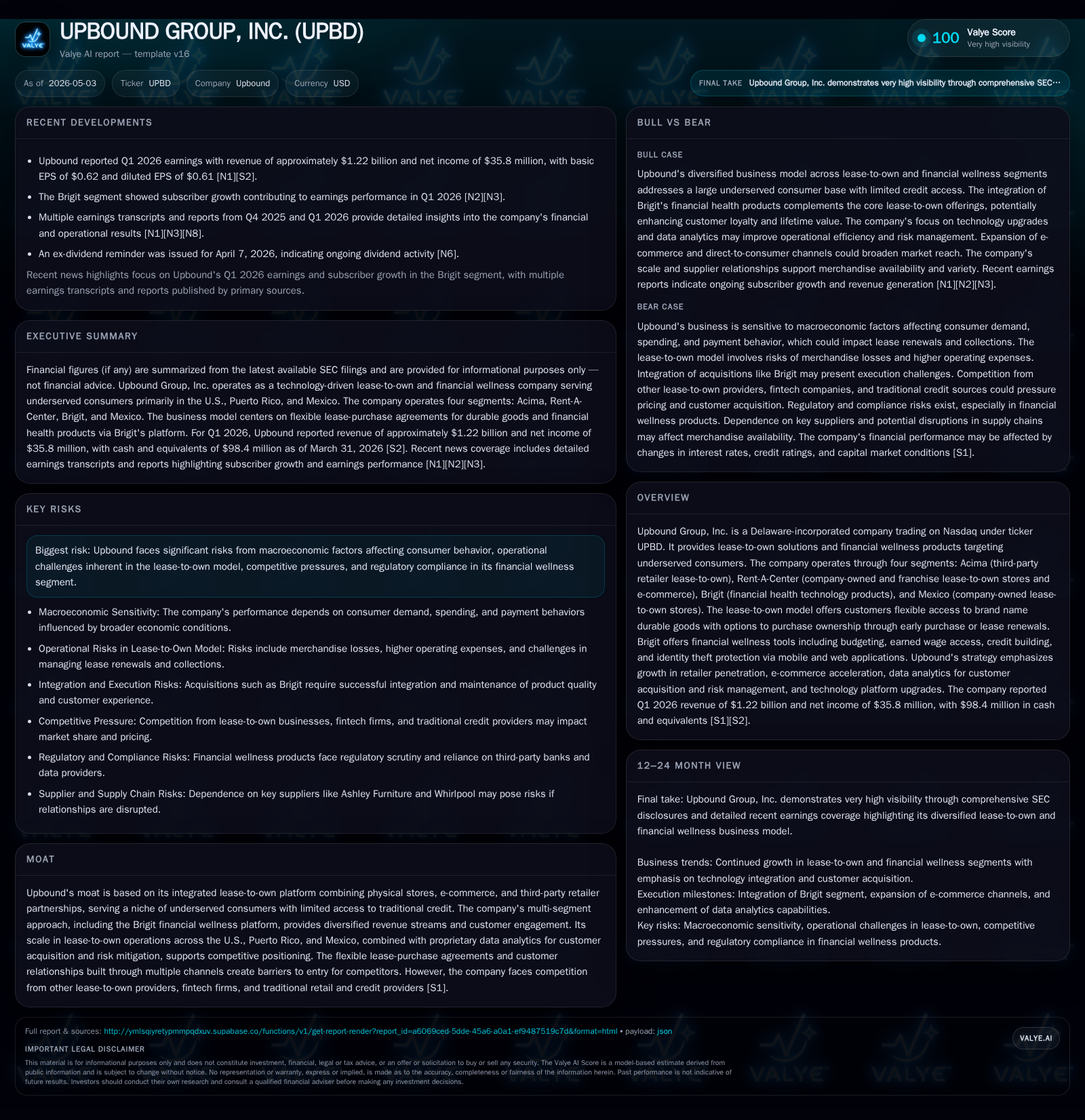
In Q1 2026, Upbound Group demonstrated operational progress highlighted by expanding user engagement and strategic retail partnerships across its Acima, Rent-A-Center, Brigit, and Mexico segments. The firm's integrated approach combining physical retail, e-commerce, and fintech offerings continues to solidify its foothold serving underserved consumers. Growth drivers center on retailer penetration, e-commerce acceleration, and proprietary analytics to enhance credit risk management and customer acquisition. Key risks remain tied to macroeconomic shifts, regulatory complexity particularly for fintech products, and operational execution across a multi-channel platform. Financially, Upbound maintains a solid cash position supporting its growth initiatives.
Latest Quarterly Operating Update: Momentum and Segment Performance
Upbound Group’s Q1 2026 results filed on May 1 reaffirm constructive operational trends across all four core segments: Acima, Rent-A-Center, Brigit, and Mexico [S2]. Notably, Brigit’s subscriber base expanded ahead of expectations as confirmed by earnings commentary on April 30 [N2][N3]. This fintech platform is emerging as a critical non-leasing revenue driver complementing Upbound’s broader lease-to-own ecosystem.
The Acima segment reported steady gains in retailer penetration—both at small to medium-sized businesses as well as incremental pipeline additions among national retailers [S2][S3]. Rent-A-Center continues to enhance its omni-channel customer experience integrating e-commerce growth with physical store operations [S2]. Meanwhile, Mexico operations maintain consistent contribution through company-owned leasing stores.
Channel mix evolves towards digital engagement without sacrificing traditional in-store accessibility—a hallmark of Upbound’s multi-faceted strategy targeting consumers underserved by conventional credit providers [N1]. The integration between leasing solutions and fintech services supports recurring engagement metrics, underpinning revenue stability.
Upbound’s Business Model: Integrated Lease-to-Own and Financial Wellness Ecosystem
Upbound generates revenue primarily by offering flexible lease-to-own contracts that enable consumers to use brand-name durable goods without immediate full payment obligations. Customers pay periodic lease fees with options for early purchase or ownership acquisition via defined lease renewals [S1]. This model minimizes credit risk owing to lack of long-term debt commitment while enabling ownership transfer opportunities.
The company’s four operating segments capture various channels:
- Acima partners with third-party retailers providing embedded lease-to-own solutions both in-store and online.
- Rent-A-Center operates company-owned and franchise stores plus a branded e-commerce platform delivering an end-to-end leasing experience.
- Brigit offers financial wellness products including earned wage access (EWA), budgeting tools, credit builder accounts, and identity theft protection accessible via mobile/web apps.
- Mexico replicates the leasing model within a targeted geographic market.
Proprietary data analytics form a core competitive advantage enabling enhanced underwriting precision, risk mitigation, targeted marketing campaigns, and personalized customer acquisition strategies [S1]. Recurring lease payments supplemented by fintech subscription revenues create diversified income streams.
Market Positioning and Competitive Framework in Consumer Leasing and FinTech
Within the lease-to-own industry—spanning the U.S., Puerto Rico, and Mexico—Upbound possesses meaningful scale particularly via its Acima platform integrated into thousands of retailers. Its multi-channel approach insulates it from reliance on a single distribution mode. Proprietary datasets leveraging consumer payment behavior provide a defensible moat against new entrants seeking to service underbanked populations [S1].
Competition comes from traditional rent-to-own companies as well as burgeoning fintech alternatives offering buy-now-pay-later or microcredit products. However, Upbound differentiates through flexible no long-term debt obligation lease structures coupled with its financial wellness technology layer delivered by Brigit.
The combined offering targets a niche demographic facing limited access to mainstream credit but desiring ownership pathways for consumer durables alongside tools to improve overall financial health—a dual value proposition not widely replicated [S1]. Regulatory dynamics affecting EWA providers constitute an external pressure point but recent CFPB advisory opinions favor certain non-credit interpretations of EWA usage which temper compliance uncertainty [S12].
Growth Drivers: Retailer Penetration, E-Commerce Acceleration, and Platform Analytics
Growth initiatives emphasize expanding third-party retailer penetration through Acima by increasing adoption amongst small/medium businesses while adding new national/regional partners [S1][N3]. This approach amplifies market coverage without direct capital expenditure per store given the partner-operated model.
Rent-A-Center's e-commerce channel focus aims to capture digital-native consumers who prefer seamless online leasing experiences alongside maintained brick-and-mortar footprint for brand presence and service continuity [S2].
Brigit's evolving product suite—including earned wage access (EWA), budgeting assistance, credit builder features—facilitates steady subscription growth validated by recent beats versus consensus subscriber metrics [N2]. These fintech innovations anchor long-term consumer engagement beyond initial lease transactions.
Analytics infrastructure improves targeting efficiency enhancing marketing ROI while lowering bad-debt exposure through superior predictive modeling of consumer risk profiles. This data-driven layering complements the physical asset-based leasing guarantees enhancing overall unit economics [S1].
Risks: Macroeconomic Sensitivity, Regulatory Environment, and Operational Complexity
Upbound remains exposed to cyclical fluctuations in consumer discretionary spending which can impact demand for leased durable goods especially in slower economic environments [S1][S2]. Payment delinquencies may rise under stress scenarios affecting collections performance.
Regulatory risks are pronounced particularly for Brigit’s EWA offerings where state-level licensing regimes diverge. Though recent federal guidance clarified certain EWA structures are typically not considered loans under TILA/Regulation Z norms, this landscape is evolving necessitating cautious compliance navigation [S12]. Moreover, regulations governing data privacy/security impose operational costs.
Managing multiple business lines across physical retail locations, franchise networks, e-commerce platforms, and SaaS-based fintech products imposes operational complexity requiring continual IT system vigilance. Disruptions either internally or within retail partner systems could cause service interruptions or elevated expenses [S1]. Competition also pressures pricing/margins necessitating constant innovation.
Catalysts and Milestones to Monitor in Upcoming Quarters
Key performance indicators include the pace of incremental third-party retailer acquisitions on Acima’s platform; continued ramp-up of Rent-A-Center e-commerce transaction volumes; quarterly increments in Brigit subscriber counts alongside product portfolio expansions; metrics relating to customer tenure & retention rates; and collection efficiencies reflecting underwriting quality [N1][S3].
Announcements regarding new retail partnerships or geographic store openings could signal upsides to growth narratives. Regulatory developments impacting EWA frameworks warrant close observation given potential implications on cost structures or product redesign requirements.
Earnings call guidance updates will offer additional lens into execution confidence particularly if management provides forward-looking commentary about demand trends or margin trajectories.
Financial Snapshot: Balance Sheet Health and Cash Flow Considerations
As of March 31, 2026 quarter-end, Upbound held $98.4 million in cash & equivalents supporting liquidity needs amid ongoing investments into growth initiatives [F1][S2]. While total debt figures are last clearly reported circa 2016 (~$192 million), no material updated leverage disclosures were present in the latest filings indicating stable debt positioning but monitoring for any refinancing activity is prudent given historical leverage levels [F1].
Operating income sustained positive levels around $223 million annually (latest full year) accompanied by net income near $73 million offering evidence of profitable base operations supporting ongoing capital deployment into multi-channel platform expansion efforts [F1]. Cash conversion dynamics will be critical to watch for sustaining investment capacity without excessive reliance on external funding sources as lease receivables scale.
This analysis synthesizes information from Upbound Group's SEC filings through May 2026 including Q1 10-Q (S2), recent event filings (S3), annual 10-K (S1), related news transcripts (N1-N3), along with up-to-date company facts snapshot (F1). It reflects current operating context without projecting speculative future outcomes or making investment recommendations.
Disclaimer: This is research-only, informational analysis and not investment advice. It may include AI-generated interpretation and general industry context. Always verify important details using primary sources.

Comments