
Solaris Energy Infrastructure Expands Power Capacity and Secures Long-Term Contracts Amid Financing Growth
Solaris Energy Infrastructure advances its gas turbine leasing platform with new multi-hundred megawatt power agreements and significant term loan financing in early 2026.
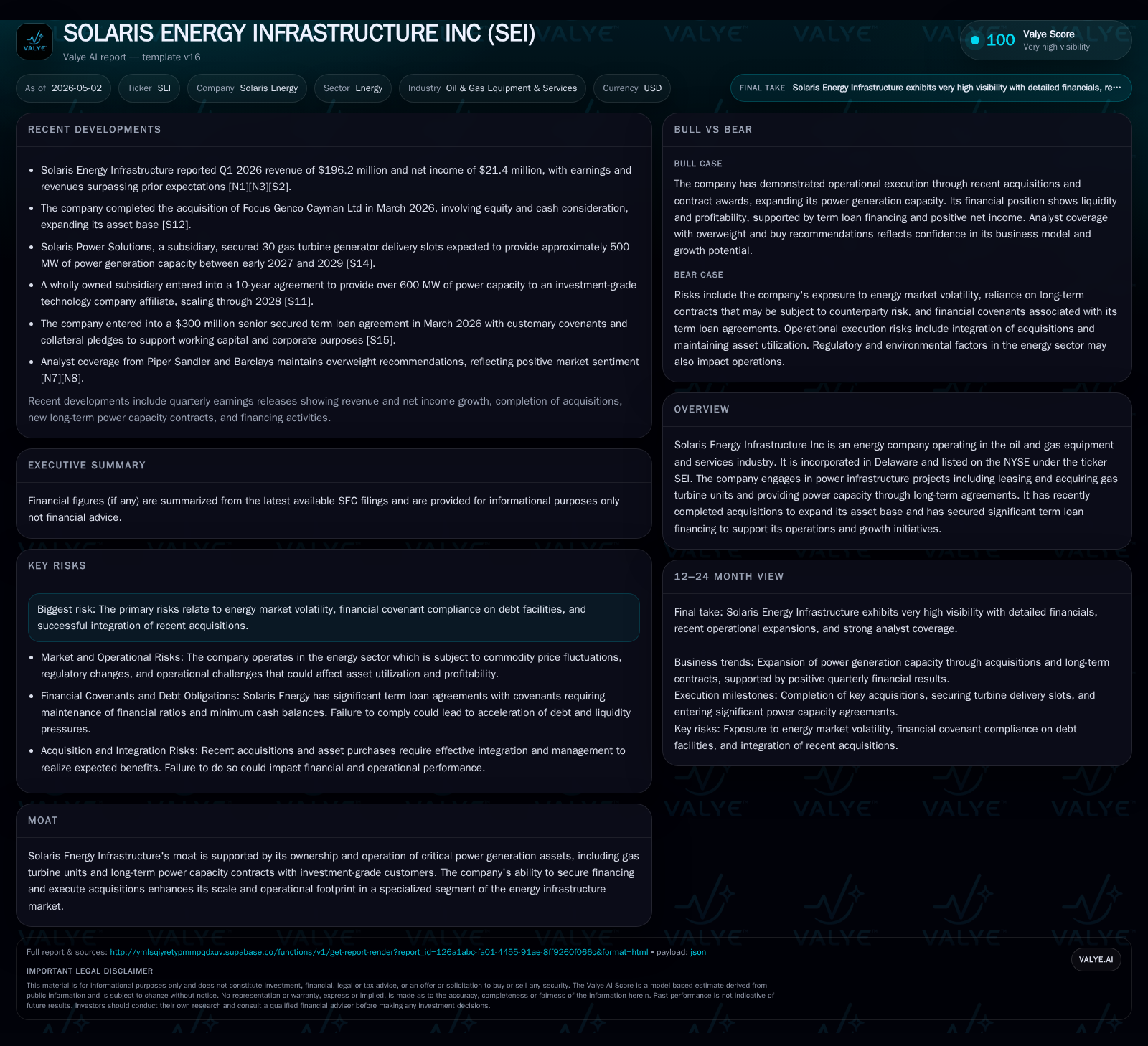
In the first quarter of 2026, Solaris Energy Infrastructure Inc. signed a landmark 10-year, 600+ MW power capacity agreement with an investment-grade technology affiliate, to commence late 2026 and scale through 2028. The company also finalized acquisitions expanding its core gas turbine asset base and secured $300 million in senior secured term loans—with an additional $200 million facility amendment available—to bolster liquidity and growth initiatives. Solaris operates by leasing critical gas turbine assets under long-term contracts primarily to investment-grade counterparties, reinforcing its stable cash flow profile within the fragmented energy equipment services industry. However, risks remain around covenant compliance due to debt leverage and integration of recent acquisitions.
Recent Operating Update
Solaris Energy Infrastructure's latest quarterly filing (10-Q dated May 1, 2026) reveals significant near-term advancements shaping its growth trajectory. Most notably, a wholly owned subsidiary entered a power capacity agreement on April 24, 2026 [S3][S14]. This contract delivers over 600 MW of power capacity plus balance-of-plant services to an affiliate of an investment-grade technology company over a decade-long term starting late 2026 and increasing through 2028. This marks a meaningful expansion into large-scale capacity leasing tied to blue-chip counterparties and underscores structural demand for reliable, long-dated energy infrastructure.
Additionally, Solaris completed strategic asset acquisitions including securing rights to approximately 500 MW through the acquisition of gas turbine generator delivery slots from Baker Hughes via the Turbine Purchase Agreement executed in early 2026 [S22]. These assets are scheduled for deployment between early 2027 to 2029, signaling continued capability scaling.
On the financing front, Solaris closed a senior secured term loan agreement totaling $300 million in March 2026 arranged by Goldman Sachs, targeted at funding working capital and growth [S25][S26]. An amendment in April provides additional commitments up to $200 million available until October 2026, reflecting proactive liquidity management for capital-intensive deployment phases [S26]. Despite these sizeable financings, Solaris reported a strong cash balance of $344 million with current assets exceeding liabilities slightly (current ratio ~1.11) at quarter end March 31, showing underlying financial stability during growth investments [F1][S2].
Business Model
Solaris Energy Infrastructure operates as a specialized energy infrastructure entity that derives revenue primarily through leasing gas turbine power generation units coupled with providing related balance of plant services. Customers pay under long-term agreements—typically spanning multiple years—to secure committed power capacity from Solaris's fleet of turbines.
Margins benefit from the company's asset-light model; rather than owning all assets outright initially, Solaris often acquires lease rights or delivery slots (e.g., from Baker Hughes) while leveraging term loan facilities for capital expenditures. The company then collects fees under operational leases which are less sensitive to commodity price swings relative to merchant generation operators.
This offering addresses increasing off-grid and hybrid microgrid trends in energy markets driven by demand for resilience and greenfield industrial power solutions. The contractual structure creates barriers to entry due to capital intensity and creditworthiness screening.
Industry Structure & Competitive Position
Solaris occupies a niche within the broader Oil & Gas Equipment & Services sector focused on energy infrastructure leasing rather than direct production or equipment manufacturing. This segment is characterized by consolidation challenges—large scale operators dominate some areas while many smaller firms compete regionally.
Key competitors include independent power producers with captive assets and infrastructure service firms offering complementary equipment leasing or maintenance services. However, Solaris’s moat arises from its portfolio of critical turbine leasing slots combined with long-term contracts anchored by large investment-grade counterparties limiting counterparty risk.
The company benefits strategically from accelerating trends toward distributed generation and corporate buyers seeking off-take stability without investing capital expenditures internally. Additionally, the ability to secure flexible capital via term loan lending partnerships bolsters Solaris's competitive advantage by enabling rapid asset position growth relative to peers constrained by balance-sheet limitations.
Growth Drivers
- Capacity Expansion Through Acquisitions: The recent acquisition of gas turbine delivery slots from Baker Hughes adds roughly 500 MW scalable over the next few years [S22].
- Long-Term Contracting With Investment-Grade Clients: Multi-year contracts like the recently announced >600 MW deal introduce revenue visibility through contractual terms typically shielded from short-term market volatility [S14].
- Off-Grid and Hybrid Power Demand Tailwinds: Structural shifts toward microgrids and distributed generation platforms favor providers like Solaris enabling flexible power solutions outside traditional utility frameworks [N9][N10].
- Financial Support Via Senior Secured Term Loans: Solaris has secured senior secured term loan commitments totaling $300 million with an amendment providing up to an additional $200 million available until October 2026, supporting organic growth and strategic acquisitions [S25][S26].
- Operational Leverage From Asset Utilization: As more turbines come online post-acquisition slots (especially between late-2026 through 2029), fixed cost absorption improves margins across expanding revenue base.
Risks & Watchpoints
- Acquisition Integration: Rapid acquisition-driven expansion imposes execution risk around timely deployment of turbines acquired via lease or purchase agreements alongside commercial contract ramp-ups.
- Energy Market Volatility: While less exposed than merchant generators, demand fluctuations in end markets or technological shifts could affect contract renewals or pricing negotiations.
- Single Large Counterparty Concentration: The recently disclosed >600 MW deal is with an affiliate of one major tech firm; dependency on such counterparties necessitates careful counterparty risk assessment despite their investment-grade status.
- Regulatory & Environmental Compliance: Operation of gas turbines requires adherence to emission standards; evolving regulations could pressure operational costs or asset utilization constraints.
What To Watch Next
- Delivery status updates and operational commencement dates for the newly acquired gas turbine delivery slots scaling out through late 2028–29 will be key milestones indicating growth realization pace [S22].
- Renewal or expansion announcements related to long-term lease agreements will signal sustained demand strength.
- Progress in integrating acquired businesses especially those connected with Baker Hughes assets will reveal execution capability amid Solaris’s scaling efforts.
- Any changes or amendments increasing liquidity beyond current $500 million combined loan commitments through year-end could alter financing risk profiles [S26].
Financial Profile (Q1 Ending March ’26)
Latest financial snapshot
| Metric | Value | Period |
|---|---|---|
| Cash & equivalents | $344mm | |
| 2026-03-31 | ||
| Current assets | $521mm | |
| 2026-03-31 | ||
| Current liabilities | $468mm | |
| 2026-03-31 | ||
| Current ratio | 1.11x | |
| 2026-03-31 |
Source: SEC companyfacts cache [F1].
As of March 31, 2026, Solaris held cash & equivalents at approximately $344 million against current liabilities totaling roughly $468 million yielding a current ratio near 1.11 indicating moderate liquidity buffers after near-term obligations [F1][S2]. Total debt data trailing into end-2024 registers about $325 million; however contemporaneous debt levels might differ slightly given new financings executed post that date but aligned credit facilities reach up to half a billion dollars combined value including amendment weapons [F1][S25][S26].
In summary, Solaris Energy Infrastructure shows robust operating momentum driven by structural contract wins in durable leased energy capacity supplemented by sizeable financing capabilities enabling asset scalability.
Disclaimer: This is research-only, informational analysis and not investment advice. It may include AI-generated interpretation and general industry context. Always verify important details using primary sources.

Comments