
INSERITY Navigates Cost Pressures with Strategic HR Solutions Expansion in Q1 2026
Insperity’s latest quarter reveals incremental workforce growth yet margin compression due to rising benefit costs, underscoring industry cost-estimation challenges.
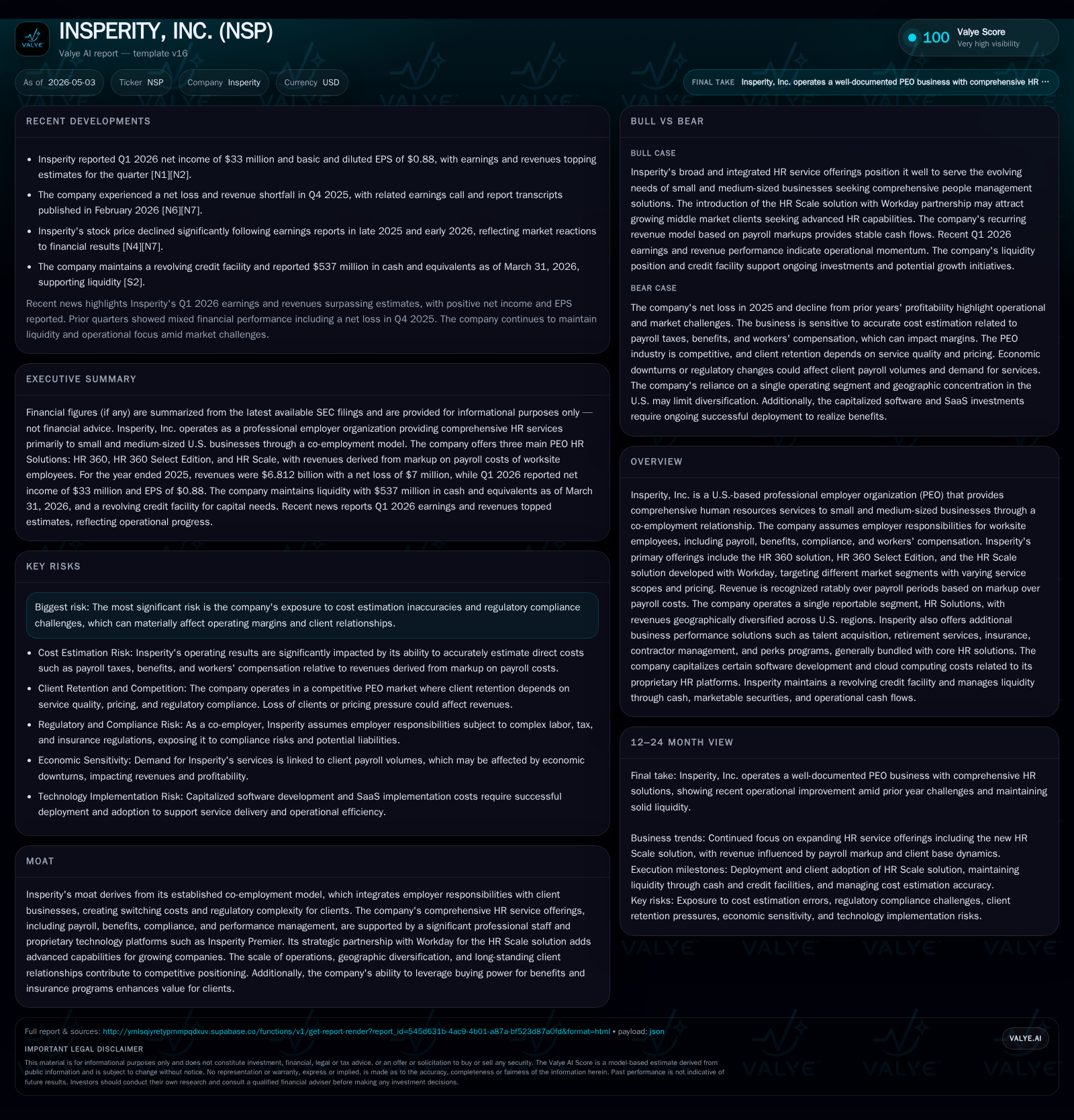
In Q1 2026, Insperity Inc. showed a modest increase in average paid worksite employees but faced ongoing margin pressure driven primarily by elevated direct costs, especially employee benefits. The company’s core business model centers on a co-employment framework delivering comprehensive HR solutions tailored for small to mid-sized businesses, with differentiated offerings including the new HR Scale service developed with Workday targeting growth-stage clients. While the labor-intensive and regulatory-complex PEO sector poses risks related to cost estimation accuracy and compliance, Insperity’s integrated technology platforms and scale provide competitive moats. Growth hinges on upselling within expanding client payroll bases and leveraging the advanced capabilities of partnerships like Workday. Key watchpoints include client adoption rates of the HR Scale solution and effective management of benefit cost inflation.
Recent Operating Update
Insperity, Inc.’s first-quarter results ending March 31, 2026 ([S2], [S3]) paint a picture of operational continuity augmented by early strategic product evolution. The company reported an approximate 1% rise in average paid worksite employees (WSEEs), a key volume metric driving revenue since its income stems from markups on payroll-related costs within its co-employment model. Despite this workforce growth, gross profit per WSEE experienced a decline attributed primarily to rising benefit-related direct costs—a dynamic consistent with ongoing inflationary pressures across health insurance premiums and workers’ compensation ([S1], [S16]).
There were no material changes in risk factors or liquidity constraints reported in the latest filings ([S2], [S5]). The company maintains robust liquidity with cash & equivalents totaling $537 million against $369 million total debt as of quarter-end ([F1]), representing a net cash position supportive of operational flexibility.
Business Model
Insperity is structured as a Professional Employer Organization (PEO) serving small to medium-sized U.S. businesses through an extensive co-employment relationship where it assumes employer responsibilities for client employees (WSEEs). This arrangement allows it to bill clients based on a markup over direct payroll costs which encompasses wages plus payroll-related taxes and employee benefits.
Revenue recognition is ratably spread over payroll periods as services are delivered ([S1]). The markup percentage is negotiated typically via annual contracts anchored on estimated direct costs—principally payroll taxes, health benefits premiums, and workers’ compensation insurance—that fluctuate due to market dynamics. This pricing model inherently exposes the company to margin volatility if direct costs increase unexpectedly or if pricing adjustments lag.
Insperity offers three principal PEO HR solutions:
- HR 360: A comprehensive full-service HR outsourcing solution, constituting the bulk of revenue ([S1]). It integrates payroll administration, employee benefits management, compliance support, performance management, and training via the proprietary Insperity Premier platform.
- HR 360 Select Edition: A streamlined product targeting middle-market clients seeking core compliance services at lower cost but with optional add-ons.
- HR Scale: A newer offering jointly developed with Workday designed for scaling companies requiring sophisticated human capital management capability combining Insperity’s expertise with Workday’s HCM software platform. Initial customer onboarding began early 2026 ([S1], [S22]).
Additional business performance-oriented services—such as talent acquisition, retirement plan administration, insurance brokerage services, contractor management, and perk programs—generally bundle with these core solutions enhancing value proposition and client retention.
Industry Structure and Competitive Position
The PEO industry blends professional services, technology platforms, insurance brokerage, and compliance expertise into bundled people management solutions for businesses lacking large internal HR departments. Competition includes other national PEOs (e.g., ADP TotalSource, TriNet) leveraging scale and breadth while regional providers may compete on localized service agility.
Insperity’s moat arises from:
- Regulatory Complexity & Switching Costs: Its co-employment model creates legal and operational friction deterring clients from switching providers easily due to complexities in transferring employment liabilities.
- Scale & Geographic Diversification: Operating broadly across U.S. regions smooths exposure to localized economic or regulatory shifts.
- Technology Platform & Partnerships: Proprietary tools like Insperity Premier enhance service consistency while collaboration with Workday brings cutting-edge HCM functions attractive to mid-market firms transitioning beyond basic PEO services.
- Benefits Purchasing Power: Scale affords advantageous insurance premium rates and better benefit offerings than smaller standalone employers could access alone.
- Experienced Professional Staff: Extensive consulting professionals cover recruitment through compliance mitigating liability risks for clients.
Growth Drivers
Structural growth stems largely from small/medium enterprise labor market expansion and outsourcing trends toward professional employer organizations amid increasing regulatory complexity. Key drivers include:
- Client Payroll Growth & Employee Additions: Volume measured via WSEE count drives topline directly under markup pricing. Early-2026 indicated a modest but positive growth trajectory ([S2]).
- Innovation via HR Scale Adoption: The partnership with Workday targets an upscale market segment demanding scalable SaaS HR technology integrated with expert services. Successful scaling of adoption here generates higher revenue per WSEE given premium pricing ([S22]).
- Enhanced Service Bundling: Cross-selling ancillary services such as retirement solutions or contractor management deepens wallet share per client.
- Price Adjustments Aligned With Cost Inflation: Periodic markup increases help maintain gross margin levels unless offset fully by external cost pressures ([S16]).
- Focus on Middle Market Segment Growth: Currently around one-quarter of WSEEs reside in this sector; expanding presence here offers margin potential given longer contract commitments linked to higher-value services ([S1]).
Risks / Watchpoints / Growth Constraints
Key risks observed include:
- Cost Estimation Accuracy: Misestimating direct costs particularly related to employee benefits inflates expenses without corresponding revenue capture if renegotiations lag. Historical data shows sensitivity of gross profits per WSEE to such fluctuations ([S16], [S19]).
- Regulatory Compliance Burden: Ever-shifting labor laws increase operational complexity potentially raising compliance cost or triggering penalties if mishandled; this risk compounds with multi-state clientele.
- Competitive Pressure & Customer Switching Costs: While co-employment creates friction against switching providers, aggressive competitors leveraging superior tech or pricing could erode market share.
- Macroeconomic Impacts on Client Hiring Patterns: Economic slowdowns directly affect client workforce size diminishing volumes billed.
- Adoption Pace & Execution Risk of New Offerings: The nascent HR Scale product’s commercial acceptance will influence future growth; failure to scale would reduce anticipated upside from this initiative.
What to Watch Next
Investors should track:
- Quarterly metric trends in average paid WSEE counts and gross profit per WSEE as immediate demand/activity indicators.
- Client onboarding velocity and uptake rates for the HR Scale solution emerging post-Q1 2026 launch.
- Management commentary updating pricing strategies vis-à-vis inflation in employee benefit costs.
- Signs of margin recovery or further compression linked to direct cost control effectiveness.
- Utilization or expansion of ancillary business performance products bundled with core offerings.
Financial Snapshot (Q1 2026)
Latest financial snapshot
The balance sheet reflects solid liquidity positioning with low leverage providing flexibility for continued investment in product development or potential acquisitions ([F1], [S2]).
This analysis emphasizes operational insights over investment recommendations. It reflects data as of early May 2026 solely based on publicly available SEC filings and company disclosures without presenting buy/sell guidance.
Disclaimer: This is research-only, informational analysis and not investment advice. It may include AI-generated interpretation and general industry context. Always verify important details using primary sources.

Comments