
Core Laboratories Advances Reservoir Solutions with Strategic Q1 Refinements
Core Laboratories’ Q1 2026 results reveal operational shifts in reservoir and production segments that sharpen its technology-driven growth trajectory amid evolving energy demands.
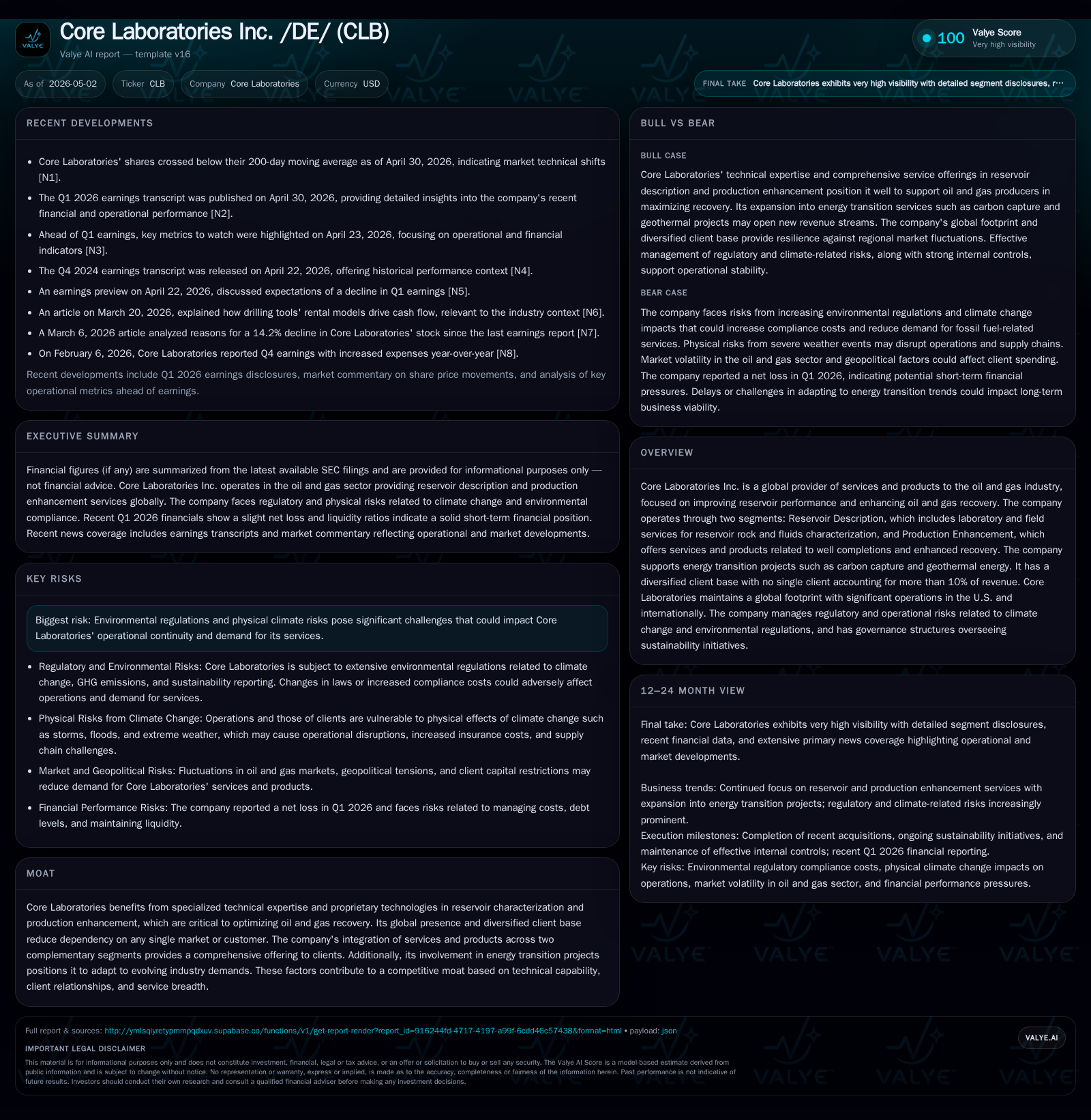
In its latest quarterly filing, Core Laboratories reported stable yet strategically nuanced operational performance, underscoring the sustained relevance of its integrated reservoir description and production enhancement services. The company continues to leverage proprietary technologies and a diversified global footprint to serve complex oilfield challenges while expanding its footprint into energy transition arenas like carbon capture and geothermal. Despite regulatory and climate-related headwinds, Core Labs’ technical stewardship and client diversification underpin a durable competitive position. Key near-term focus areas include execution on new energy service lines and monitoring geopolitical impacts on client investment patterns.
First Quarter Operating Highlights and Strategic Adjustments
Core Laboratories’ Q1 2026 financial disclosure [S2] highlights a stable revenue profile driven primarily by sustained demand in its Reservoir Description segment coupled with steady Production Enhancement contributions. While total revenues showed resilience amid global oilfield activity uncertainties, subtle segmental revenue composition adjustments reflect shifting client spending patterns influenced by geopolitical turmoil notably in Middle Eastern arenas [N11]. Segment operating income remained solid, supported by operational efficiencies despite inflationary cost pressures.
Notably, the recent 8-K filing [S3] announces a cash dividend of $0.01 per share, reinforcing Core Labs’ commitment to shareholder returns amidst cautious capital deployment strategies. The company also announced strategic initiatives targeting enhanced recovery techniques leveraging proprietary diagnostics to combat reservoir depletion trends.
Core Laboratories’ Business Model: Synergizing Reservoir Description and Production Enhancement
Core Labs operates through two complementary operating segments:
Reservoir Description: Specializes in laboratory-based analyses of rock and fluid properties critical for characterizing reservoirs. It offers sophisticated subsurface diagnostic capabilities essential for optimizing well placement, evaluating hydrocarbon quality, and informing enhanced recovery techniques. The segment also supports emerging energy projects such as carbon sequestration and geothermal evaluation efforts [S1][S14].
Production Enhancement: Focuses on products and services that improve well completions, monitor production efficacy, and enable enhanced oil recovery (EOR). Diagnostic services combined with proprietary stimulation products assist clients in maximizing output from mature fields.
This dual approach integrates detailed characterization with actionable production solutions, providing clients an end-to-end optimization ecosystem grounded in proprietary technology platforms. The recent acquisition of Solintec Consultoria, a leading Brazilian geology service provider, fortifies Core’s local market expertise and broadens service fidelity in Latin America’s oilfields [S9][S25].
The business model derives revenue from diverse global operators who pay for specialized laboratory analyses, field diagnostics, consulting services, and engineered products mainly on a contract basis. Volume drivers include the number of analytical data points produced, completions serviced, and product units delivered. Pricing power stems from high technical entry barriers due to proprietary measurement techniques and deep domain expertise.
Industry Context: Competitive Moat Built on Technical Excellence and Global Reach
Core Laboratories competes within the specialized upstream oilfield services subspace focused on reservoir characterization and production technologies—a niche where scientific precision translates directly into improved hydrocarbon recovery economics. The company’s moat is reinforced by:
- Proprietary measurement technologies validated by decades of peer-reviewed industry application.
- A global footprint spanning over 70 offices in 50+ countries allowing proximity to key reservoirs.
- Client diversification reducing single-customer revenue concentration below 10%, mitigating geopolitical or regional volume shocks [S14][S18].
- Integrated service offerings bridging reservoir analytics with enhanced recovery solutions improve switching costs for clients entrusted with mission-critical reservoir stewardship.
However, the segment faces cyclical risks related to upstream capital expenditure trends which fluctuate alongside crude price volatility, as well as structural constraints driven by stringent environmental regulations impacting fossil fuel extraction zones.
Climate change-related policies pose both risks and transformational opportunities. On one hand, regulatory pressures could constrain traditional hydrocarbon development reducing serviceable markets; on the other hand, increased demand for monitoring and verification technologies to support carbon capture utilization/storage (CCUS) initiatives opens new client horizons [S1].
Growth Drivers: Technology Innovation and Expanding Energy Transition Engagement
Core Labs’ growth blueprint leverages:
- Continued roll-out of advanced reservoir characterization technologies incorporating digital analytics and machine learning to provide sharper petrophysical insights.
- Expansion into clean energy integration services supporting CCUS projects—leveraging existing expertise in subsurface fluid monitoring to certify storage integrity.
- Incremental development of geothermal reservoir evaluation offerings aligned with ongoing industry energy transition mandates.
- Strategic geographic expansion highlighted by acquisitions like Solintec enabling deeper penetration in South American resource plays where technical differentiation is a competitive lever [S3][N2].
These initiatives link to measurable KPIs such as backlog growth in CCUS-related contracts, segment-specific order intake increases, and pilot project wins in geothermal exploration support [N1]. Successful commercialization depends on navigating complex client adoption cycles characteristic of cutting-edge energy transition services.
Risks and Constraints: Regulatory Pressures and Climate-Related Operational Challenges
Key risks identified in the annual SEC filing emphasize:
- Potential reduced demand for fossil-fuel basin diagnostics due to tightening GHG emissions regulations worldwide not only increasing client compliance costs but also shifting investment away from conventional projects [S1].
- Physical climate risks including extreme weather events disrupting operations either directly (facility damage) or indirectly (client project delays).
- Political pressures or litigation linked to environmental concerns may impair timely project execution or restrict access to capital for Core Labs’ customers leading to deferred or canceled orders.
Operationally, adapting internal processes to align with new environmental regulations entails increased compliance expenses which could pressure margins if not offset by pricing adjustments or efficiency gains [S2]. The evolving regulatory landscape requires agile governance oversight ensuring enduring conformity without diluting technical delivery excellence.
Key Watchpoints: Upcoming Milestones and Market Signals
Stakeholders should closely monitor:
- Quarterly updates for shifts in client spend patterns reflecting geopolitical instability effects on exploration/production budgets [S3][N7].
- Contract announcements tied to energy transition frameworks such as awarded CCUS or geothermal service agreements serving as proxies for Core Labs’ diversification success.
- Execution progress against planned integration of recent acquisitions enhancing regional penetration especially within Latin America.
- Adjustments to dividend policy or share repurchase programs signaling management’s confidence in cash flow consistency amid sector cyclicality.
Performance on these fronts will provide clarity regarding Core Labs’ positioning amidst evolving oilfield services dynamics influenced by energy demand shifts and sustainability imperatives.
Current Financial Position: Liquidity, Leverage, and Capital Structure Snapshot
Latest financial snapshot
| Metric | Value | Period |
|---|---|---|
| Cash & equivalents | $23mm | |
| 2026-03-31 | ||
| Total debt | $114mm | |
| 2026-03-31 | ||
| Net debt | $92mm | |
| 2026-03-31 | ||
| Current assets | $214mm | |
| 2026-03-31 | ||
| Current liabilities | $105mm | |
| 2026-03-31 | ||
| Current ratio | 2.05x | |
| 2026-03-31 |
Source: SEC companyfacts cache [F1].
As of March 31, 2026 balance sheet data from companyfacts [F1] confirms Core Laboratories maintains robust liquidity with cash & equivalents totaling approximately $22.8 million against current liabilities of about $104.7 million resulting in a healthy current ratio of 2.05. Total debt stands near $114.5 million yielding net debt around $91.6 million after accounting for cash reserves.
The company’s capital structure is characterized by moderate leverage complemented by ample revolving credit capacity ($150 million total facility with additional accordion upsize option), ensuring flexibility for both working capital needs and strategic investments [S4][S5][S6].
Readers should consult the primary source filings before making any assessments about Core Laboratories Inc.’s prospects or financial health.
Disclaimer: This is research-only, informational analysis and not investment advice. It may include AI-generated interpretation and general industry context. Always verify important details using primary sources.

Comments