
Portland General Electric Expands into Washington with $1.9B Acquisition, Faces Utility Regulatory and Wildfire Risk
Q1 2026 results reflect operating challenges amid strategic growth via PacifiCorp asset purchase.
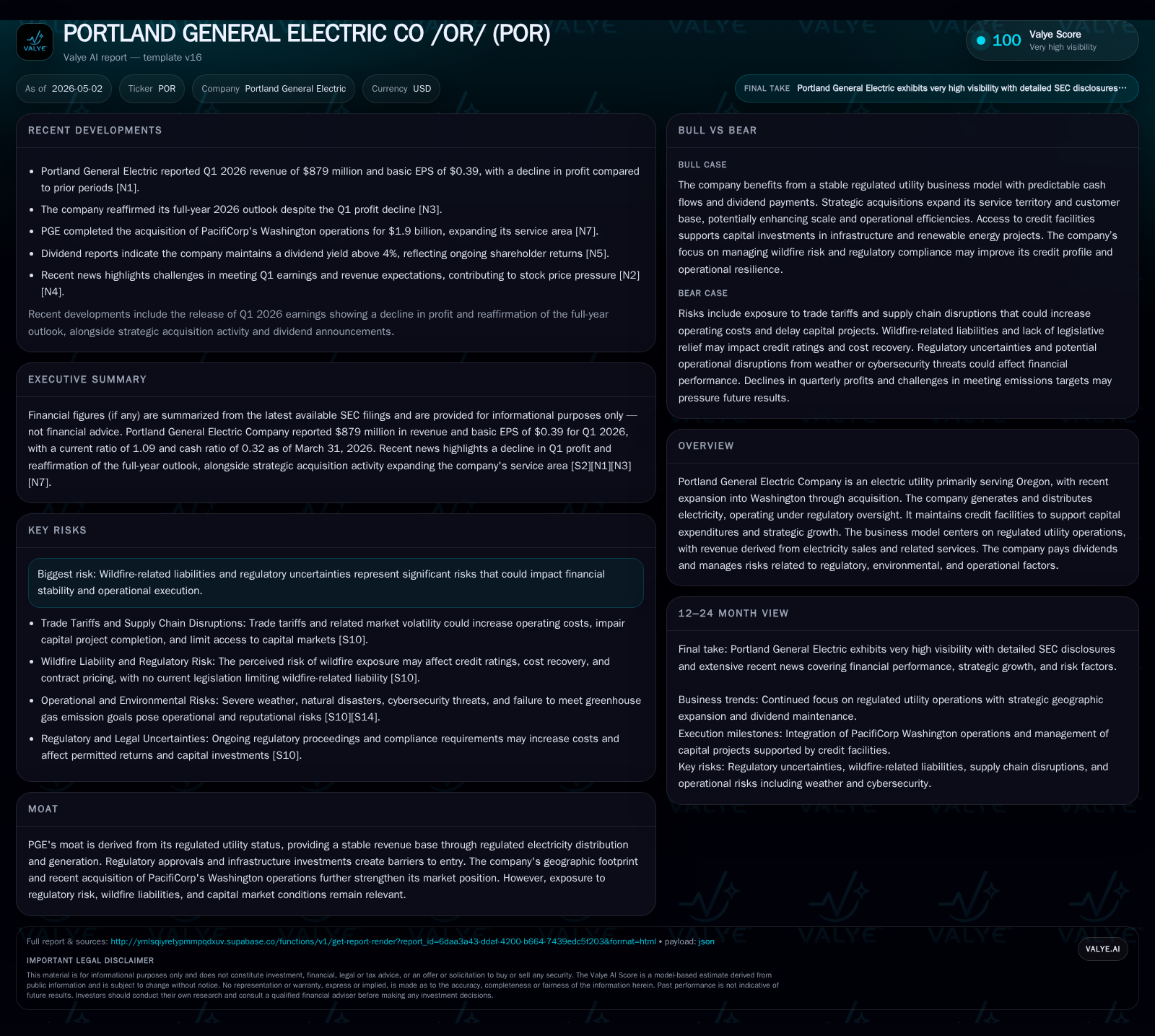
Portland General Electric Company (PGE) reported Q1 2026 results showing a decline in profitability despite steady operational execution, reaffirming its full-year outlook. The key development is PGE's acquisition of PacifiCorp’s electric transmission, distribution assets, and generation facilities in Washington for $1.9 billion, expanding its geographic footprint beyond Oregon and enhancing scale. PGE’s regulated utility business model benefits from stable revenues but faces significant risks from wildfire-related liabilities and regulatory uncertainties. Capital investments aimed at grid modernization and clean energy integration drive growth, supported by regulated returns and recent settlements with Oregon regulators.
Recent Operating Update
Portland General Electric Company's (PGE) Q1 2026 10-Q filing dated May 1 shows mixed operating performance against the backdrop of strategic expansion [S2]. The company reported a pre-tax charge of approximately $15 million linked to storm cost recovery adjustments primarily related to Oregon Public Utility Commission (OPUC) final rulings [S25]. These costs were excluded from adjusted non-GAAP earnings guidance to isolate core operating performance. Despite some headwinds impacting near-term earnings, the company reaffirmed its full-year 2026 outlook at the earnings call held concurrently with the filing [S16][N1][N4].
The quarter also marked the recent closure of PGE's asset acquisition from PacifiCorp covering six Washington counties including Lewis, Yakima, Walla Walla, Columbia, Garfield, and Benton [S24]. This transaction involved a $1.9 billion upfront cash payment plus consideration adjustments tied to assets delivered at closing. The transferred assets encompass transmission and distribution infrastructure along with gas-fired Chehalis combined cycle plant alongside multiple wind farms—Goodnoe Hills Wind and Marengo I & II Wind projects—broadening PGE’s generation mix [S24].
The acquisition significantly expands PGE’s regulated service territory beyond Oregon into Washington state through ownership of critical infrastructure serving a new customer base.
Business Model
PGE functions as a vertically integrated electric utility predominantly under Oregon Public Utility Commission regulation. Its revenue base derives mainly from retail electricity sales to residential, commercial, and industrial customers within its service footprint. Charges are established through regulatory rate cases assuring cost recovery plus an allowed return on invested capital. Ancillary revenues arise from wholesale power assets management and transmission services.
PGE's business model leverages the predictability inherent in regulated returns secured by infrastructure investments such as generation plants, transmission lines, and distribution networks. Rate cases submitted periodically authorize rate base expansions reflecting capital expenditures necessary for system reliability improvements and clean energy adoption.
The recently consummated acquisition from PacifiCorp demonstrates strategic efforts to achieve scale advantages by extending PGE's geographic reach into Washington state while augmenting its portfolio with gas-fired power alongside renewable wind assets. This enhances operational diversification within a regulated framework where pricing power is governed by regulators.
Industry Structure and Competitive Position
The U.S. utility sector remains dominated by regional monopolies licensed under state regulatory bodies ensuring consumer protections while enabling utilities reasonable returns on infrastructure investment. PGE’s competitive moat resides in its regulated status limiting entry barriers for other providers within its territory.
Oregon’s environmental policies drive utilities like PGE toward greater clean resource integration while maintaining grid resilience amidst growing electrification trends. This dynamic favors incumbents investing in modernization programs that harmonize renewables integration with reliability mandates.
Geographically expanding into Washington diversifies PGE’s exposure though both states share overlapping regulatory complexities including wildfire risk liabilities prompting enhanced safety investments.
Competitors typically include other regional electric utilities such as Puget Sound Energy in Washington; however, PGE’s infrastructural footprint post-acquisition positions it as a significant player providing comprehensive local service access.
Growth Drivers
- Regulated Asset Base Expansion: Settlement agreements with OPUC support annual increases in rate base—$218 million noted for Distribution System Plan alternative recovery mechanism—bolstering revenue potential through authorized ROEs at levels around 9.34% [S20].
- Acquisition-Fueled Geographic Expansion: Integration of PacifiCorp’s Washington transmission/distribution plus generation capacity introduces new revenue streams aligned under regulation [S24].
- Clean Energy Integration: Investment in wind assets coupled with grid modernization facilitates compliance with sustainability mandates that preserve long-term relevance [S1][S14].
- Electrification Trends: Growing demand for electricity across residential and industrial sectors linked to electric vehicles adoption and data center energy needs drives volume growth structurally rather than cyclically.
- Regulatory Cost Recovery Mechanisms: Conditions such as Revenue Requirement Adjustments (RRAs) tied to capital expenditure ensure timely recovery of prudent investments supporting steady cash flows.
Risks / Watchpoints / Growth Constraints
- Wildfire Liabilities: Persistent wildfire exposure without explicit legislative relief remains a critical risk factor capable of impairing credit profile or triggering onerous cost absorption [S17].
- Regulatory Uncertainty: Although recent settlements are encouraging, future rate case outcomes or changes in allowed ROEs may materially impact profitability.
- Integration Challenges: Assimilating complex acquired assets from PacifiCorp demands effective operational alignment; unexpected costs or regulatory hurdles could arise [S24].
- Supply Chain & Tariffs: Inflationary pressure from tariffs on construction materials may elevate project costs constraining margin expansion [S17].
- Capital Market Conditions: Large-scale capital needs dependent on debt issuance subject companies like PGE to lending market dynamics affecting financing costs [F1].
- Customer Usage Patterns: Demand-side shifts such as energy efficiency gains or distributed generation adoption could moderate volumetric growth.
What to Watch Next
Investors should monitor:
- Regulatory decisions in the ongoing Oregon general rate case docket (UE 459), expected outcomes impacting effective rates potentially starting April 2026 or May 2027 [S20].
- Progress updates on integration milestones from the PacifiCorp acquisition including customer transition smoothness and asset performance metrics [S24].
- Legislative developments addressing wildfire liability relief frameworks across Oregon/Washington jurisdictions.
- Quarterly earnings releases for normalized adjusted earnings trajectory following exclusion of non-recurring storm-related charges observed in Q1 2026 [S2][N4].
- Capital expenditure pacing aligned with Grid Modernization plans facilitating renewables penetration without compromising system reliability.
Financial Profile Snapshot (latest available)
Latest financial snapshot
| Metric | Value | Period |
|---|---|---|
| Total debt | $4.7bn | |
| 2025-12-31 | ||
| Net debt | $4.4bn | |
| 2025-12-31 | ||
| Current assets | $1010mm | |
| 2026-03-31 | ||
| Current liabilities | $929mm | |
| 2026-03-31 | ||
| Current ratio | 1.09x | |
| 2026-03-31 |
Source: SEC companyfacts cache [F1].
| Metric | Value | Period End |
|---|---|---|
| Revenue | $3.576 billion | |
| 2025-12-31 | ||
| Operating Income | $555 million | |
| 2025-12-31 | ||
| Cash & Equivalents | $294 million | |
| 2021-09-30 | ||
| Total Debt | $4.679 billion | |
| 2025-12-31 | ||
| Current Ratio | 1.09 | |
| 2026-03-31 |
PGE carries substantial debt reflective of typical capital intensity in utilities but maintains liquidity buffers indicated by current ratio above one [F1]. Stability in operating income supports cash flow adequacy for ongoing capital commitments alongside dividend payments outlined previously [S13].
This analysis is based exclusively on publicly available SEC filings as listed in sources below and news reports without any speculative forecasts or investment recommendations.
Disclaimer: This is research-only, informational analysis and not investment advice. It may include AI-generated interpretation and general industry context. Always verify important details using primary sources.

Comments