
Western Digital Posts Robust Q3 as AI Demand Supercharges Storage Growth
AI-driven cloud storage demand fuels strong quarterly revenue and margin expansion, underscoring Western Digital's strategic positioning in data infrastructure.
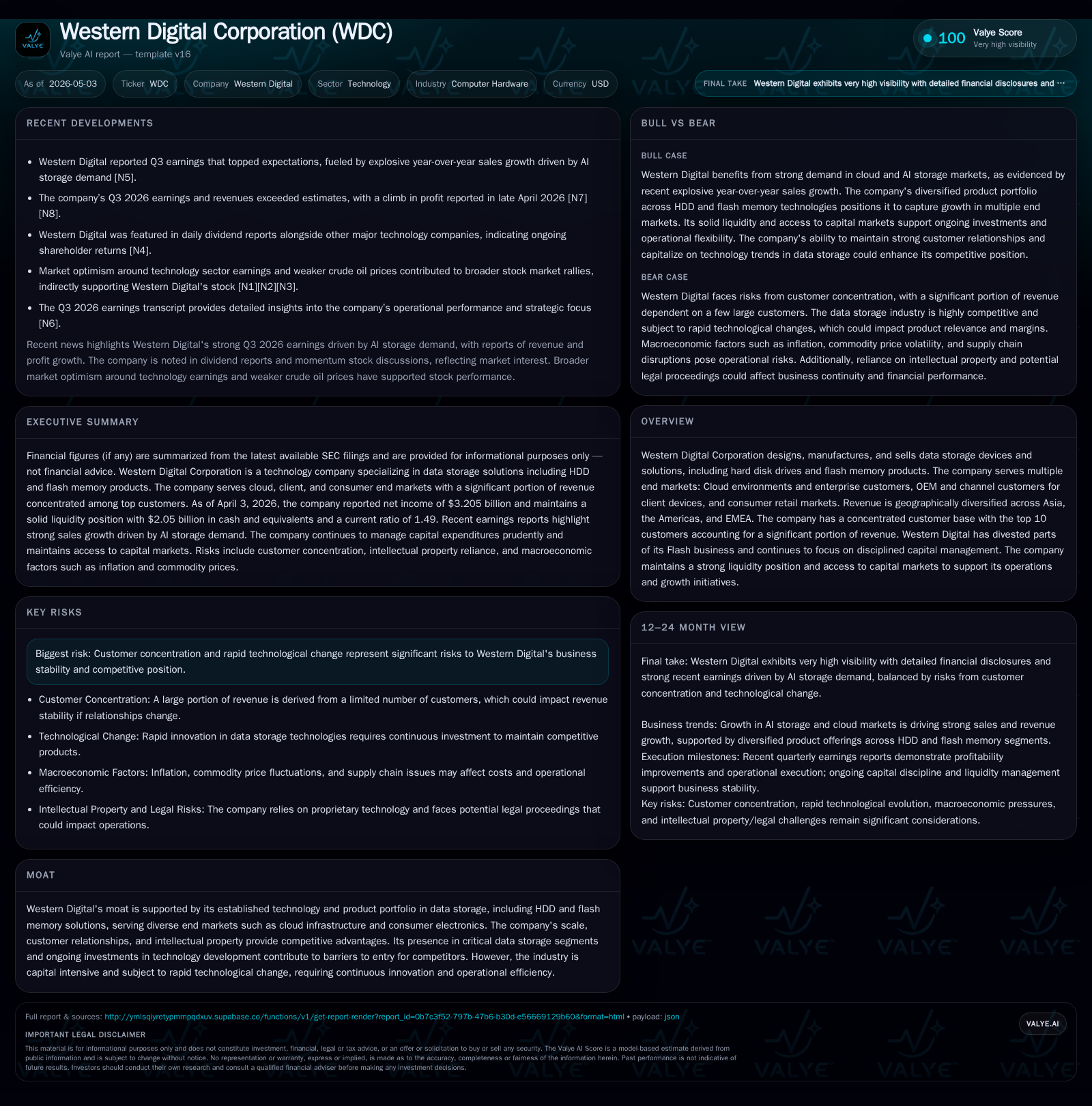
Western Digital delivered a solid fiscal Q3 performance marked by significant year-over-year revenue growth mainly driven by surging AI-related storage requirements in cloud and enterprise segments. The company’s disciplined focus on its core HDD business after divesting substantial flash assets has sharpened its operational execution and capital allocation strategy. Despite exposure to concentrated customers and rapid technological change, WDC leverages scale, technology investments, and entrenched customer relationships to sustain competitive advantage amid a capital-intensive industry.
Latest Quarterly Operating Update and Why It Matters
Western Digital’s fiscal third quarter ended April 3, 2026, marks a pivotal moment as the company reports accelerating revenue growth fueled by robust adoption of AI-enabled storage demand in cloud infrastructure. The 10-Q filed May 1 details elevated shipments of both HDDs and flash products primarily driven by hyperscale cloud customers expanding capacity to support compute- and data-intensive AI workloads [S2]. External commentary validates this surge as an "explosive year-over-year sales growth" influenced by large-scale AI deployments reshaping storage consumption patterns across the industry [N1].
Margins improved materially attributable to stronger pricing power linked to favorable supply-demand dynamics as well as operational efficiencies achieved post-separation of Flash business units earlier last year [S2][S3]. Customer concentration intensified slightly with top clients accounting for approximately 70% of revenues reflecting entrenched relationships rather than new volatility [S4], underscoring reliance but also stability among global cloud providers.
This near-term earnings momentum reflects not only cyclical acceleration but signals structural shifts whereby storage density advancement combined with AI workload proliferation is reshaping hardware demand profiles. This operating update obliges revisiting Western Digital’s strategic positioning amid shifting market dynamics preceding the annual context.
How Western Digital Makes Money and Product Quality Assessment
Western Digital’s core business model rests on designing, manufacturing, and selling storage devices primarily comprising hard disk drives (HDDs) plus flash memory products retained selectively after its divestment of major Flash assets into Sandisk Corporation which became independent in February 2025 [S1][S16]. Revenue flows from three principal end-markets:
- Cloud: Primarily high-capacity HDDs tailored for public and private cloud data centers plus enterprise clients seeking scalable bulk storage.
- Client: OEMs and channels for PCs, notebooks, gaming devices requiring reliable HDDs with competitive price/performance.
- Consumer: Retail-facing products emphasizing brand recognition including external drives catering to individual buyers.
Revenue distribution is geographically broad with Asia, Americas, and EMEA logistics enabling global customer reach [S4]. Product quality centers on industry-recognized reliability records for HDDs—integrating proprietary technologies to improve areal densities (storage bits per square inch) which directly influence cost per terabyte metrics critical to hyperscalers.
Pricing power is nuanced: while commodity HDD volumes face pressure from flash alternatives in some markets, Western Digital’s cutting-edge higher-capacity segments exhibit structural insulation supported by investing heavily in R&D to extend media technology roadmaps [S26]. Customer switching costs remain elevated given integration complexities in cloud environments coupled with contract volume commitments fostering stickiness.
Competitive Dynamics and Industry Structural Considerations
The computer hardware storage sector is characterized by heavy capital expenditure requirements due to complex wafer fabrication for flash components alongside precision mechanical assembly lines for HDD production. This capital intensity establishes high barriers to entry limiting competition mainly to established players such as Seagate Technology in HDDs and Micron Technology in flash memory chips [S1].
Western Digital benefits from economies of scale facilitating innovation cycles that push storage density thresholds upwards while lowering cost/kilobyte benchmarks crucial for cloud operators managing massive datasets. Intellectual property generated over decades—including advanced heads/towers in HDD assemblies—provides defense mechanisms against disruptive entry though inflections in technology paradigms (e.g., emergence of alternative non-volatile memories) introduce ongoing attrition risks.
Supply chains remain sensitive to geopolitical considerations affecting semiconductor availability; however, Western Digital has leveraged diversified supplier bases plus strategic inventories to mitigate acute shortages witnessed historically during COVID disruptions. Regulatory factors including data security protocols influence product specifications especially where encryption-enabled drives fulfill compliance demands within enterprise/cloud segments.
Key Growth Drivers Supporting Demand Acceleration
Several converging forces underpin Western Digital’s growth outlook:
AI Infrastructure Expansion: The rising prevalence of generative AI models multiplies backend data generation/storage needs exponentially. Hyperscale cloud providers increasingly invest in petabyte-scale HDD arrays optimized for archival cold data but accessible for training/inference workloads—a segment where WDC holds material exposure [N1][S2].
Cloud Data Center Proliferation: Public/private clouds expand geographically necessitating vast bulk storage arrays enabling hybrid architectures that rely on HDD-flash composites balancing latency and capacity demands.
Technology Roadmaps: Continued advancements in HAMR (Heat Assisted Magnetic Recording) technology increase per-disk capacity while reducing operational wattage enhancing gross margin potential through better performance/watt ratios; simultaneous efforts focus on flash memory cost reductions post spinout allowing tighter collaboration with Sandisk focused purely on NAND technologies [S1][S26].
OEM Partnerships & Client Diversification: With SSD-related operations spun off, WDC concentrates on growing channel OEM relationships around client market upgrades (gaming PCs etc.) supporting incremental volume gains complemented by consumer retail brand loyalty programs.
The interaction between these drivers suggests secular trends uplift underlying demand beyond cyclical tech spending fluctuations.
Risks and Constraints Impacting Future Trajectory
Western Digital faces identifiable headwinds worth monitoring:
Customer Concentration: Approximately 70% revenue exposure from top ten clients elevates dependency risk; significant portion tied to a handful of hyperscalers potentially subjecting WDC to renegotiations or demand shocks if cloud capital expenditures recalibrate abruptly [S4].
Technological Disruption: Rapid progress in solid-state technologies or emergent storage media could erode HDD relevance particularly if competing cost/performance metrics surpass roadmap projections forcing accelerated write-downs or inventory obsolescence risks.
Pricing Pressure & Cyclicality: Commoditization in lower-capacity drives tightens margins constraining leverage; additionally, broader cyclical swings correlated with semiconductor/tech spending impact utilization rates directly affecting fixed cost absorption.
Capital Intensity & R&D Intensity: Maintaining leadership necessitates sustained investment which could strain free cash flow especially if margin compression materializes or if new product ramp timelines extend unexpectedly creating operational drag [F1][S26].
Legal & Regulatory Exposure: Ongoing patent litigation settlements remain considerations though recent global settlements have mitigated major liabilities; evolving privacy/regulatory standards may impose additional compliance costs.
Upcoming Catalysts and What to Monitor Next
Watching WDC’s next phases involves focusing on several execution markers:
- Subsequent quarterly earnings releases providing updated guidance particularly gross margin trends correlating with scaling AI-related orders [S2][N5].
- Visibility into client diversification efforts beyond concentrated hyperscale providers.
- Progress announcements regarding new HDD capacities leveraging HAMR or improved flash interfaces impacting ASPs (average selling prices).
- Supply chain normalization status particularly around critical components influencing manufacturing lead times/cost structures.
- Any refinancing activities or adjustments in debt profile that could enhance financial flexibility amid growth investments.
- New product launches accompanying tailored solutions for emerging AI/cloud workloads could validate sustained secular demand capture.
Brief Financial Profile: Balance Sheet Strength and Liquidity
Latest financial snapshot
| Metric | Value | Period |
|---|---|---|
| Cash & equivalents | $2.0bn | |
| 2026-04-03 | ||
| Total debt | $1600mm | |
| 2026-04-03 | ||
| Net debt | $-450mm | |
| 2026-04-03 | ||
| Current assets | $6.9bn | |
| 2026-04-03 | ||
| Current liabilities | $4.6bn | |
| 2026-04-03 | ||
| Current ratio | 1.49x | |
| 2026-04-03 |
Source: SEC companyfacts cache [F1].
As of quarter-end (April 3, 2026), Western Digital maintains a sound financial footing evidenced by a cash and equivalents balance of approximately $2.05 billion alongside total debt near $1.6 billion resulting in a net cash posture around $450 million positive [F1]. Current assets of $6.91 billion comfortably cover current liabilities totaling $4.64 billion yielding a current ratio of 1.49 indicative of reasonable short-term liquidity buffers supporting working capital needs without straining credit facilities [F1].
This liquidity stance provides capacity necessary for aggressive capex on technology advancement while underwriting potential working capital expansions linked to demand surges. The manageable leverage level also supports gearing optionality aligned with corporate financing strategies following the Flash business separation event concluded last year.
This analysis is based exclusively on publicly available SEC filings through May 2026 alongside corroborative market commentary. It neither offers investment advice nor predicts share price movements but aims to provide an informed perspective on Western Digital's operational positioning within the evolving data storage landscape.
Disclaimer: This is research-only, informational analysis and not investment advice. It may include AI-generated interpretation and general industry context. Always verify important details using primary sources.

Comments