
Amgen Advances Growth Despite Patent Losses and Regulatory Challenges
Strong Q1 2026 results showcase Amgen's resilience amid patent expirations and regulatory headwinds.
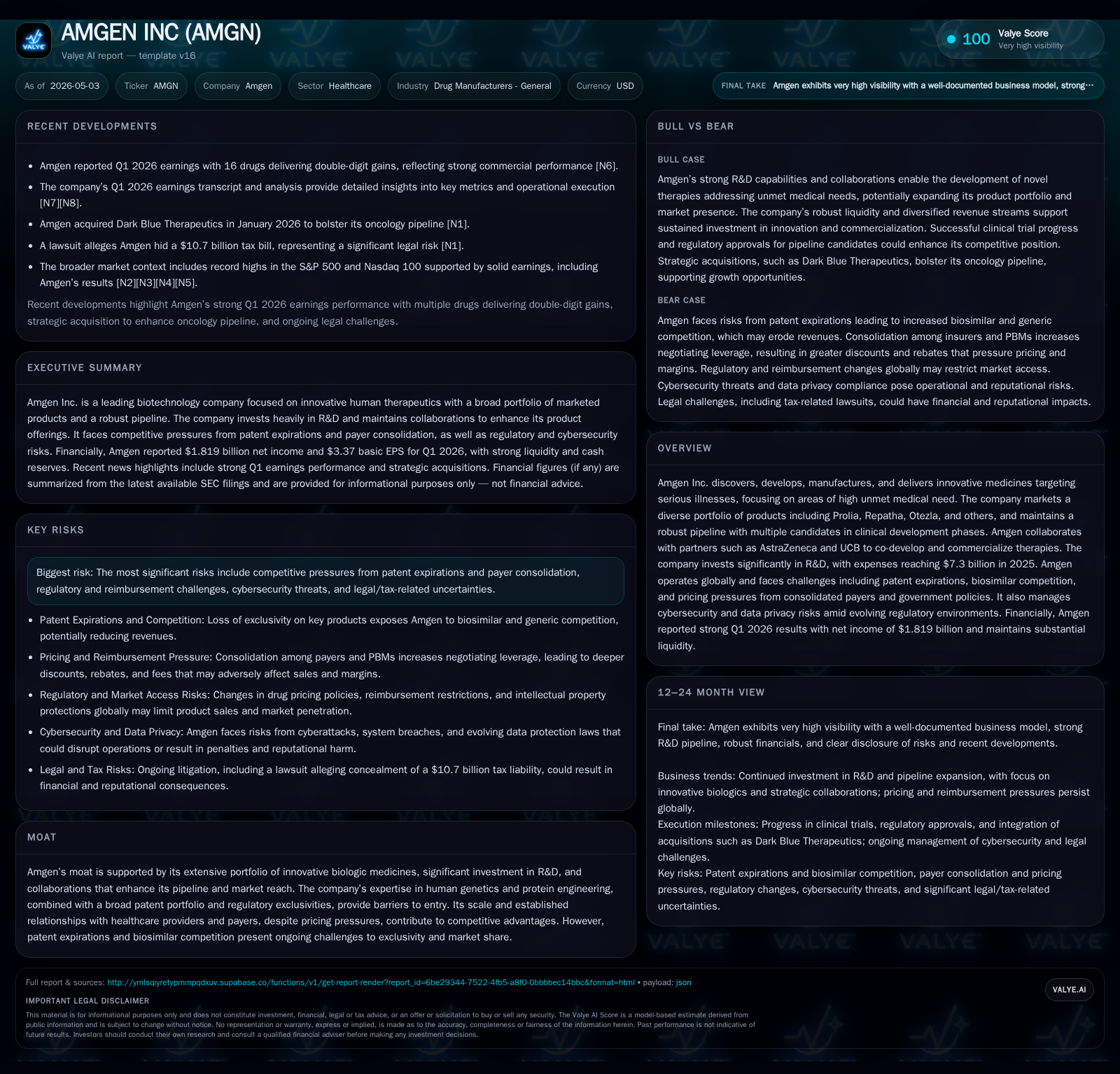
Amgen reported robust first-quarter 2026 earnings driven by broad strength across its portfolio despite recent patent expirations affecting key products like Prolia. The company continues to invest heavily in R&D with $7.3 billion spent in 2025, maintaining a deep innovation pipeline and strong collaborations with partners such as AstraZeneca. However, pricing pressures persist due to payer consolidation, biosimilar competition, and regulatory scrutiny, including ongoing FDA challenges surrounding TAVNEOS. Amgen’s scale, biologics expertise, and strategic alliances underpin its competitive moat and growth prospects while it navigates industry-wide reimbursement reforms and global market complexities.
Recent Operating Update: Q1 2026 Earnings and Regulatory Developments
Amgen’s latest quarterly filing for Q1 ended March 31, 2026, reveals a strong operational performance despite facing significant challenges from recently expired patents on key products like Prolia. The company reported net income of approximately $1.819 billion for the quarter, outpacing Wall Street estimates by a notable margin [S2][N4]. This reflects healthy demand across a diverse product portfolio where sixteen drugs recorded double-digit sales gains according to recent media reports [N4]. This robust top-line momentum underscores Amgen's ability to sustain growth amidst evolving industry dynamics.
However, not all news is positive; the FDA has proposed withdrawing approval for TAVNEOS—a product acquired via the ChemoCentryx acquisition—citing new questions about data sufficiency around effectiveness and allegations regarding the original approval application [S25]. Amgen strongly contests these findings and remains engaged with the FDA process to preserve market access. This regulatory episode highlights inherent risks in maintaining approvals for products approved under accelerated pathways.
Moreover, patent expirations for Prolia's RANKL antibodies formally took effect in February 2025 (US) and November 2025 (Europe), resulting in increased biosimilar pressure impacting sales potential for this previously high-margin therapy [S1]. Concurrently, payer consolidation has intensified discounting pressure: major pharmacy benefit managers (PBMs) such as CVS Health’s Rebate Management Organization have boosted their leverage over biopharma pricing negotiations leading to deeper rebates and service fees that erode margins despite volume growth [S2][S8]. These factors coalesce to constrain pricing power even as volume trends remain resilient.
Business Model: Revenue Mechanics and Strategic Strengths
Amgen manufactures innovative biologic medicines primarily focused on serious illnesses with high unmet needs—such as osteoporosis (Prolia), cardiovascular disease (Repatha), inflammatory conditions (Otezla), rare diseases (BLINCYTO), oncology (KYPROLIS) and eye diseases (TEPEZZA). Revenue generation hinges on proprietary biologics that command premium pricing under patent protection complemented by lifecycle management strategies including new indications and delivery innovations.
Customers consist largely of healthcare providers purchasing through wholesalers/distributors who then serve hospitals, specialty clinics, pharmacies, or insurers; however substantial revenue deductions arise from rebates negotiated with large PBMs and integrated insurer plans amid consolidating payers. Contracts often entail complex volume-based discounts, formulary placement fees, rebates tied to utilization management protocols, and post-launch pricing adjustments.
Amgen’s margin profile is supported by manufacturing scale achieved at its global facilities—including US plants that benefit from recent tariff relief—and vertical integration extending from drug development through production to commercialization [S1][F1]. Robust R&D investment ($7.3 billion in FY2025) underpins an innovation engine focused on genetically-guided targets harnessing human genetics insights merged with protein engineering technology. Strategic collaborations notably with AstraZeneca and UCB amplify pipeline breadth by co-developing novel modalities that enrich therapeutic areas beyond core capabilities.
Competitive advantages stem from Amgen’s dominant position in biologics with established market share in key therapeutic categories alongside a well-diversified drug portfolio mitigating concentration risk. Its global footprint enables geographic diversification albeit subject to regional reimbursement variations and regulatory stringency.
Industry Structure and Competitive Positioning
The biotechnology sector for innovative drugs operates within a stringent regulatory environment enforced by agencies like the FDA and EMA requiring rigorous clinical data for approvals followed by ongoing pharmacovigilance responsibilities. Payers are increasingly consolidating—centralizing purchasing power among fewer entities—intensifying rebate negotiations which pressure pricing globally.
Amgen competes against other large biopharma firms producing branded biologics but also faces accelerating threats from biosimilars as patents expire—especially for widely used blockbuster therapies such as Prolia/XGEVA's anti-RANKL agents. Biosimilar entry typically results in steep price erosion driven by tendering processes common outside the US but gaining traction domestically as the biosimilar pathway matures.
Furthermore, governments worldwide continue revising pharmaceutical policies aimed at cost containment including international reference pricing benchmarks (e.g., EU general pharmaceuticals law reforms slated by 2027) and tariff dynamics that could affect supply chains or manufacturing costs [S1][S2]. Against this backdrop, amgen differentiates itself via:
- Proprietary human genetics-driven target discovery conferring higher clinical success probability,
- Extensive patent estate coupled with regulatory exclusivities allowing premium pricing windows,
- Strategic partnerships expanding reach into immuno-oncology delivery systems,
- Strong commercial infrastructure enabling disciplined launch execution.
Its competitive positioning is robust but not impervious given external pricing reforms coupled with internal risk factors tied to novel product approvals (e.g., TAVNEOS uncertainty).
Growth Drivers
Amgen’s path forward rests primarily on several vectors:
- Pipeline advancement: Multiple candidates at various clinical development stages exploit cutting-edge biology aiming at first-in-class or best-in-class status.
- New indications / label expansions: Extending lifespan of matured drugs through incremental approvals ensures continued revenue streams.
- Emerging markets penetration: Expanding presence in countries like China where rising healthcare spending fuels demand although execution remains complex due to local regulations.
- Biosimilar commercialization: Leveraging experience gained helps compete effectively against biosimilars eroding originator franchises while opening new revenue lines.
- Collaborative innovations: Partnerships with entities such as AstraZeneca enable sharing of development risks/costs while accessing novel technologies enhancing future offerings.
Quantifiable KPIs to monitor include:
- Pipeline progression milestones (trial initiations/completions)
- Backlog/order book update from new business development deals
- Prescribing trends under varied reimbursement contexts including formulary inclusion rates
- Real-world evidence supporting label expansion opportunities
- Biosimilar market share shifts versus traditional biologics
Risks / Watchpoints / Growth Constraints
Several material risks warrant attention:
- Regulatory setbacks: Potential withdrawal or non-renewal of product approvals (as seen with the TAVNEOS FDA proposal) impose revenue uncertainty.
- Pricing pressures: Growing payer consolidation reduces price realization through heightened rebates/service fees combined with government drug price reforms internationally.
- Patent cliffs: Loss of exclusivity exposes major products like Prolia to biosimilar encroachment rapidly compressing sales volumes.
- Global macroeconomic volatility: Trade tensions manifesting via tariffs or sanction regimes create cost plus supply chain disruptions especially in emerging markets where expansion is targeted.
- Cybersecurity & Data privacy: Increasing digital dependence elevates vulnerability profiles amid evolving compliance regimes requiring investment stabilization.
- Clinical trial/approval delays: Shifts in regulatory standards for endpoints or trial designs can extend development timelines hence defer commercialization benefits.
Proactive monitoring of FDA actions related to postmarketing safety requirements remains vital alongside assessment of payer negotiation impacts particularly through PBM policy reforms expected over coming quarters [S7][S9][S15][S16].
What to Watch Next
Upcoming critical developments include:
- Resolution of the FDA’s proposal on TAVNEOS approval withdrawal and its implications on sales trajectory [S25]
- Advancement status of key clinical assets within the pipeline especially those targeting genetic validation approaches reported at R&D centers globally [S27]
- Pricing dynamics influenced by PBM contractual renewals or legislative changes affecting rebate frameworks domestically [S2]
- Impact assessment from newly implemented EU pharmaceutical regulation starting phased rollouts targeting intellectual property protections circa 2027 [S2]
- Quarterly sales updates on legacy biologics facing biosimilar substitution reflecting competitive intensity shifts [N4]
- Execution progress on expansion strategies into emerging economies amid geopolitical flux affecting trade/tariffs [S7]
These milestones will materially influence Amgen’s medium-term revenue visibility and strategic flexibility amid sector headwinds.
Financial Profile Snapshot as of Q1 2026 End
Latest financial snapshot
| Metric | Value | Period |
|---|---|---|
| Cash & equivalents | $12.0bn | |
| 2026-03-31 | ||
| Total debt | $57.3bn | |
| 2026-03-31 | ||
| Net debt | $45.3bn | |
| 2026-03-31 | ||
| Current assets | $31.5bn | |
| 2026-03-31 | ||
| Current liabilities | $25.0bn | |
| 2026-03-31 | ||
| Current ratio | 1.26x | |
| 2026-03-31 |
Source: SEC companyfacts cache [F1].
| Metric | Value (USD billions) | Period Ended |
|---|---|---|
| Cash & Equivalents | 12.04 | |
| 2026-03-31 | ||
| Total Debt | 57.32 | |
| 2026-03-31 | ||
| Current Assets | 31.48 | |
| 2026-03-31 | ||
| Current Liabilities | 24.95 | |
| 2026-03-31 | ||
| Current Ratio | 1.26 | |
| 2026-03-31 | ||
| Net Debt* | ~45.29 | |
| 2026-03-31 | ||
| (*Calculated as Total Debt minus Cash & Equivalents) |
This balance sheet configuration provides sufficient short-term liquidity but elevated leverage metrics underscore capital allocation tightrope amid ongoing transformation investments and shareholder return commitments through dividends/repurchases [F1][S14].
Disclaimer: This analysis synthesizes recent SEC filings along with validated news sources to provide an operational overview without offering investment advice or recommendations.
Disclaimer: This is research-only, informational analysis and not investment advice. It may include AI-generated interpretation and general industry context. Always verify important details using primary sources.

Comments