
Arcosa's Portfolio Moves and Margin Management Signal Demand Shifts
Recent portfolio divestiture and leadership changes coincide with margin pressures and evolving demand dynamics in Arcosa’s cyclical manufacturing sectors.
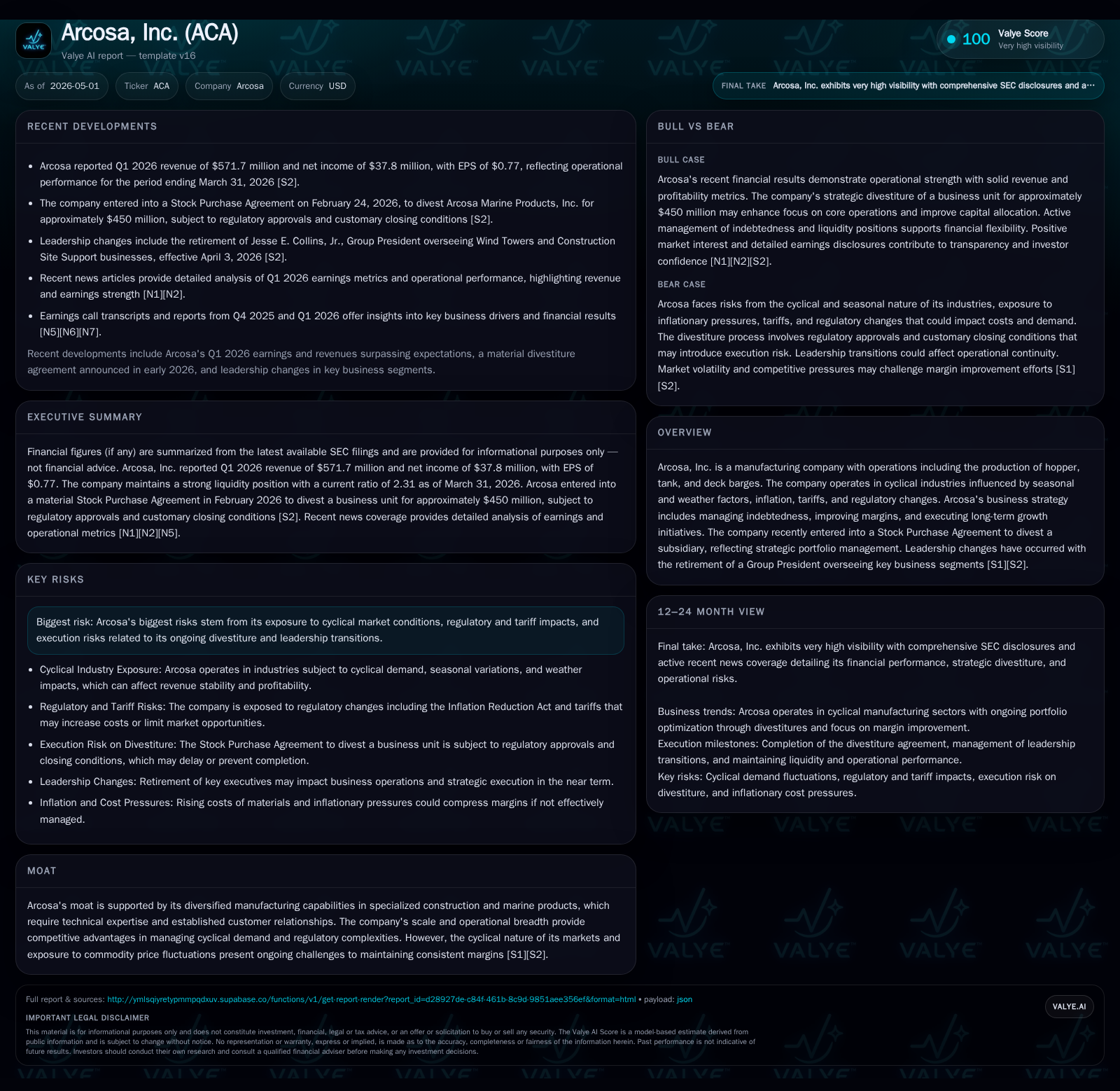
Arcosa's latest quarterly filing reveals strategic portfolio rationalization with a $450 million divestiture of its inland barge unit, expected to close in Q2 2026. The company faces ongoing margin challenges driven by inflation and market cyclicality but is advancing operational improvements. Leadership transitions add an execution layer of complexity amid a mixed demand outlook shaped by regulatory and tariff pressures. Near-term growth depends on successful divestiture completion, backlog delivery, and effective management succession.
First Quarter 2026 Operating Highlights and Strategic Developments
Arcosa's first quarter 10-Q dated May 1, 2026 [S2] spotlights a mixed operating environment shaped by positive top-line delivery alongside margin pressures. Revenue outperformed analyst estimates per external commentary [N3], reflecting steady order flow from key construction-related businesses. However, gross margins contracted amid elevated raw material costs—steel prices remain volatile given ongoing inflationary pressures—and incremental labor expenses squeezed profitability.
A pivotal event outlined in the filings is Arcosa’s entry into a binding Stock Purchase Agreement around late February 2026 for the sale of its inland barge business to Wynnchurch Capital affiliate at roughly $450 million cash consideration [S3][S19]. This strategic divestiture signals management’s intention to refocus on core manufacturing segments while unlocking value from non-core assets. The transaction closure hinges on regulatory approvals expected by mid-2026 under Hart-Scott-Rodino antitrust protocols.
Simultaneously, personnel changes add complexity to near-term execution. Group President Jesse E. Collins Jr., responsible for overseeing wind towers and construction site support units—two vital components of Arcosa’s revenue base—retired effective April 3, 2026 [S11]. Though the departure is amicable, such leadership turnover during a transformative phase raises governance vigilance alongside operational continuity concerns.
Arcosa’s Business Model: Manufacturing Specialization Across Cyclical Markets
Arcosa operates as an industrial manufacturer concentrating on highly engineered products such as hopper barges, tank barges, deck barges, wind towers, and various construction site support equipment [S1]. Its customers span infrastructure development firms, marine transportation operators, energy sector participants, and related heavy industry entities — all sectors exhibiting pronounced cyclicality tied to capital investment cycles, government funding patterns, and macroeconomic conditions.
Revenue arises primarily from contract manufacturing orders driven by customer capital expenditure decisions. Pricing reflects project-specific contracting often sensitive to commodity price inputs such as steel and logistical costs. Customers tend to display moderate switching resistance due to product customization requirements and engineering support involved in complex builds.
Seasonality linked to weather affects delivery schedules fundamentally; winter slowdowns in certain regions compress volume recognition periods. Tariff regimes further complicate supply chain economics by impacting import/export costs on raw materials or intermediate components used in fabrication.
Industry Context and Competitive Dynamics in Construction and Marine Product Segments
The broader industry encompasses fragmented competition with several niche specialists competing on product quality, lead time capabilities, engineering innovation, and price stability. Regulatory frameworks have heightened in recent years with tariffs imposed on steel imports amplifying input cost volatility [S8].
Supply chain disruptions continue to challenge unit economics as available steel inventory fluctuates against rising demand from domestic infrastructure initiatives. Arcosa's ability to maintain production cadence while negotiating favorable raw material contracts embodies an operational moat enabling somewhat stable margins despite external shocks.
Backlog levels disclosed hint at constrained capacity utilization but also potential upside if order flow accelerates following easing commodity price transience or enhanced government spending patterns on infrastructure projects [N1].
Growth Opportunities: Portfolio Rationalization, Margin Improvement, and Market Recovery Signals
The sale of the barge subsidiary emerges as a meaningful shift aimed at refining the asset footprint towards higher-margin or more sustainable growth segments [S19]. Capital realized from this disposal can be deployed against debt reduction or reinvestment into technology enhancements designed to elevate manufacturing efficiency.
Margin enhancement initiatives center around improved procurement strategies, automation-driven labor efficiencies, and operational overhead controls [[S2],[N1]]. Early-stage indications suggest these efforts partially offset inflationary cost escalations but are unlikely to fully neutralize external cost pressures until commodity markets stabilize.
Customer demand signals remain mixed yet not entirely subdued. Backlog figures disclosed in earnings commentary imply some order book maturation that could benefit revenue trajectory across upcoming quarters—contingent upon stable macroeconomic conditions post-divestiture [N1].[N3].
Risks and Constraints: Cyclicality, Commodity Exposure, Regulatory Changes, and Execution Risks
The fundamental cyclical nature of Arcosa’s end markets imposes persistent revenue volatility exacerbated lately by erratic weather patterns influencing seasonal shipment timings [S8]. Inflation-linked input cost surges erode margin predictability despite ongoing cost control measures.
Tariff conditions inject uncertainty periodically disrupting supply economics particularly for steel components sourced internationally. Regulatory compliance requirements increase complexity in scheduling and cost forecasting.
Execution risks magnify amid architecture shifts with leadership transitions compounded by divestiture timelines potentially distracting management focus during critical integration periods [S11][S19].
No significant litigation or legal contingencies were flagged recently; however industry regulators' evolving environmental policies warrant continuous monitoring given Arcosa’s exposure in manufactured goods sectors regulated for emissions or sustainability standards [S8].
Key Milestones Ahead: Divestiture Completion, Leadership Succession, and Backlog Delivery
Investors should monitor progress toward closing the barge sale scheduled for Q2 2026 considering regulatory clearance milestones under antitrust statutes [S19]. Any delays or modification requests by regulators could shift capital redeployment timing with implications on liquidity use.
Succession planning following Mr. Collins’ retirement remains pivotal—the timely appointment of capable leaders ensuring uninterrupted oversight across wind towers & construction support units will be critical to maintaining operational momentum [S11].
Quarterly backlog disclosures will serve as real-time barometers of demand resilience or deterioration providing forward-looking insights into order intake velocity fundamental to revenue forecasting through late 2026 [N1][N3].
Latest Financial Snapshot: Balances, Leverage, Cash Position, and Operating Profitability
Latest financial snapshot
| Metric | Value | Period |
|---|---|---|
| Cash & equivalents | $153mm | |
| 2026-03-31 | ||
| Current assets | $1133mm | |
| 2026-03-31 | ||
| Current liabilities | $490mm | |
| 2026-03-31 | ||
| Current ratio | 2.31x | |
| 2026-03-31 |
Source: SEC companyfacts cache [F1].
Current liquidity appears robust with cash balances exceeding $150 million as of Q1-end supporting working capital needs amid cyclical fluctuations [F1]. The current ratio at 2.31 underscores solid short-term solvency cushion relative to liabilities.[F1]
Total debt figures stem from historical reference points circa early-2021; no recent filings explicitly update absolute indebtedness though net leverage after adjusting cash suggests a near-neutral net debt position conducive for nimble capital allocation post-divestiture.[F1]
Profitability metrics indicate operating income generation but compressed margins reflect input cost inflation as emphasized throughout recent disclosures.[F1]
Disclaimer: This analysis is based exclusively on publicly available SEC filings dated through May 1st, 2026 (), supplemented by news sources () and companyfacts data ([F1]). It contains no investment advice or forecast guarantees but aims to provide a grounded evaluation of Arcosa's current strategic position within its industrial manufacturing context.
Disclaimer: This is research-only, informational analysis and not investment advice. It may include AI-generated interpretation and general industry context. Always verify important details using primary sources.

Comments