
Safehold Inc. Expands Hotel Operations While Maintaining Ground Lease Portfolio Discipline
Safehold reports steady income from long-term ground leases and begins direct hotel property management, building on its niche real estate strategy.
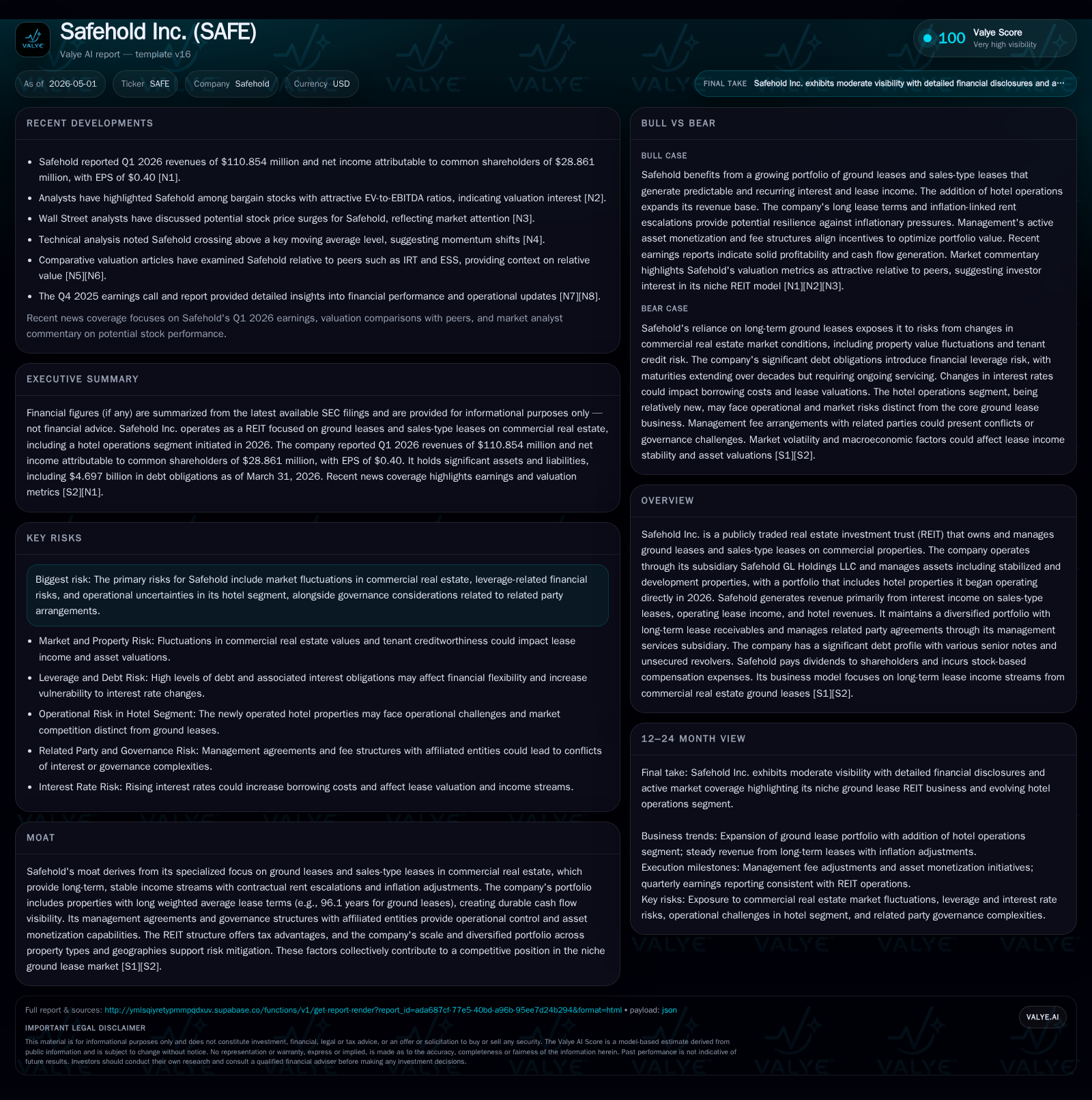
In the first quarter of 2026, Safehold Inc. sustained stable net income and cash flows primarily from its core ground lease investments while expanding its hotel operations segment after the expiration of a master lease. The company’s business model leverages a portfolio of long-duration ground leases generating contractual rent escalations and inflation-linked income streams, supplemented by diversification into hotel assets it now operates directly, enhancing its growth avenues. With a sizable debt load of approximately $4.75 billion balanced by $19 million in cash, Safehold is navigating through market risks associated with leverage and operational uncertainties in hospitality. Its competitive moat lies in specialized asset control and REIT tax advantages, but its ability to monetize related-party assets and optimize new investment opportunities remains key to near-term performance.
Recent Operating Update: Q1 2026
Safehold Inc.'s latest quarterly filing for the period ending March 31, 2026 [S2] highlights a consistent operating rhythm anchored by its primary revenue streams: interest income from sales-type leases (including ground leases) and operating lease income. Net income for the quarter was approximately $28.9 million compared to $29.4 million in Q1 2025 [S10]. The slight dip is offset by various non-cash adjustments linked to lease accounting standards and interest components related to the company's considerable debt obligations.
A notable development during this quarter is Safehold's assumption of direct operational responsibility for two hotel properties starting January 1, 2026, consequent to the expiration of a prior master lease arrangement [S21]. This marks a material change as the company diversifies into active hospitality operations alongside its traditional ground lease investment model.
Concurrently, Safehold continues managing the orderly monetization of affiliated entity Star Holdings’ assets via its subsidiary Safehold Management Services Inc., which earns contractual fees linked to gross book values of the portfolio [S2][S21].
Business Model Overview
Safehold operates as a specialized real estate investment trust (REIT) focused predominantly on commercial ground leases and sales-type leases structured to generate long-term contractual rent streams with built-in escalations tied to inflation or fixed percentage bumps [S1]. These leases confer ownership of land beneath high-value commercial properties such as office buildings, life science facilities, student housing, mixed-use developments, and increasingly hotels.
Revenue originates primarily from interest income recognized on sales-type leases rather than traditional rent due to the lease accounting treatment where Safehold records its lease interests akin to financial receivables rather than operating lease rental income exclusively [S1][S2]. Lease terms spanning multiple decades (often over 90 years) provide exceptional visibility into future cash inflows while mitigating tenant turnover risk.
The business model benefits from:
- Predictable cash flow streams that escalate via contractually fixed bumps or inflation-linked adjustments.
- Tax efficiencies inherent in REIT status enabling distributions without corporate-level tax drag.
- Strategic control via ownership of underlying land with reversion rights enhancing asset value upon lease termination or sale.
Beyond ground leases, Safehold has expanded into direct hotel operations as a new revenue stream following lease expirations where it assumes control rather than continuing third-party operators [S21]. This adds operational complexity but offers potential higher-margin earnings contribution over time.
Complementing these activities is Safehold Management Services Inc., which administers related-party agreements—primarily overseeing Star Holdings’ asset monetization—with structured fees providing diversification from core ground leasing revenue [S2][S21].
Industry Structure and Competitive Position
Safehold occupies a unique position within commercial real estate markets focused on land ownership via long-term ground leases rather than outright property ownership. This niche serves institutional investors who seek stable, inflation-protected cash flow with lower property management burdens.
Competition is limited based on specialized knowledge of structuring sales-type leases with durations often exceeding standard commercial leasing terms. This generates high barriers to entry given legal complexity and necessity of deep expertise in valuation and asset management over extended periods.
Furthermore, Safehold’s scale—managing a diversified portfolio that spans various property types across geographies—enables risk mitigation relative to single asset class or regional concentration. Ownership control through Portfolio Holdings LLC consolidates assets under a centralized entity beneficial for governance and efficient monetization strategies [S3].
The company’s governance alignment with MSD Partners and other outside investors provides stable backing while allowing flexibility for strategic capital deployment. Tax advantages as a REIT enhance shareholder returns compared to taxable alternative structures.
Growth Drivers
Portfolio Expansion Through New Lease Originations
Safehold continually seeks new ground lease acquisitions involving high-quality commercial land beneath premium developments or redevelopment projects. These are originated at yields reflective of underlying property economics plus contractual rent escalation provisions that protect against inflationary pressures [S1].
Loans Receivable Growth
In addition to direct leasing investments, Safehold extends loans secured against underlying properties or related entities extending credit facilities that complement its ground lease portfolio [S16]. Net loan receivables have exhibited growth reflecting this push.
Equity Method Investments Increase
Safehold has deployed capital into strategic equity joint ventures investing in real estate assets that fit its risk-return profile—providing upside through property appreciation alongside leasing income diversification [S16].
Hotel Operations Segment Development
The transition to managing two hotel properties independently post master-lease expiration gives Safehold new avenues to capture operating income potentially exceeding traditional passive ground lease yields over time [S21]. Performance here will be critical to watch for stabilization metrics such as occupancy rates and RevPAR (revenue per available room).
Related-Party Asset Monetization Services
Ongoing management fees derived through contractual agreements with Star Holdings represent steady fee-based revenue tied to asset book value reductions over time as holdings are monetized [S2][S21]. This also improves capital recycling capacity.
Risks and Watchpoints
Market Cyclicality in Commercial Real Estate Values
While long-term contracts provide stability, fluctuations in commercial real estate values can impact underlying asset valuations and Safehold’s ability to acquire new leases at attractive returns or monetize existing holdings.
Leverage Exposure Amid Rising Interest Rates
With total debt close to $4.75 billion versus roughly $19 million in cash at quarter-end (net debt approx. $4.73 billion) [F1], Safehold carries substantial leverage requiring disciplined refinancing strategies to avoid covenant pressures or refinancing costs especially if credit markets tighten further.
Hotel Sector Operational Risks
Direct hotel operations introduce exposure to consumer demand volatility related to travel trends and macroeconomic factors unlike passive ground leasing. Success depends on operational efficiency and market positioning.
Governance Complexity from Related-Party Relationships
Contracts involving Star Holdings necessitate transparency and effective alignment between parties; any disputes or renegotiations could affect revenues or asset disposal schedules [S2][S21].
Valuation Uncertainty for Newly Acquired Leases Pending External Appraisals
Interim internal estimates are used pending independent valuation reports from CBRE or others; this injects potential timing risk around fair value recognition impacting reported assets [S3].
What To Watch Next
Key near-term indicators for monitoring Safehold include:
- Pace and yield profile of new sales-type lease originations announced or consummated.
- Updates on equity investment contributions versus realizations in joint ventures affecting earnings volatility.
- Performance trends from newly operated hotel properties including occupancy levels and operating margins.
- Progress reports on Star Holdings asset monetization milestones impacting fee revenue trajectory.
- Refinancing activities around unsecured revolvers maturing in 2029 or senior notes repricing given large outstanding debt load [F1][S25].
- Published external appraisal updates providing valuation clarity across the lease portfolio particularly where major redevelopment is underway.
- Dividend policy signals reflecting cash flow sustainability amid evolving portfolio mix.
Financial Profile Summary (Q1 2026)
Latest financial snapshot
| Metric | Value | Period |
|---|---|---|
| Cash & equivalents | $19mm | |
| 2026-03-31 | ||
| Total debt | $4.75bn | |
| 2026-03-31 | ||
| Net debt | $4.73bn | |
| 2026-03-31 |
Source: SEC companyfacts cache [F1].
The balance sheet reflects a heavily leveraged but well-capitalized approach underpinned by stable rental income streams secured by long-dated commercial real estate interests [F1][S2].
This report synthesizes the latest SEC filings and company disclosures without offering investment advice or forecasts. The narrative aims purely at evaluating corporate strategy execution within Safehold Inc's specialized REIT domain.
Disclaimer: This is research-only, informational analysis and not investment advice. It may include AI-generated interpretation and general industry context. Always verify important details using primary sources.

Comments